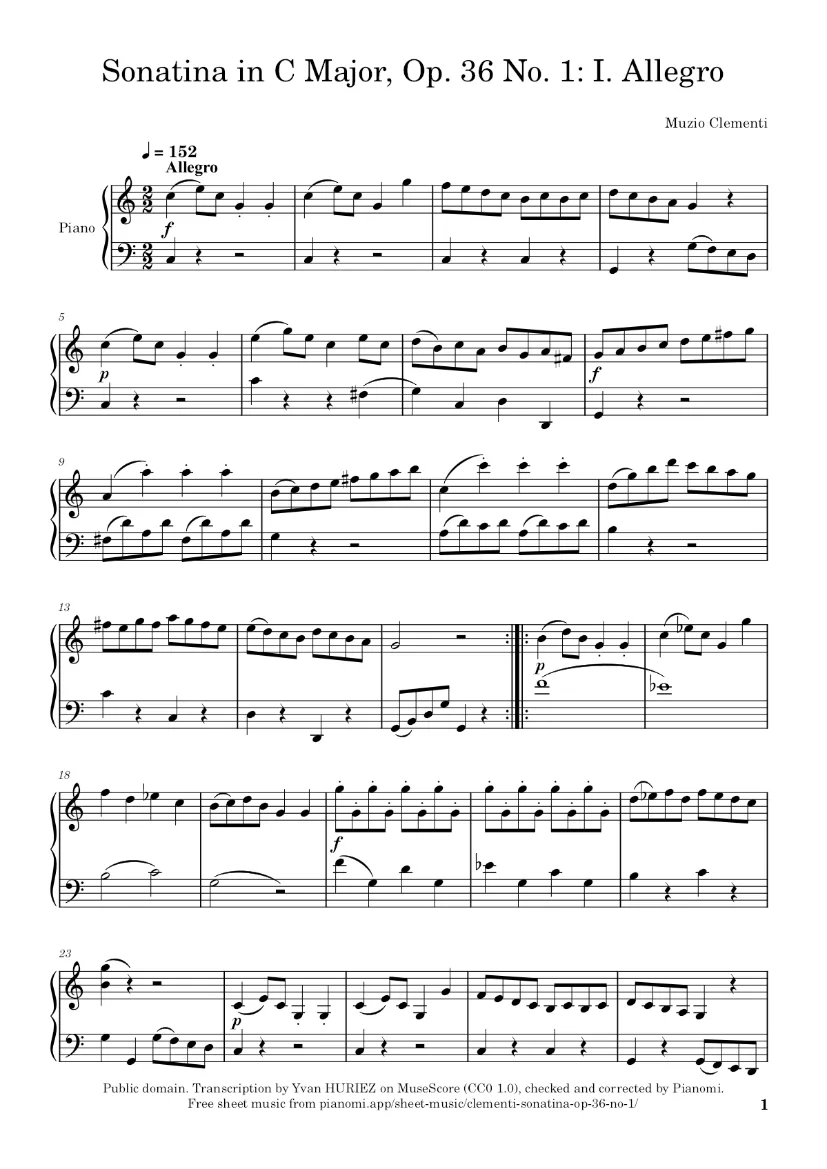
Sonatina in C Major, Op. 36 No. 1 letter notes
The tune’s notes by name, bar by bar (the right hand’s top line), bars 1–16. ♯ is a sharp, ♭ a flat: play the black key just above or below.
- C E C G G
- C E C G G
- F E D C B C B C
- D C B A G
- C E C G G
- E G E C E C
- D B C A B G A F♯
- G A B C D E F♯ G
- A A A A
- B C D E F♯ G A B
- C C C C
- D G B D C B A G
- F♯ E G F♯ A G F♯ E
- E D C B D C B A
- G
- B D B G G
The names alone leave out the rhythm and the left hand: the music above has both, and the score with note names prints every note’s name under it.
About Sonatina in C Major, Op. 36 No. 1
Clementi was born in Rome in 1752 and lived mostly in London, where the six sonatinas of his Op. 36 were printed in 1797 by Longman and Broderip. They were written for pupils and have been teaching pieces ever since. This is the first movement of the first sonatina. The other two are an Andante and a Vivace.
It is built like a miniature sonata. The first tune (bars 1 to 8) is made of a C major arpeggio and a falling scale, answered by a run up to G. The second theme, from bar 16, is in G major. From bar 24 the music starts again in C major and comes to a firm cadence. The first edition says Allegro and marks loud and soft in turn; some later editions say Spiritoso, lively.
How hard is Sonatina in C Major, Op. 36 No. 1?
Not very. It is a standard pupil’s piece, usually learned in the second or third year of lessons. The scales need evenness, the octave leaps need accuracy and Clementi’s loud and soft markings are part of the music.
It reads like level 31 of 44, “Rests”: grade 1 to 2 in graded exams’ sight reading, roughly. Its hands, chords and rhythm read like level 26, alberti bass. On top of that: rests, accidentals, moving out of position and left-hand jumps. Practise reading at that level with the free sight-reading exercises.
How to practise it
The left hand is simple at first, a long note to a bar, so let it ring and keep the right hand clear. The right hand’s opening is a C major arpeggio, and at the end of bar 2 it leaps up an octave, from G to G. Practise that leap without looking at your hand.
The scales in bars 8 and 10 run up in eighth notes. Play them slowly with a metronome, with the thumb tucked under smoothly, and follow Clementi’s loud and soft markings. In bars 20 and 21 the right hand jumps between a high and a low G on every eighth note: use a loose wrist.
Bar 9 is a surprise for players who expect C major: the left hand begins on F♯, not F, and plays a broken chord (F♯, D, A, D) that is a D major chord. Learn it hands apart, then slowly together.
The score
- Composer
- Muzio Clementi (1752–1832)
- Catalogue
- Op. 36 No. 1
- Written
- by 1797
- Key
- C major
- Time
- 2/2
- Tempo
- Allegro, ♩ = 152
- Length
- 38 bars, about 2 minutes with its repeats
- Range
- C2 to D6
Transcribed by Yvan HURIEZ on MuseScore and given to the public domain (CC0 1.0). We compared every note with other transcriptions and early editions and corrected it where it was wrong.