Arabesque, Op. 100 No. 2 letter notes
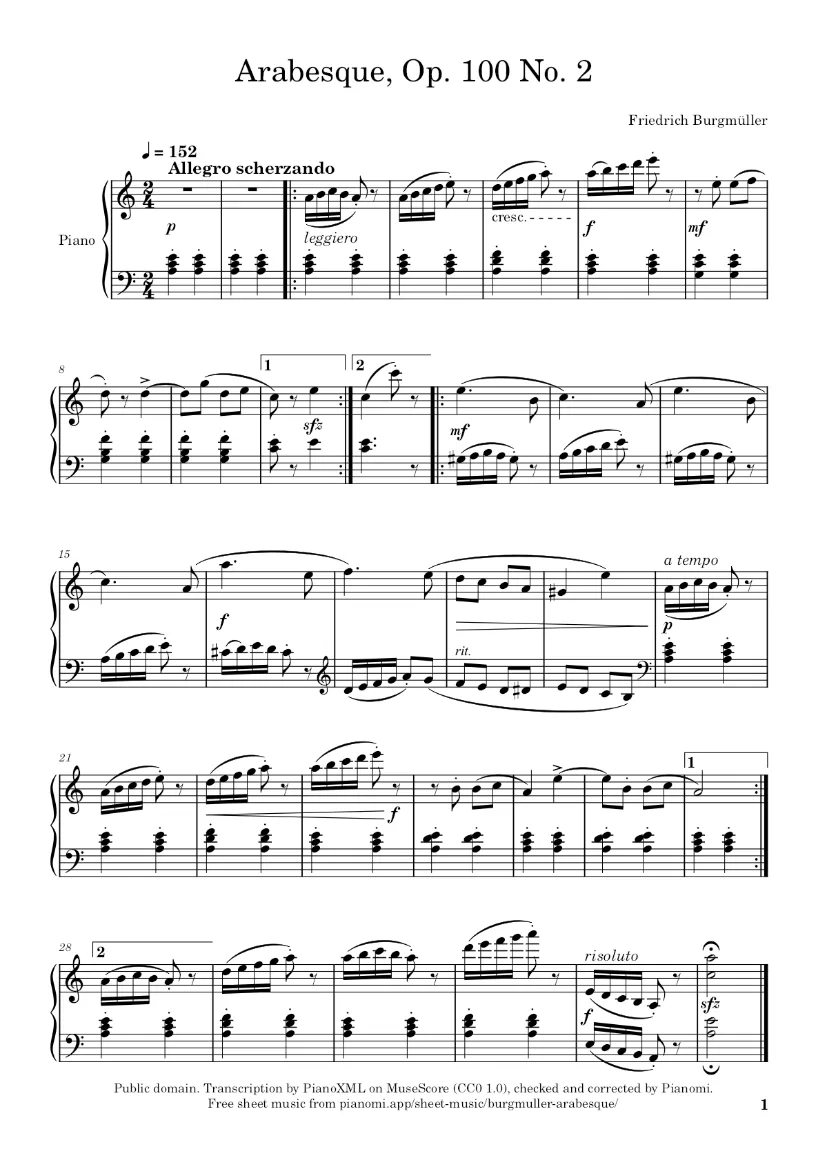
The tune’s notes by name, bar by bar (the right hand’s top line), bars 3–20. ♯ is a sharp, ♭ a flat: play the black key just above or below.
- A B C B A
- A B C D E
- D E F G A
- A B C D E
- E E F
- D D
- G D E
- C E
- C C
- E B
- C A
- E B
- C A
- A E
- F E
- D C B A
- G♯ E
- A B C B A
The names alone leave out the rhythm and the left hand: the music above has both, and the score with note names prints every note’s name under it.
About Arabesque, Op. 100 No. 2
Friedrich Burgmüller published his 25 Easy and Progressive Studies, Op. 100, in Paris in 1851. Each is a short piece with a title and one thing to learn. The Arabesque is the second. An arabesque is a decorative pattern, and the right hand’s running notes are the decoration.
The piece is in A minor and 2/4, marked Allegro scherzando: quick and playful. The left hand plays two bars of chords alone, then the right hand enters with a five-note run, A, B, C, B, A. The runs climb in the next bars, each one starting higher. In the middle (bars 12 to 19) the hands swap roles: the right hand holds long notes while the left hand has the running notes. The opening returns at bar 20, and the piece ends with a scale falling in both hands, in octaves, in bar 32.
How hard is Arabesque, Op. 100 No. 2?
It is an early intermediate piece. The notes are easy to read, but playing the running notes quickly, evenly and lightly, while the left hand stays steady, takes a few months of work. It is short and repeats its ideas, so it is a good first étude.
At sight, it’s harder to read than all 44 of Pianomi’s sight-reading levels, which end at about grade 3 sight reading, at gentle tempos. What takes it past them: busy hands together. On top of that: rests, accidentals, dotted rhythms and moving out of position.
How to practise it
Start with the left hand’s chords: play them light and short, with the wrist loose, then the right hand’s five-note groups, hands apart, with the fingers quick and close to the keys. The score is full of staccato dots and slurs, so follow them as printed.
In the middle section, practise the left hand’s running notes alone until they are even, while the right hand holds still. Then add the long notes of the right hand, and keep them quieter than the left hand’s run.
At the end, both hands play the falling A minor scale in octaves. Keep them exactly together. The edition suggests ♩ = 152, but start much slower, with the metronome, and raise the speed only when the runs stay even.
The score
- Composer
- Friedrich Burgmüller (1806–1874)
- Catalogue
- Op. 100 No. 2
- Written
- by 1851
- Key
- A minor
- Time
- 2/4
- Tempo
- Allegro scherzando, ♩ = 152
- Length
- 33 bars, under a minute with its repeats
- Range
- A2 to A6
Transcribed by PianoXML on MuseScore and given to the public domain (CC0 1.0). We compared every note with other transcriptions and early editions and corrected it where it was wrong.