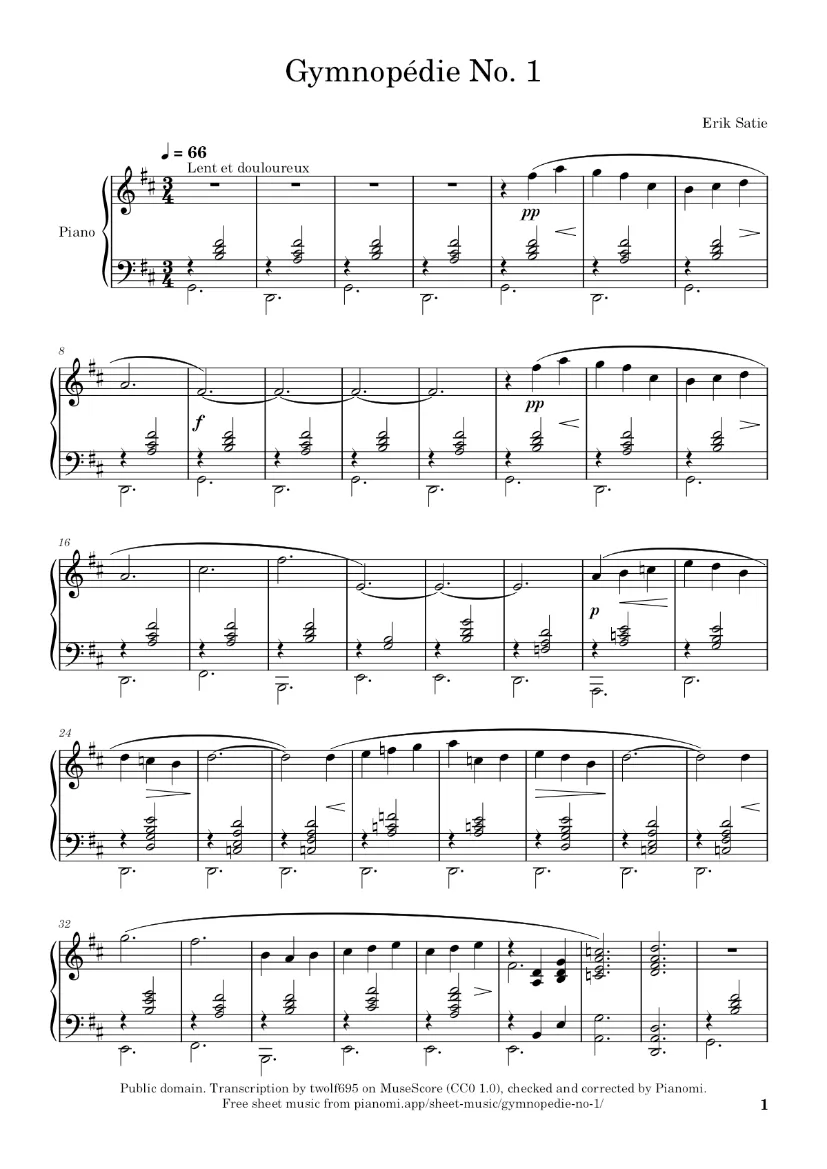
Gymnopédie No. 1 letter notes
The tune’s notes by name, bar by bar (the right hand’s top line), bars 22–31. ♯ is a sharp, ♭ a flat: play the black key just above or below.
- A B C
- E D B
- D C B
- D
- D
- E F G
- A C D
- E D B
- D
- D
The names alone leave out the rhythm and the left hand: the music above has both, and the score with note names prints every note’s name under it.
About Gymnopédie No. 1
Satie wrote the three Gymnopédies in 1888, in his early twenties, and the first was printed that same year, dedicated to Mademoiselle Jeanne de Bret. The name comes from the gymnopaedia, a festival of ancient Sparta at which young men danced. Debussy later orchestrated this one, with the third.
Satie marks it Lent et douloureux: slow and sorrowful. Four bars of the left hand alone set the pattern that runs all through, a low note on the first beat and a soft chord on the second, at first rocking between two chords. Over it the right hand sings a long, plain tune that climbs, falls and rests on held notes.
The first 39 bars are then played again, note for note, until the last few bars. The first time the piece closes on a D major chord; the second time F naturals darken the tune and it ends in D minor.
How hard is Gymnopédie No. 1?
Not the notes: a pianist with two or three years of lessons can play them. What takes work is the left hand’s jumps between bass and chord, and keeping the sound soft, even and unhurried all the way through, which makes it an early intermediate piece.
At sight, it’s harder to read than all 44 of Pianomi’s sight-reading levels, which end at about grade 3 sight reading, at gentle tempos. What takes it past them: four-note chords. On top of that: 2 sharps, accidentals, moving out of position, chords with sharps or flats and left-hand jumps.
How to practise it
Learn the left hand first. Every bar is a jump: a low bass note, then a chord more than an octave higher, as in bar 22, from A1 up to A3, C4 and E4. Practise the jump without looking, landing softly on the chord, and change the pedal just as each new bass note sounds so the harmonies stay clean.
The tune is easy to find and hard to play beautifully. Keep it above the chords, and hold the long notes their full length: the F♯ of bar 9 lasts four bars. From bar 22 the tune brings C naturals and F naturals although the key signature has C♯ and F♯, so read the accidentals carefully.
In bars 37 and 76 the right hand holds the tune’s long note and plays two quiet chords under it. Let the held note ring and keep the chords soft. Satie gives no metronome mark: count three slow, steady beats and don’t let the long notes hurry.
The score
- Composer
- Erik Satie (1866–1925)
- Written
- 1888
- Key
- D major
- Time
- 3/4
- Tempo
- Lent et douloureux, ♩ = 66
- Length
- 78 bars, about 3½ minutes with its repeats
- Range
- A1 to A5
Transcribed by twolf695 on MuseScore and given to the public domain (CC0 1.0). We compared every note with other transcriptions and early editions and corrected it where it was wrong.