About Arietta, Op. 12 No. 1
Grieg wrote the first book of his Lyric Pieces, Op. 12, in 1866 and 1867, when he was in his early twenties, and it was printed in Copenhagen in 1867. Arietta (a little song) is the first. Over the next 34 years he wrote ten books of them, 66 pieces in all. In the last, Op. 71 (1901), he ended with a piece, Remembrances, that brings back the Arietta’s tune as a waltz.
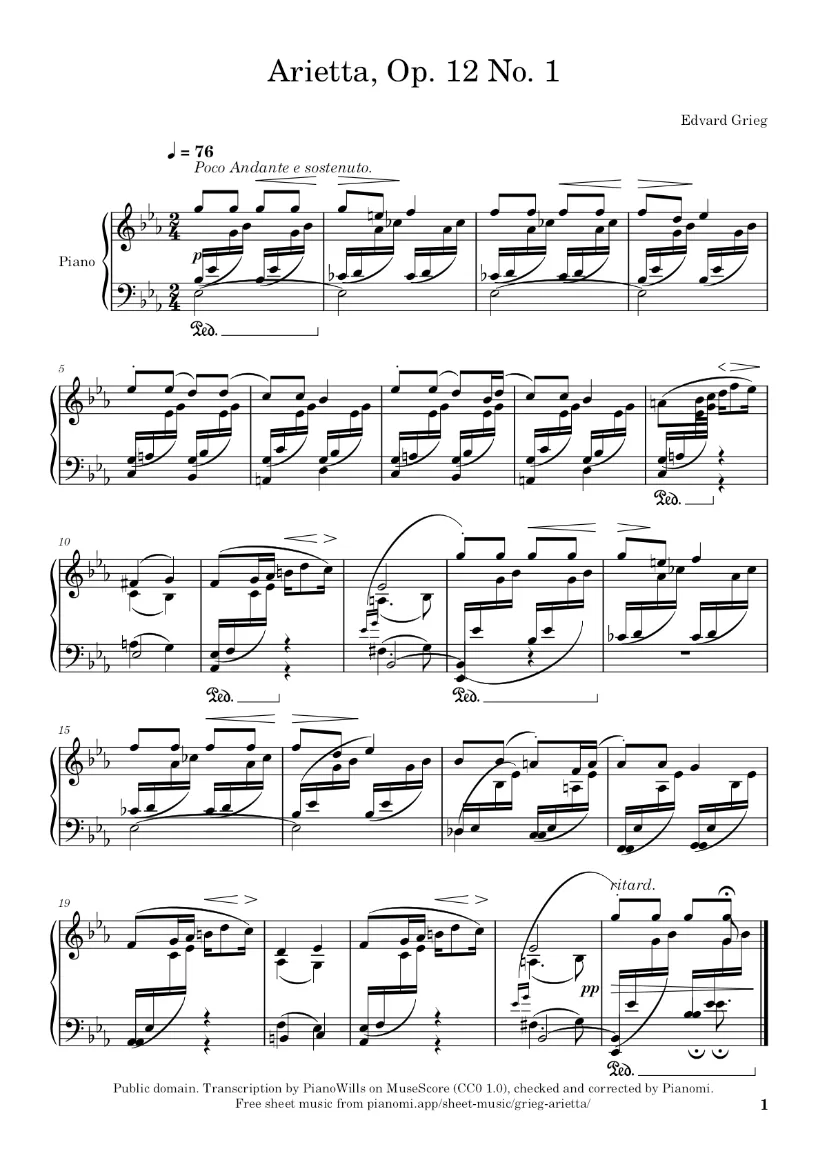
The piece is in 2/4, marked Poco andante e sostenuto: a little moving and sustained. The right hand plays the tune in the top voice and keeps a soft pulse of repeated notes under it, in the same hand. The left hand adds a bass note and light chords. The opening four bars return at bar 13, and the piece ends with a held chord under a fermata.
How hard is Arietta, Op. 12 No. 1?
No. It is a short piece with a clear tune, within reach after a year or two of lessons. The care it asks for is touch: the tune must sing above repeated notes in the same hand, and the whole piece should stay soft.
At sight, it’s harder to read than all 44 of Pianomi’s sight-reading levels, which end at about grade 3 sight reading, at gentle tempos. What takes it past them: big jumps. On top of that: 3 flats, rests, accidentals, moving out of position, chords with sharps or flats and left-hand jumps.
How to practise it
The right hand has two jobs: the tune on top and the repeated notes underneath (for example G and B♭ below the tune’s high G in bar 1). Practise the lower notes alone, softly and evenly, then add the tune and let it sing out above them.
Keep the left hand soft. It plays a bass note with a chord note, then a higher note just after the beat. Use the pedal to join the harmonies, changing it with each new bass note, especially in the middle (bars 9 to 12), where the harmony moves quickly.
The last chord has a fermata. Hold it for as long as feels right, then let it go quietly.
The score
- Composer
- Edvard Grieg (1843–1907)
- Catalogue
- Op. 12 No. 1
- Written
- 1866–67
- Key
- E♭ major
- Time
- 2/4
- Tempo
- Poco Andante e sostenuto, ♩ = 76
- Length
- 23 bars, under a minute with its repeats
- Range
- D♯2 to G5
Transcribed by PianoWills on MuseScore and given to the public domain (CC0 1.0). We compared every note with other transcriptions and early editions and corrected it where it was wrong.