About Of Foreign Lands and Peoples
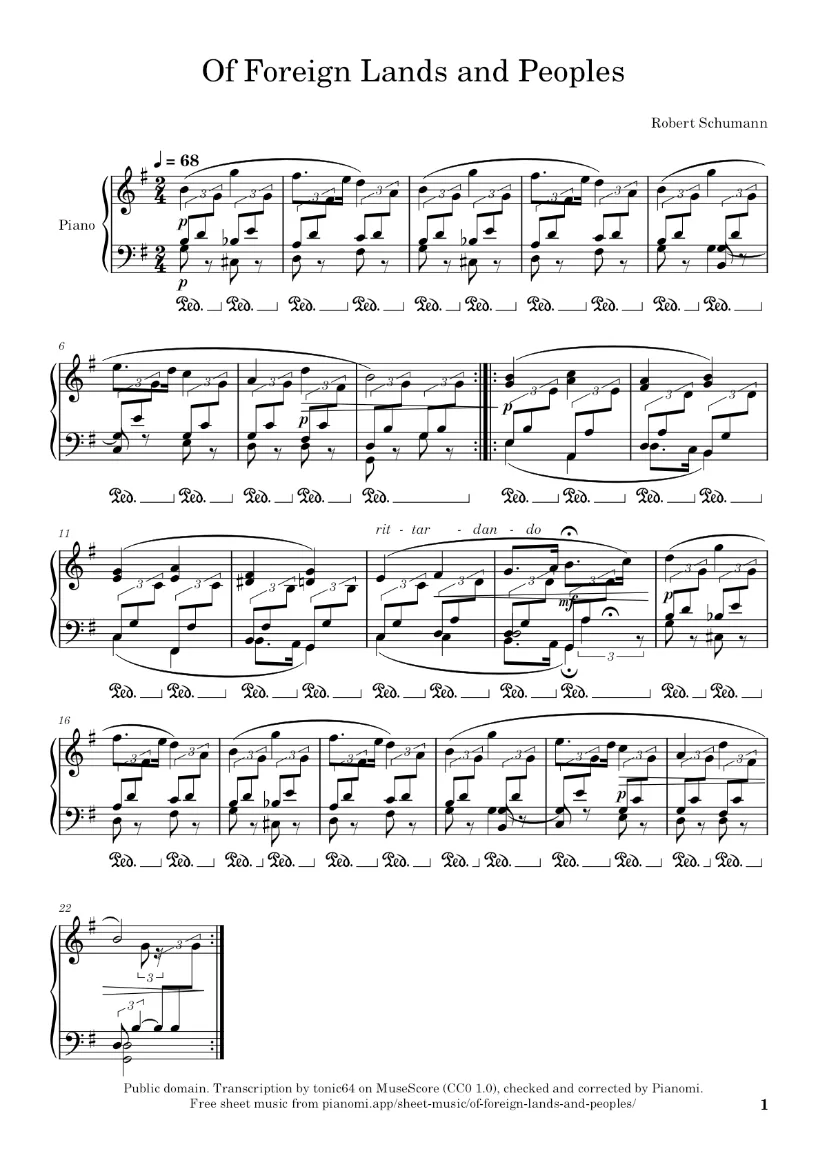
Schumann wrote Kinderszenen (Scenes from Childhood) in early 1838, and it was printed in 1839: thirteen short pieces that look back on childhood. This is the first. Its German title, Von fremden Ländern und Menschen, means the same as the English: of foreign lands and people.
The same two-bar idea opens the piece twice (bars 1 to 4) and comes back near the end (bars 15 to 18), with a middle part that wanders through other chords before it returns home. In the right hand the rhythm is a long note, then a short one late in the beat, again and again; the left hand rolls through broken chords, two groups to a bar.
How hard is Of Foreign Lands and Peoples?
No. It is short and slow, and within reach of a pianist after a year or two of lessons. What takes patience is the touch: the tune must be light and even over a flowing left hand, with a long and short rhythm that sits correctly in the beat. Early intermediate.
At sight, it’s harder to read than all 44 of Pianomi’s sight-reading levels, which end at about grade 3 sight reading, at gentle tempos. What takes it past them: big jumps and busy hands together. On top of that: rests, accidentals, moving out of position, chords with sharps or flats, left-hand jumps and one sharp.
How to practise it
The tune is easy to find, but it has to sound unhurried. Count two slow beats in each bar. The short notes come late in the beat, on the last third, so count a triplet: practise the right hand’s rhythm alone until the long and short notes keep their places.
Practise the left hand’s rolling figure alone until it flows, with each group of notes joined to the next. Keep it softer than the tune, and use the pedal lightly, changing it with the harmony.
Let each two-bar phrase breathe: lean a little on its high point and let the end fall away. That shape matters more here than any speed.
The score
- Composer
- Robert Schumann (1810–1856)
- Catalogue
- Op. 15 No. 1
- Written
- 1838
- Key
- G major
- Time
- 2/4
- Tempo
- ♩ = 68
- Length
- 22 bars, about 1½ minutes with its repeats
- Range
- F♯2 to G5
Transcribed by tonic64 on MuseScore and given to the public domain (CC0 1.0). We compared every note with other transcriptions and early editions and corrected it where it was wrong.