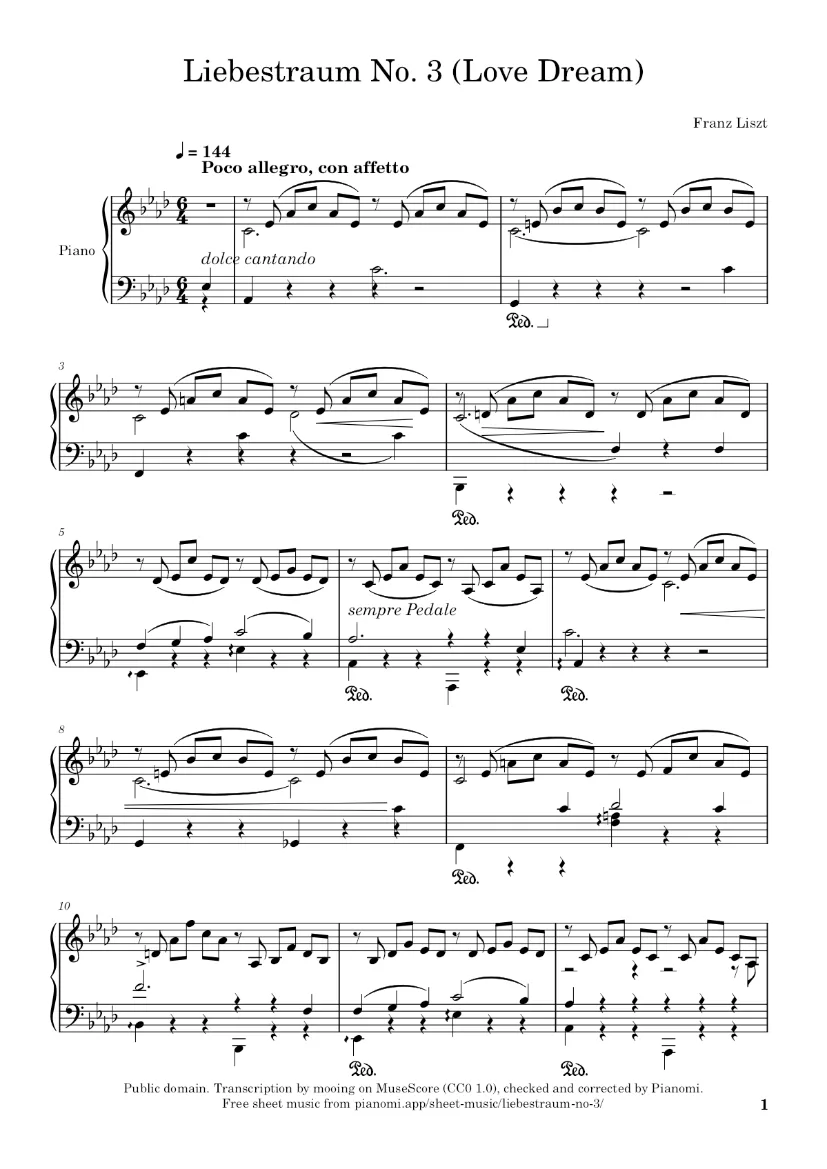
About Liebestraum No. 3
Liszt published the three Liebesträume (Love Dreams) in 1850 as piano pieces made from songs of his own. This third one began as a song to a poem by Ferdinand Freiligrath that opens “O lieb, so lang du lieben kannst”: oh love, as long as you can love. Liszt marks it Poco allegro, con affetto: a little lively, with feeling.
It is in A♭ major, in 6/4, with the right hand’s flowing broken chords through the first pages. The first cadenza (bars 25 and 26) breaks the rhythm with a rush of quick notes, and after it the music passes through other keys and climbs to a climax with octaves in the right hand. At bar 51 it comes back to A♭ major, and the second cadenza (bars 60 to 62) leads to the closing pages. From bar 63 the left hand’s staff moves into the treble clef, for high chords above the right hand’s arpeggios, so the hands cross over each other.
How hard is Liebestraum No. 3?
Yes. It is an advanced piece. The melody is simple, but the accompaniment’s rolling figures, the cadenzas, the changes of key and the wide reach of the hands need good technique and careful control of tone. Many pianists learn it after several years of lessons.
At sight, it’s harder to read than all 44 of Pianomi’s sight-reading levels, which end at about grade 3 sight reading, at gentle tempos. What takes it past them: its time signature, big jumps and four-note chords. On top of that: 5 sharps, 4 flats, rests, accidentals, moving out of position, chords with sharps or flats and left-hand jumps.
How to practise it
Practise one bar at a time with the pedal changing on each bar. Play the arpeggios softly and evenly, and bring the melody notes out a little above them. The pattern rolls through six quarter-note beats to the bar, so count it in two groups of three.
The cadenzas look hard and aren’t quite: they are written in plain eighth notes at the same speed as the rest. In the first, in bars 25 and 26, the hands climb together high up the keyboard in quick pairs of notes and then fall back. The second, in bars 60 to 62, falls from the top of the keyboard in pairs of notes a third apart. Learn them slowly in groups, hands apart.
For the closing pages from bar 63, work out the crossing of the hands slowly, one hand at a time. Decide which hand goes over before you play at speed, and keep the arpeggio under the chords light.
The score
- Composer
- Franz Liszt (1811–1886)
- Catalogue
- S. 541 No. 3
- Written
- 1850
- Key
- A♭ major
- Time
- 6/4
- Tempo
- Poco allegro, con affetto, ♩ = 144
- Length
- 88 bars, about 4 minutes with its repeats
- Range
- G♯1 to G7
Transcribed by mooing on MuseScore and given to the public domain (CC0 1.0). We compared every note with other transcriptions and early editions and corrected it where it was wrong.