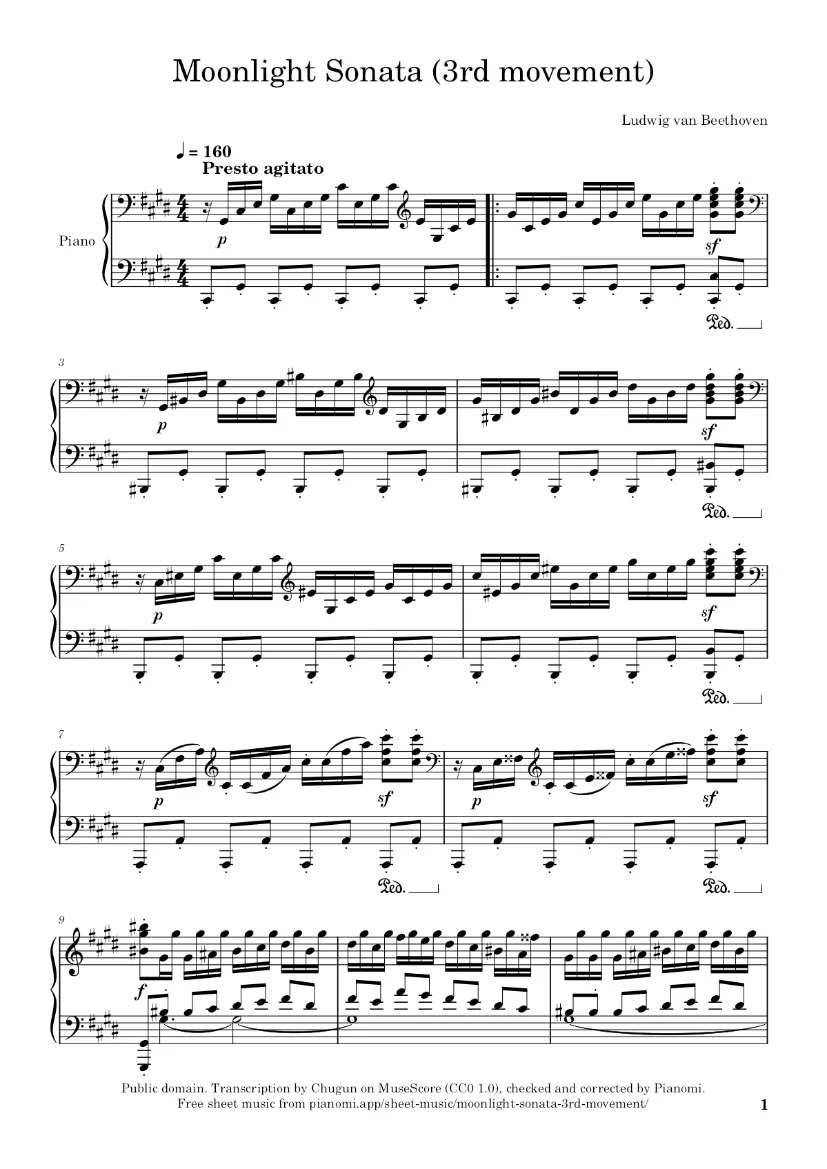
About Moonlight Sonata, 3rd Movement
Beethoven wrote the sonata in 1801 and it was printed in 1802. This is its last movement, in the same key as the slow first movement, C♯ minor, and it is the opposite in character. The nickname Moonlight was given to the first movement and doesn’t fit this one. Beethoven marks it Presto agitato: very fast and agitated.
It opens with rising broken chords in the right hand over a bass that alternates C♯ and G♯, and the first phrase ends on two sharp chords (bars 1 and 2). From bar 9 the right hand strikes a high G♯ again and again while the left hand has a tune of its own. The second theme, at bar 21, is calmer: long notes in the right hand over a left hand that rolls in sixteenths. Repeated chords fill bars 43 to 56.
The opening figure returns at bar 65 and the middle section develops it. Bars 88 to 101 sit on a deep G♯ octave in the left hand, repeated in sixteenths, until the opening comes back for the last time at bar 103. The end comes in stages: a short slow passage, with a chromatic scale that runs from the left hand into the right (bars 186 and 187) and stops on a held note, then the fast music returns and finishes with arpeggios falling through both hands and two last chords.
How hard is Moonlight Sonata, 3rd Movement?
Yes. It is an advanced piece. The notes can be learned section by section, but the movement asks for fast, even fingers, a loose wrist for the repeated octaves and chords, and the stamina to keep going for about six and a half minutes. It is usually learned after years of lessons, and long after the first movement.
At sight, it’s harder to read than all 44 of Pianomi’s sight-reading levels, which end at about grade 3 sight reading, at gentle tempos. What takes it past them: four-note chords, big jumps and busy hands together. On top of that: 4 sharps, rests, accidentals, dotted rhythms, moving out of position, chords with sharps or flats and left-hand jumps.
How to practise it
Start with the right hand’s arpeggios in bars 1 and 2, hands apart, at half speed with a metronome. Keep the sixteenth notes light and even, leaning forward onto each beat. Then learn the two chords that end bar 2, four notes each, until you can land them without looking.
Bars 9 to 13 are the first real test. The right hand alternates a repeated high G♯ with lower notes, while the left hand plays a tune that rises step by step. Learn the left hand’s tune first, then add the right hand’s lower notes, then the repeated top note, keeping it quieter than the tune below it.
The left hand’s octaves in bars 88 to 101 are tiring if you play them from the fingers. Play them from the forearm, loose, and practise them in short stretches with rests. The repeated chords of bars 43 to 56 need the same relaxed arms. Raise the tempo only when a whole section is comfortable at the speed before.
The score
- Composer
- Ludwig van Beethoven (1770–1827)
- Catalogue
- Op. 27 No. 2
- Written
- 1801
- Key
- C♯ minor
- Time
- 4/4
- Tempo
- Presto agitato, ♩ = 160
- Length
- 201 bars, about 6½ minutes with its repeats
- Range
- F1 to E6
Transcribed by Chugun on MuseScore and given to the public domain (CC0 1.0). We compared every note with other transcriptions and early editions and corrected it where it was wrong.