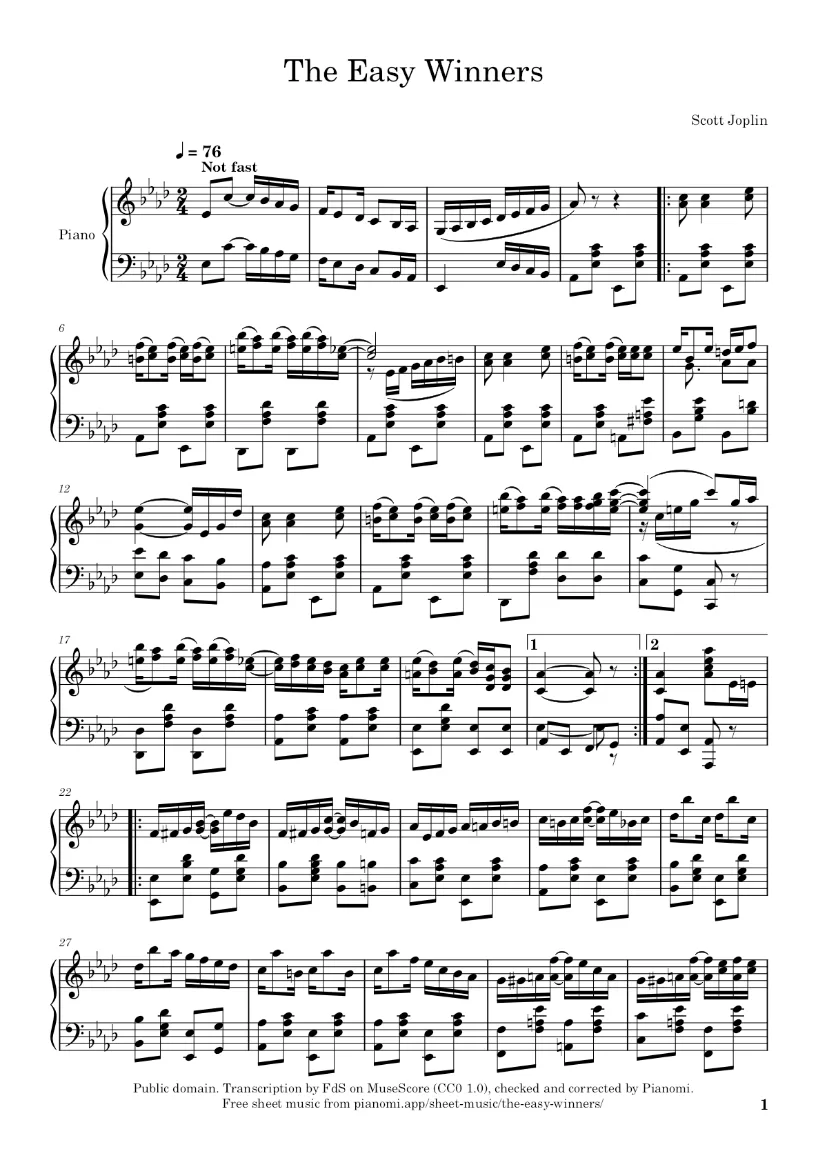
About The Easy Winners
The Easy Winners was published in 1901 with the subtitle A Rag Time Two Step, and Joplin marked it Not fast. Like his other rags it is written out in full and meant to be played steadily. The film The Sting (1973) used it too, in Marvin Hamlisch’s arrangement, along with The Entertainer.
It opens with both hands in octaves, playing a falling phrase and then a rising scale (bars 1 to 3). The first strains are in A♭ major. From bar 55 the music moves to D♭ major, the key of the trio, which has five flats, one more than A♭ major.
How hard is The Easy Winners?
It is a late intermediate piece. The notes are within reach once you can play a rag at the level of The Entertainer, but the octave opening, the quick alternating chords and the move to five flats at bar 55 need careful practice. Play it steadily, not fast.
At sight, it’s harder to read than all 44 of Pianomi’s sight-reading levels, which end at about grade 3 sight reading, at gentle tempos. What takes it past them: busy hands together, big jumps and four-note chords. On top of that: 5 flats, 4 flats, rests, accidentals, moving out of position, chords with sharps or flats and left-hand jumps.
How to practise it
Learn the opening hands apart and then together: both hands play the same notes, one octave apart. It is easy to get ahead in one hand, so play it with a metronome and listen for the two hands landing together.
The right hand often alternates two chords of two notes each, very quickly (bars 10 and 17). Practise them with a loose wrist, in short stretches, with the beat steady. Then add the left hand, a bass note and a chord, and keep it steady even when the right hand has the interest.
Look at the key signature at bar 55 before you reach it: the trio is in D♭ major, with five flats. Bar numbers here give each first and second ending a number of its own.
The score
- Composer
- Scott Joplin (1868–1917)
- Written
- 1901
- Key
- A♭ major
- Time
- 2/4
- Tempo
- Not fast, ♩ = 76
- Length
- 94 bars, about 4 minutes with its repeats
- Range
- G♯1 to C♯6
Transcribed by FdS on MuseScore and given to the public domain (CC0 1.0). We compared every note with other transcriptions and early editions and corrected it where it was wrong.