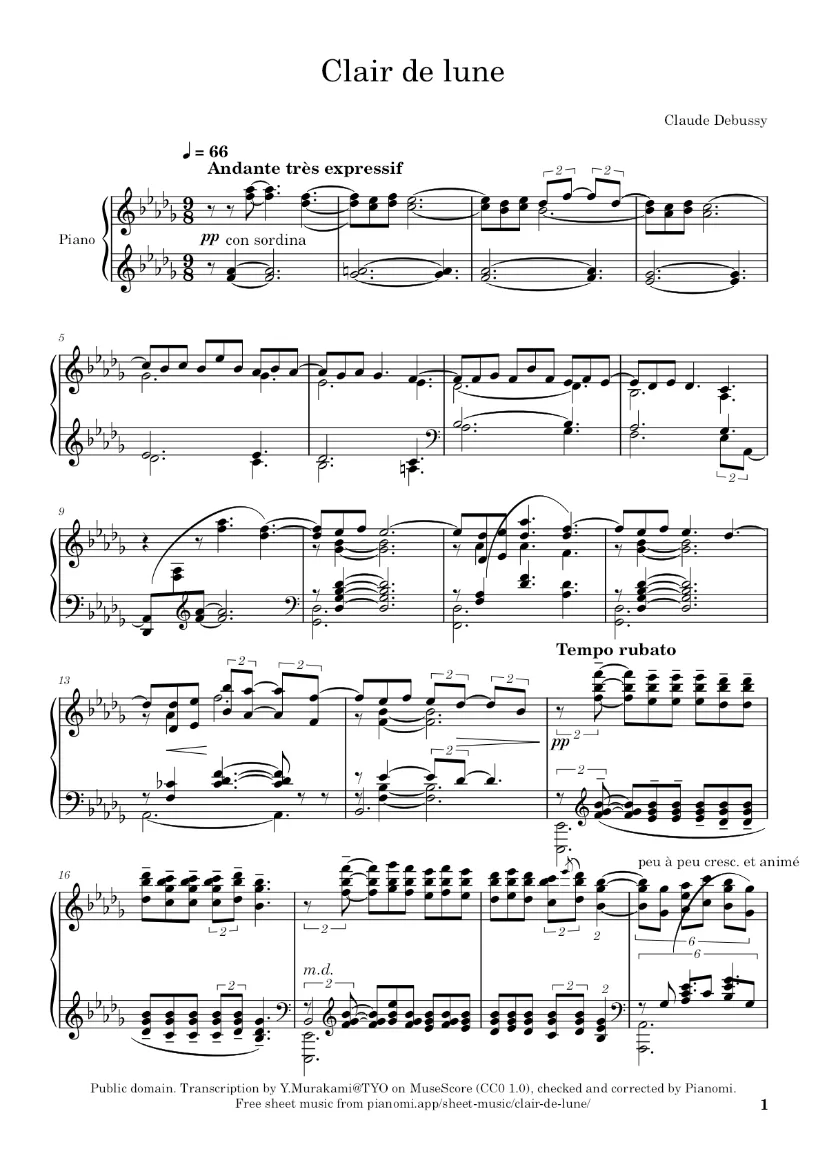
About Clair de lune
Debussy began the Suite bergamasque around 1890, in his late twenties, but published it only in 1905, after revising it. It has four movements: Prélude, Menuet, Clair de lune and Passepied. Clair de lune is also the title of a poem by Paul Verlaine, whose line about “masques et bergamasques” probably gave the suite its name too.
It’s in D♭ major and 9/8, three slow beats in a bar, each of three eighths. But it starts off the beat and often sets two notes against three, so the beat is hard to feel and the music seems to float. Debussy marks it pp con sordina: very soft, with the soft pedal.
A fuller section, Tempo rubato, grows from bar 15 to big rolled chords in bars 25 and 26. Then, Un poco mosso, a new tune sings over arpeggios, moves into sharps at En animant in bar 37 and reaches the piece’s only forte in bar 41. The opening returns in bar 51, higher and even softer, and the end dies away, morendo jusqu’à la fin.
How hard is Clair de lune?
It’s a late intermediate piece. The opening’s notes are slow, but its rhythm, its five flats and its soft, even sound take time, and the middle section’s arpeggios, shared between the hands under a held tune, need real control. There’s an easy version of its opening on a page of its own.
At sight, it’s harder to read than all 44 of Pianomi’s sight-reading levels, which end at about grade 3 sight reading, at gentle tempos. What takes it past them: its time signature, four-note chords, big jumps and busy hands together. On top of that: 5 flats, rests, accidentals, moving out of position, chords with sharps or flats and left-hand jumps.
How to practise it
Count the opening before you shape it. Bars 1 to 14 mix eighths with duplets, two notes in the time of three: tap the beat while you play until the twos sit evenly against it. Five flats and many tied notes make it slow to read, so learn it a few bars at a time.
From bar 27 the arpeggios often start low in the left hand and finish in the right, while the right hand also holds the tune above them. Practise the arpeggios on their own first, both hands sharing them, until they ripple evenly and softly; then add the tune and let it sing over them.
Bars 15 to 26 have full chords in both hands: keep them even and listen for the top note. In bar 41 the left hand runs up two octaves and back while the right hand comes down in thirds: practise it slowly, hands apart. Use plenty of pedal, but change it with each new harmony.
The score
- Composer
- Claude Debussy (1862–1918)
- Catalogue
- L. 75 (L. 82), No. 3
- Written
- 1890, revised 1905
- Key
- D♭ major
- Time
- 9/8
- Tempo
- Andante très expressif, ♩. = 44
- Length
- 72 bars, about 5 minutes with its repeats
- Range
- D♯1 to C♯7
Transcribed by Y.Murakami@TYO on MuseScore and given to the public domain (CC0 1.0). We compared every note with other transcriptions and early editions and corrected it where it was wrong.