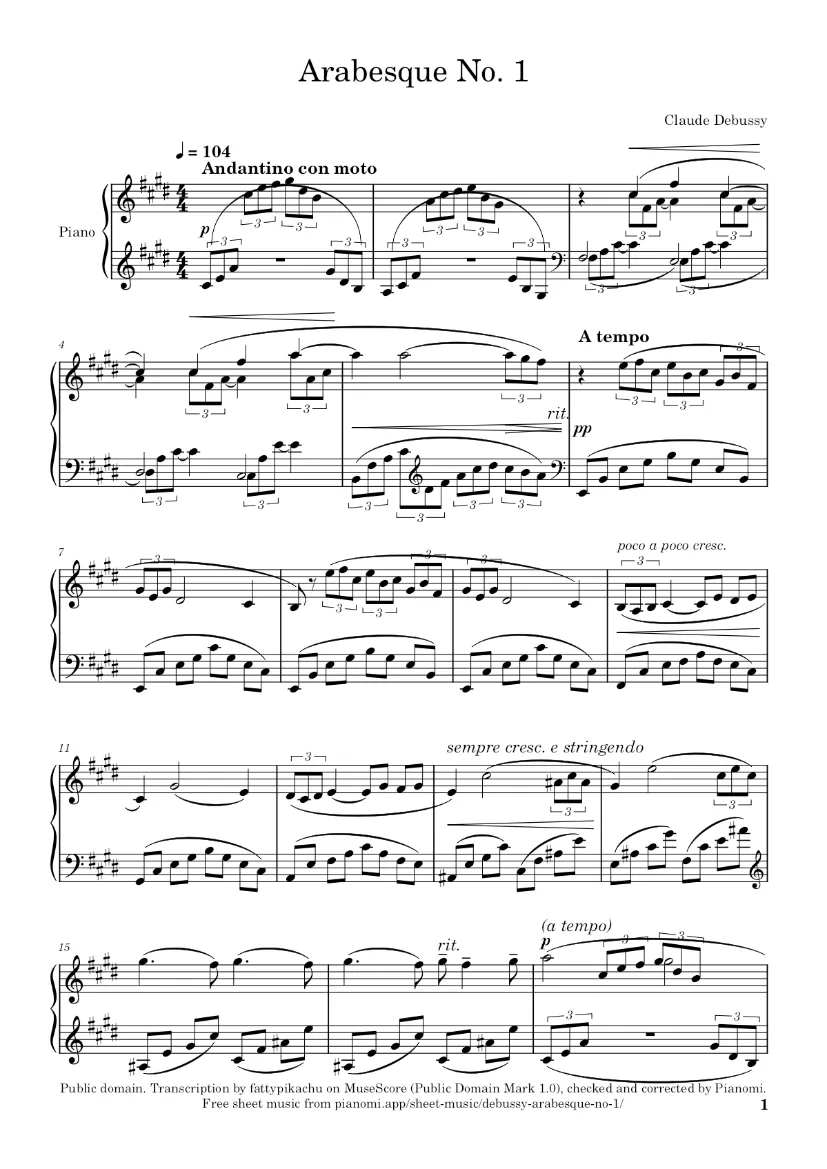
About Arabesque No. 1
Debussy wrote the Deux Arabesques between 1888 and 1891, in his late twenties, and Durand published them in Paris in 1891. They are early works, printed more than ten years before Clair de lune.
An arabesque is a flowing, curling ornament, and the piece is built from one: chains of triplets that pass from hand to hand and climb and fall around the tune. It’s in E major, marked Andantino con moto (gently moving), and in the first section the right hand’s triplets often sound against even eighths in the left, three against two.
The middle section, Tempo rubato (un peu moins vite, a little less fast), turns to A major and a tune in chords, with two Mosso passages that rush up to forte. A firm passage marked Risoluto leads back to the opening (1° Tempo), and the piece ends very softly on high chords and a last low E.
How hard is Arabesque No. 1?
It’s a late intermediate piece. The notes lie well under the hands, but the triplets must flow evenly from start to finish, often against eighths in the other hand, and the climbs need quick, light fingers.
At sight, it’s harder to read than all 44 of Pianomi’s sight-reading levels, which end at about grade 3 sight reading, at gentle tempos. What takes it past them: big jumps, busy hands together and four-note chords. On top of that: 4 sharps, 3 sharps, rests, accidentals, dotted rhythms, moving out of position, chords with sharps or flats and left-hand jumps.
How to practise it
Start with bars 1 and 2, where one line of triplets runs from the left hand to the right and back. Practise the handovers slowly until it sounds like one hand playing it all.
Then work on three against two. From bar 6 the left hand plays even eighths while the right hand plays triplets: tap the two rhythms together on a table, then play the bars slowly until both flow at once.
The hardest bars are the climbs: bars 13 to 16, sempre cresc. e stringendo (louder and faster), the Mosso passages from bars 47 and 51, and the Risoluto chords from bar 63. Learn them hands apart in short groups. In bars 89 to 94 the left hand holds a low note under its own triplets: keep the triplets even and let the held notes sound.
The score
- Composer
- Claude Debussy (1862–1918)
- Catalogue
- L. 66 (L. 74), No. 1
- Written
- 1888–1891
- Key
- E major
- Time
- 4/4 (it changes)
- Tempo
- Andantino con moto, ♩ = 104
- Length
- 107 bars, about 4 minutes with its repeats
- Range
- E1 to G♯6
Transcribed by fattypikachu on MuseScore and given to the public domain (Public Domain Mark 1.0). We compared every note with other transcriptions and early editions and corrected it where it was wrong.