About Maple Leaf Rag
John Stark published the Maple Leaf Rag in Sedalia, Missouri, in 1899, after Joplin signed a contract with him that August. The name probably comes from the Maple Leaf Club, a Sedalia dance hall where Joplin played, but nobody is certain. The rag sold so well that it made Joplin’s name.
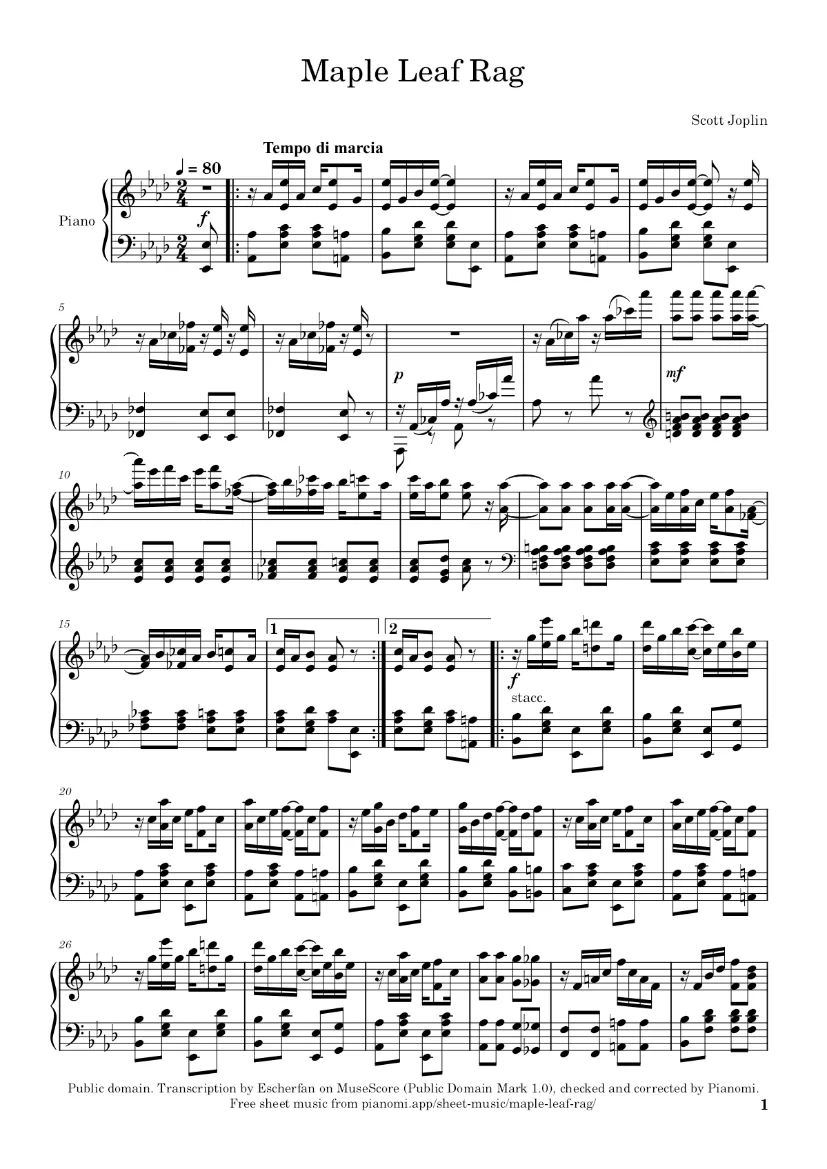
Like most rags it is built in strains. The first strain opens the piece and returns after the second. The third strain, the trio, moves to D♭ major at bar 51, and the last strain comes back to A♭ major at bar 68. Joplin marks it Tempo di marcia, march tempo: in 2/4 it should feel like a march, with a steady left hand and the right hand’s accents dancing against it.
How hard is Maple Leaf Rag?
Yes, more than its famous tune suggests. The notes are within reach of a late intermediate player, but the left hand’s leaps, the octaves and the steady march feel need patience, and it is easy to play it too fast. Joplin marked it as a march.
At sight, it’s harder to read than all 44 of Pianomi’s sight-reading levels, which end at about grade 3 sight reading, at gentle tempos. What takes it past them: four-note chords, big jumps and busy hands together. On top of that: 5 flats, 4 flats, rests, accidentals, moving out of position, chords with sharps or flats and left-hand jumps.
How to practise it
The left hand is the main work. It alternates a bass octave with a chord above it, and the jumps are large: in bar 1 it goes from a low A♭ up to a chord ending on C, then down to the bass again. Practise the jumps without looking, slowly, until you can land the chord in time.
The right hand plays octaves as part of the tune from the first bar, so keep your hand open and relaxed. In bars 9 and 13 it repeats an A♭ octave, the second time an octave lower, while the left hand plays four-note chords on every eighth note. Learn those two bars on their own, slowly, because they tire the arms. Bar 8 ends the first section with a quick rising arpeggio to a high A♭, so practise it alone.
Keep a steady tempo, and don’t let it run away. Bar numbers here count the upbeat as bar 0 and give each first and second ending a number of its own.
The score
- Composer
- Scott Joplin (1868–1917)
- Written
- 1899
- Key
- A♭ major
- Time
- 2/4
- Tempo
- Tempo di marcia, ♩ = 80
- Length
- 85 bars, about 3½ minutes with its repeats
- Range
- G♯1 to G♯6
Transcribed by Escherfan on MuseScore and given to the public domain (Public Domain Mark 1.0). We compared every note with other transcriptions and early editions and corrected it where it was wrong.