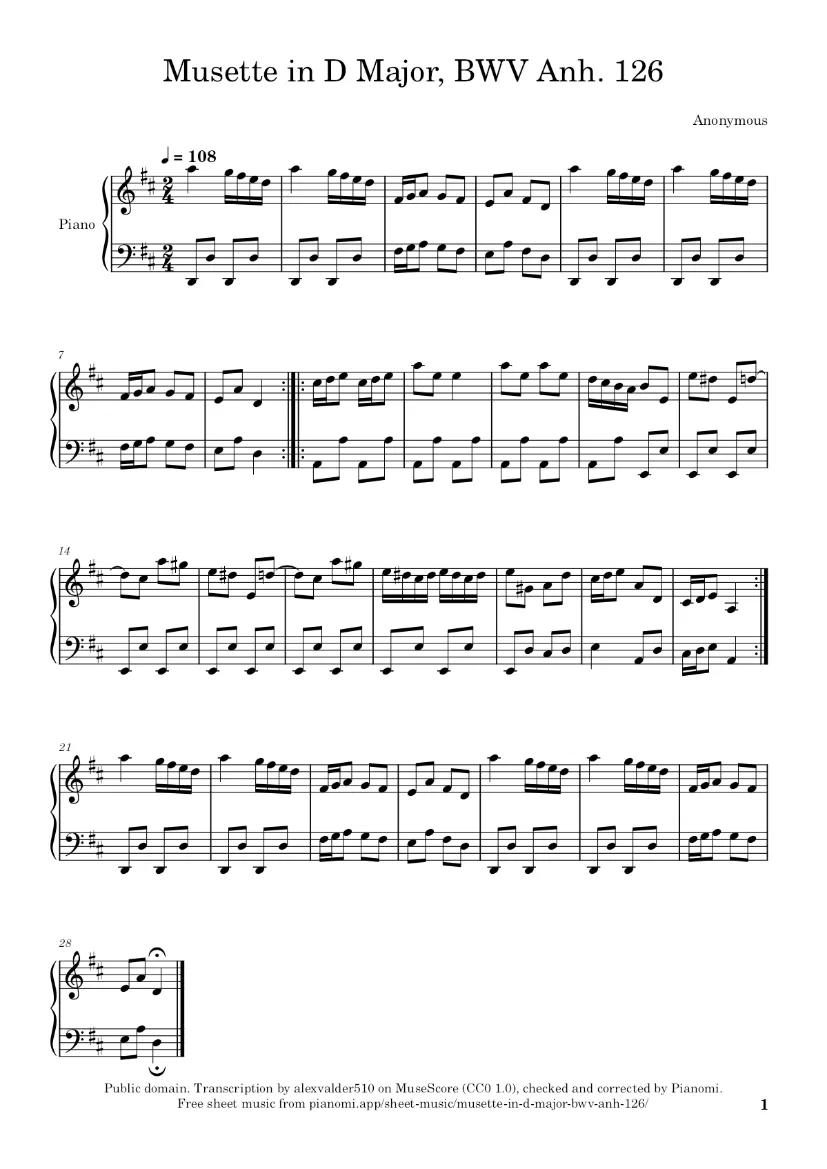
Musette in D Major, BWV Anh. 126 letter notes
The tune’s notes by name, bar by bar (the right hand’s top line), bars 1–8. ♯ is a sharp, ♭ a flat: play the black key just above or below.
- A G F♯ E D
- A G F♯ E D
- F♯ G A G F♯
- E A F♯ D
- A G F♯ E D
- A G F♯ E D
- F♯ G A G F♯
- E A D
The names alone leave out the rhythm and the left hand: the music above has both, and the score with note names prints every note’s name under it.
About Musette in D Major, BWV Anh. 126
A musette is a small French bagpipe, and a piece called a musette imitates its drone: here the left hand jumps between a low note and the same note an octave higher, again and again. The piece is in the book of music Bach gave his wife, Anna Magdalena, in 1725. It was long printed as Bach’s, but nobody knows who wrote it.
The first part, in D major, is 8 bars, played twice; in bars 3 and 4, and 7 and 8, the hands play the same notes an octave apart. The second part goes to A major, over a left hand that drums on A and then on E, and is played twice too. Then the first part comes back once more to end. The source says Da Capo al Fine; here the return is written out as bars 21 to 28, so you can play straight through.
How hard is Musette in D Major, BWV Anh. 126?
It’s an early piece, usually learned a little after the Minuet in G. The notes are simple, but the left hand’s constant octave jumps and the quick sixteenths make it a step up: practise the left hand on its own until it runs by itself.
At sight, it’s harder to read than all 44 of Pianomi’s sight-reading levels, which end at about grade 3 sight reading, at gentle tempos. What takes it past them: busy hands together and big jumps. On top of that: 2 sharps, accidentals, moving out of position and left-hand jumps.
How to practise it
Start with the left hand: the octave jumps go on through most of the piece. Keep the hand loose and let it swing between the two notes without looking down every time, a bar at a time until the jump is sure.
In the right hand the tune keeps jumping too. In bars 13 to 16 it leaps from E down an octave and up to D: practise those bars slowly, hands separately, before you join them.
Play it brightly, with the eighth notes a little detached, the sixteenths even, and a firm pulse of two beats in a bar.
The score
- Composer
- Anonymous
- Catalogue
- BWV Anh. 126
- Key
- D major
- Time
- 2/4
- Tempo
- ♩ = 108
- Length
- 28 bars, about 1 minute with its repeats
- Range
- D2 to A5
Transcribed by alexvalder510 on MuseScore and given to the public domain (CC0 1.0). We compared every note with other transcriptions and early editions and corrected it where it was wrong.