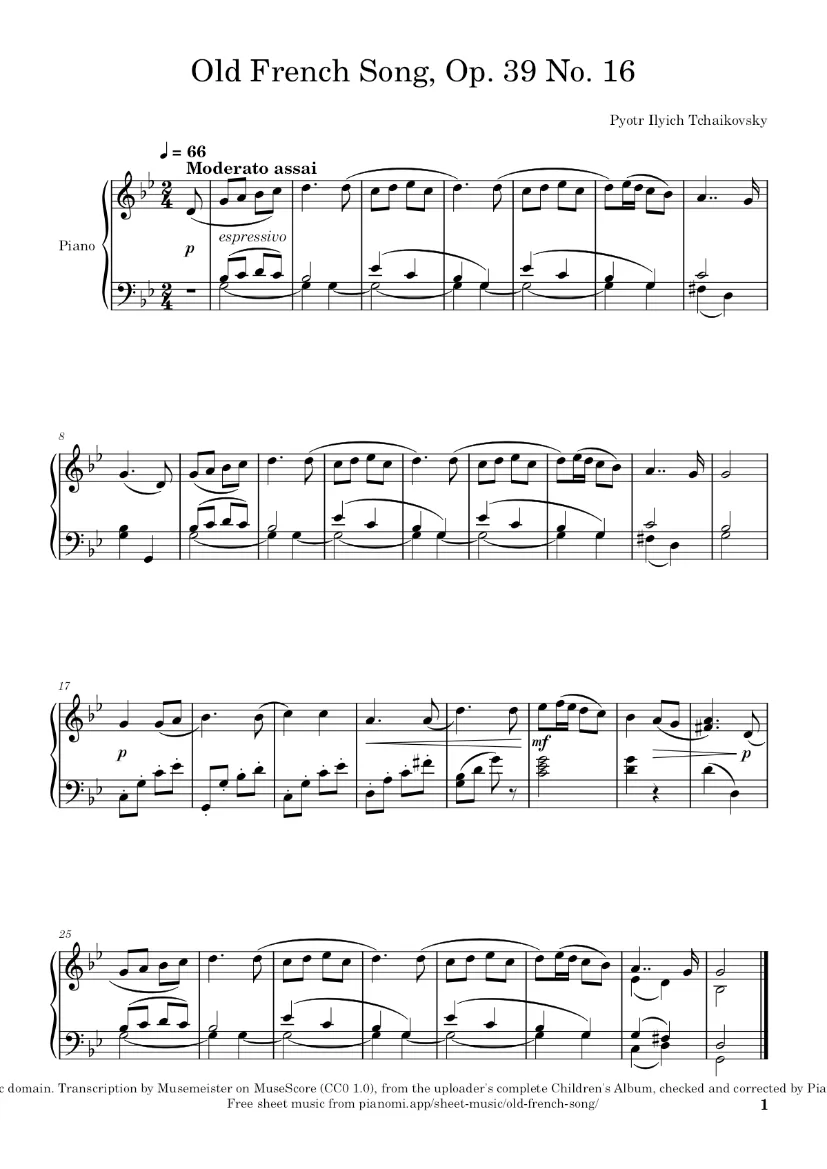
Old French Song, Op. 39 No. 16 letter notes
The tune’s notes by name, bar by bar (the right hand’s top line), bars 0–16. ♯ is a sharp, ♭ a flat: play the black key just above or below.
- D
- G A B♭ C
- D D
- C D E♭ C
- D D
- C D E♭ C
- D E♭ D C B♭
- A G
- G D
- G A B♭ C
- D D
- C D E♭ C
- D D
- C D E♭ C
- D E♭ D C B♭
- A G
- G
The names alone leave out the rhythm and the left hand: the music above has both, and the score with note names prints every note’s name under it.
About Old French Song, Op. 39 No. 16
Tchaikovsky wrote the Album for the Young, Op. 39, in 1878: 24 short pieces for children, dedicated to his young nephew Vladimir Davydov, in the spirit of Schumann’s album of the same kind. The Old French Song is the sixteenth. It is one of several pieces in the album in the style of songs from other countries, including an Italian, a German and a Neapolitan song.
It is in 2/4 and marked Moderato assai, at a moderate pace. The tune is played twice (bars 1 to 8, then again from bar 9). A brighter part follows (bars 17 to 24), with a rising broken-chord pattern in the left hand, and then the first tune comes back for the last eight bars, from bar 25.
How hard is Old French Song, Op. 39 No. 16?
No. It is an easy piece, within reach after a year of lessons: the right hand plays one note at a time, the left hand plays simple chords, and the key of G minor adds only two flats and an occasional F♯. It is a good piece for practising a singing tone.
It reads like level 40 of 44, “Sixteenth notes”: grade 2 to 3 in graded exams’ sight reading, roughly. Its hands, chords and rhythm read like level 40, sixteenth notes. On top of that: 2 flats, accidentals, dotted rhythms, moving out of position, chords with sharps or flats and left-hand jumps. The hardest bars are 18, 19 and 20. Practise reading at that level with the free sight-reading exercises.
How to practise it
The right hand plays one note at a time, so learn the shape of the tune first. Its phrases rise by step and then fall (G, A, B♭, C, then D), and each long D that repeats on the last half beat in bars 2 and 4 should be counted out.
The left hand plays two-note and three-note chords. Practise it alone, then listen to make it softer than the tune. The key of G minor has two flats, but the F♯ in bars 7 and 15 is a sharp, the raised seventh note of the minor scale.
The brighter part (bars 17 to 24) has a left-hand pattern that rises through a broken chord (C, G, C, E♭ in bar 17). Make it light and keep the long notes of the tune singing above it.
The score
- Composer
- Pyotr Ilyich Tchaikovsky (1840–1893)
- Catalogue
- Op. 39 No. 16
- Written
- 1878
- Key
- G minor
- Time
- 2/4
- Tempo
- Moderato assai, ♩ = 66
- Length
- 33 bars, about 1 minute with its repeats
- Range
- G2 to F5
Transcribed by Musemeister on MuseScore and given to the public domain (CC0 1.0). We compared every note with other transcriptions and early editions and corrected it where it was wrong.