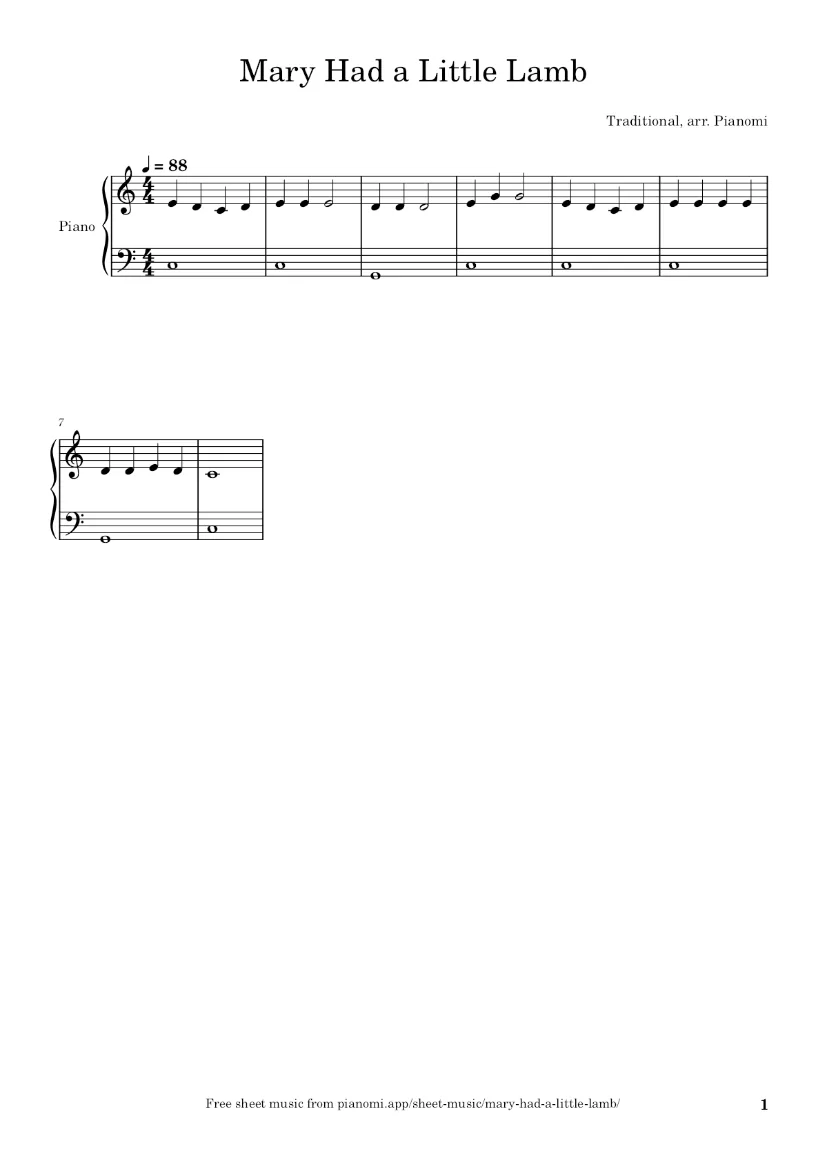
Mary Had a Little Lamb letter notes
The tune’s notes by name, bar by bar (the right hand’s top line), bars 1–8. ♯ is a sharp, ♭ a flat: play the black key just above or below.
- E D C D
- E E E
- D D D
- E G G
- E D C D
- E E E E
- D D E D
- C
The names alone leave out the rhythm and the left hand: the music above has both, and the score with note names prints every note’s name under it.
About Mary Had a Little Lamb
The words are a poem by Sarah Josepha Hale, first published in Boston in 1830. The tune sung to them today isn’t the one first set to them in the 1830s: it’s the tune of “Merrily we roll along”, the chorus of Goodnight, Ladies. In 1877 Thomas Edison spoke the rhyme into his new phonograph, the first thing he recorded on it.
This arrangement is eight bars long. The right hand plays the tune with its thumb on middle C, using only C, D, E and G, so it never has to move. The left hand plays one note a bar, held for all four beats: the C below middle C, and the G below that in bars 3 and 7.
How hard is Mary Had a Little Lamb?
No. The tune sits under five fingers without moving, and the left hand plays one long note a bar. It’s often one of the first pieces beginners play with both hands.
It reads like level 8 of 44, “Left hand holds”: before grade 1 in graded exams’ sight reading, roughly. Its hands, chords and rhythm read like level 8, left hand holds. Practise reading at that level with the free sight-reading exercises.
How to practise it
Start with the right hand alone. Put your thumb on middle C and a finger over each key up to G: the tune moves by step, apart from the skip from E up to G in bar 4. Count four beats in every bar out loud, and hold the half notes at the ends of bars 2, 3 and 4 for their full two beats.
Then learn the left hand. It has only two notes, C and the G below it, so practise moving between them until you can do it without looking. Put the hands together slowly, the left hand’s note going down with the first note of each bar, and only speed up once you can play it through without stopping.
The score
- Composer
- Traditional
- Key
- C major
- Time
- 4/4
- Tempo
- ♩ = 88
- Length
- 8 bars, under a minute with its repeats
- Range
- G2 to G4
Arranged for piano by Pianomi, from a tune in the public domain.