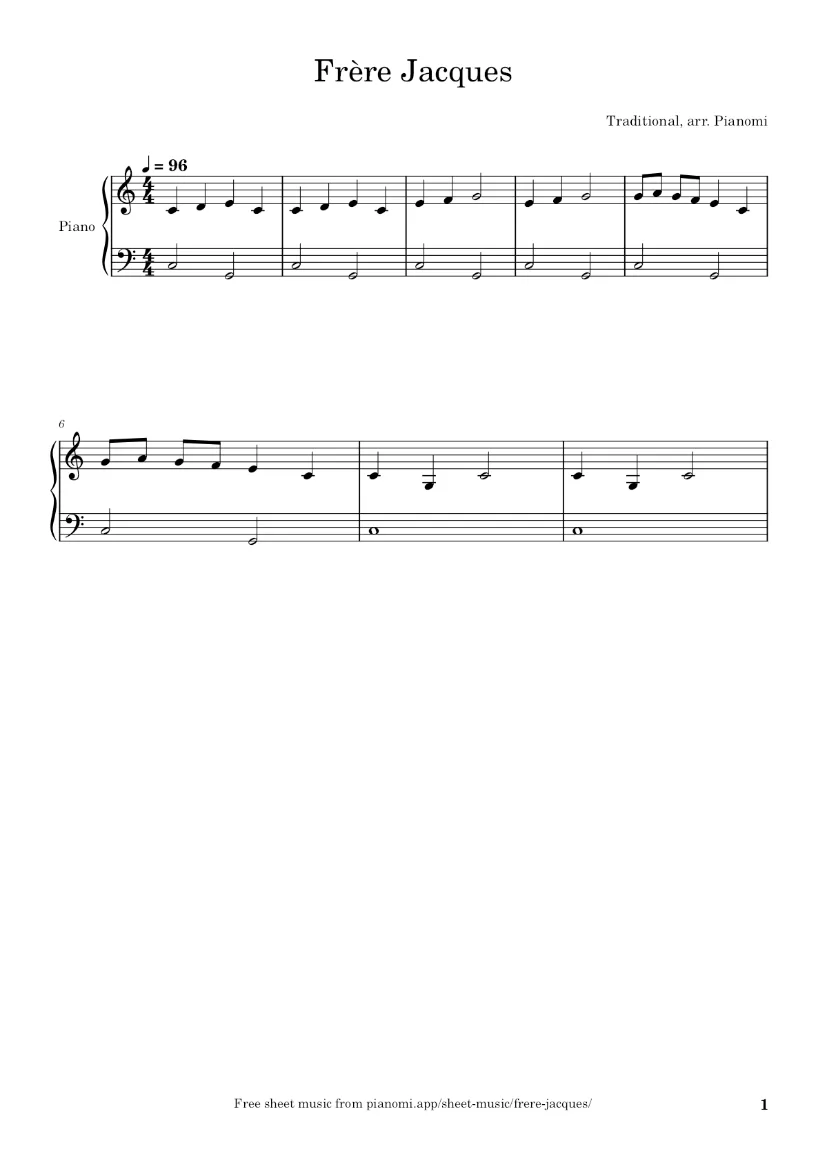
Frère Jacques letter notes
The tune’s notes by name, bar by bar (the right hand’s top line), bars 1–8. ♯ is a sharp, ♭ a flat: play the black key just above or below.
- C D E C
- C D E C
- E F G
- E F G
- G A G F E C
- G A G F E C
- C G C
- C G C
The names alone leave out the rhythm and the left hand: the music above has both, and the score with note names prints every note’s name under it.
About Frère Jacques
Frère Jacques is a French nursery song about a friar who has overslept and must be woken to ring the bells for matins, the early morning prayers. Its tune is first found in a French manuscript from around 1780. It’s usually sung as a round, each voice starting two bars after the one before. Mahler used it in the third movement of his First Symphony, slowed down in a minor key, like a funeral march.
Here it’s for one player. The tune is eight bars, each bar played twice, and the left hand plays C and the G below it every half bar, until the last two bars, where it holds a low C.
How hard is Frère Jacques?
No. The tune moves mostly by step and the left hand repeats two notes. The quick notes in bars 5 and 6 are the only tricky bit: take them slowly and count.
It reads like level 28 of 44, “Changing positions”: grade 1 to 2 in graded exams’ sight reading, roughly. Its hands, chords and rhythm read like level 13, eighth notes. On top of that: moving out of position. Practise reading at that level with the free sight-reading exercises.
How to practise it
Each bar comes twice, so there are only four bars to learn. Bars 5 and 6 are the busy ones: two pairs of quick eighth notes, G A and G F, then E and C. Count them “1 and 2 and 3, 4” slowly until they feel even. In bars 7 and 8 the tune drops to the G below middle C: play it with your thumb, and the Cs either side with your fourth finger.
The left hand plays the same two notes all the way, a half bar each, so it’s a good first taste of keeping a steady beat under a tune. Learn it until you can play it without thinking, then add the right hand slowly. Once you know it, try it as a round with someone else, right hands only: the second player starts from bar 1 when the first reaches bar 3.
The score
- Composer
- Traditional
- Key
- C major
- Time
- 4/4
- Tempo
- ♩ = 96
- Length
- 8 bars, under a minute with its repeats
- Range
- G2 to A4
Arranged for piano by Pianomi, from a tune in the public domain.