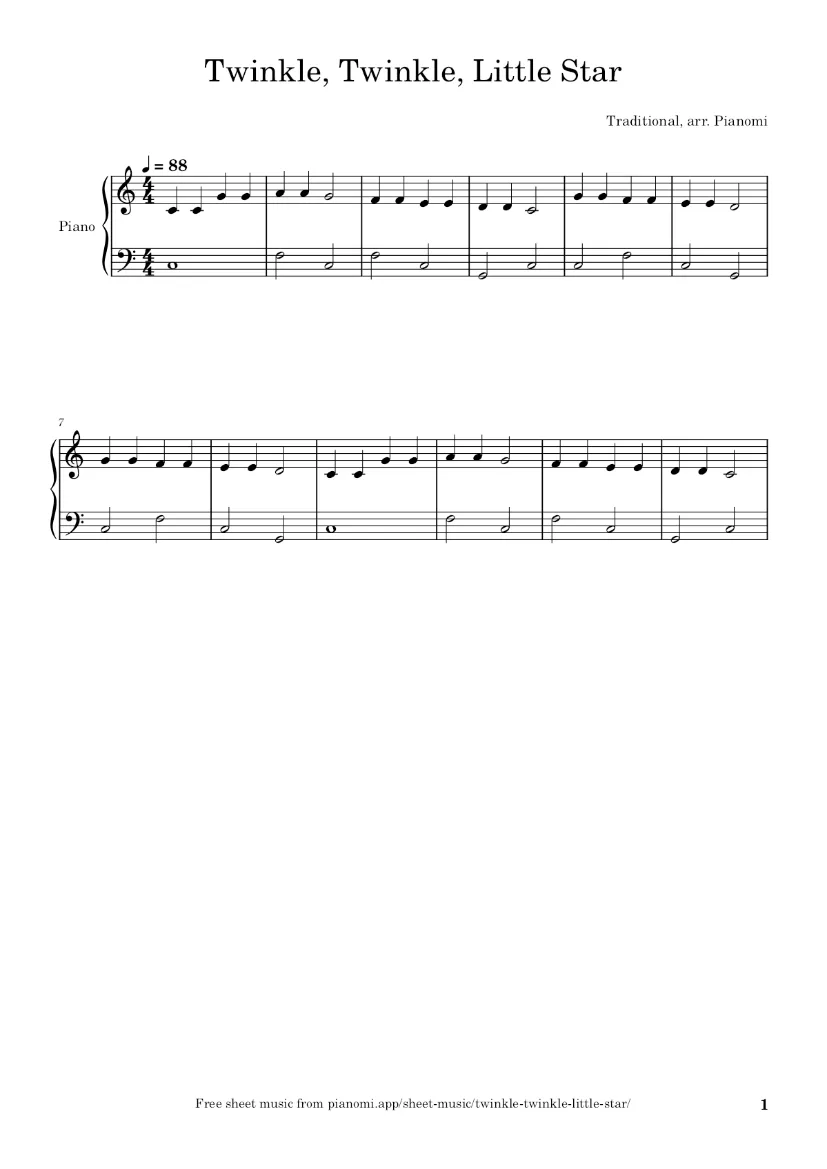
Twinkle, Twinkle, Little Star letter notes
The tune’s notes by name, bar by bar (the right hand’s top line), bars 1–12. ♯ is a sharp, ♭ a flat: play the black key just above or below.
- C C G G
- A A G
- F F E E
- D D C
- G G F F
- E E D
- G G F F
- E E D
- C C G G
- A A G
- F F E E
- D D C
The names alone leave out the rhythm and the left hand: the music above has both, and the score with note names prints every note’s name under it.
About Twinkle, Twinkle, Little Star
The tune is French: Ah! vous dirai-je, maman, first published in 1761. Mozart wrote a set of twelve variations on it, and it’s also the tune of the alphabet song and Baa, Baa, Black Sheep. The English words are Jane Taylor’s poem The Star, published in London in 1806 in Rhymes for the Nursery, a book she wrote with her sister Ann.
The arrangement is twelve bars in three parts: the opening four bars, a middle four that play the same two-bar line twice, and the opening again. The right hand plays the tune; the left hand plays the C and F below middle C and the G below them, a note or two a bar, on the chords under the tune.
How hard is Twinkle, Twinkle, Little Star?
No: it’s a first piece. The right hand moves mostly by step, with one reach up to A, and the left hand plays one or two long notes a bar. The hardest part is changing the left hand’s note in the middle of the bar while the right hand carries on.
It reads like level 14 of 44, “G position”: about grade 1 in graded exams’ sight reading, roughly. Its hands, chords and rhythm read like level 9, left hand in halves. On top of that: moving out of position. Practise reading at that level with the free sight-reading exercises.
How to practise it
Learn the right hand first. Put your thumb on middle C. Most notes come in pairs, and each line walks down by step to its end, so it’s easy to remember. In bar 2 the tune reaches A, one key above G, so let your hand open a little for it, then come back.
The left hand changes note halfway through most bars, so count “1, 2, 3, 4” and play its notes on 1 and 3. Practise each hand until it’s easy, then put them together very slowly, and speed up only when the hands land together without stopping.
The score
- Composer
- Traditional
- Key
- C major
- Time
- 4/4
- Tempo
- ♩ = 88
- Length
- 12 bars, under a minute with its repeats
- Range
- G2 to A4
Arranged for piano by Pianomi, from a tune in the public domain.