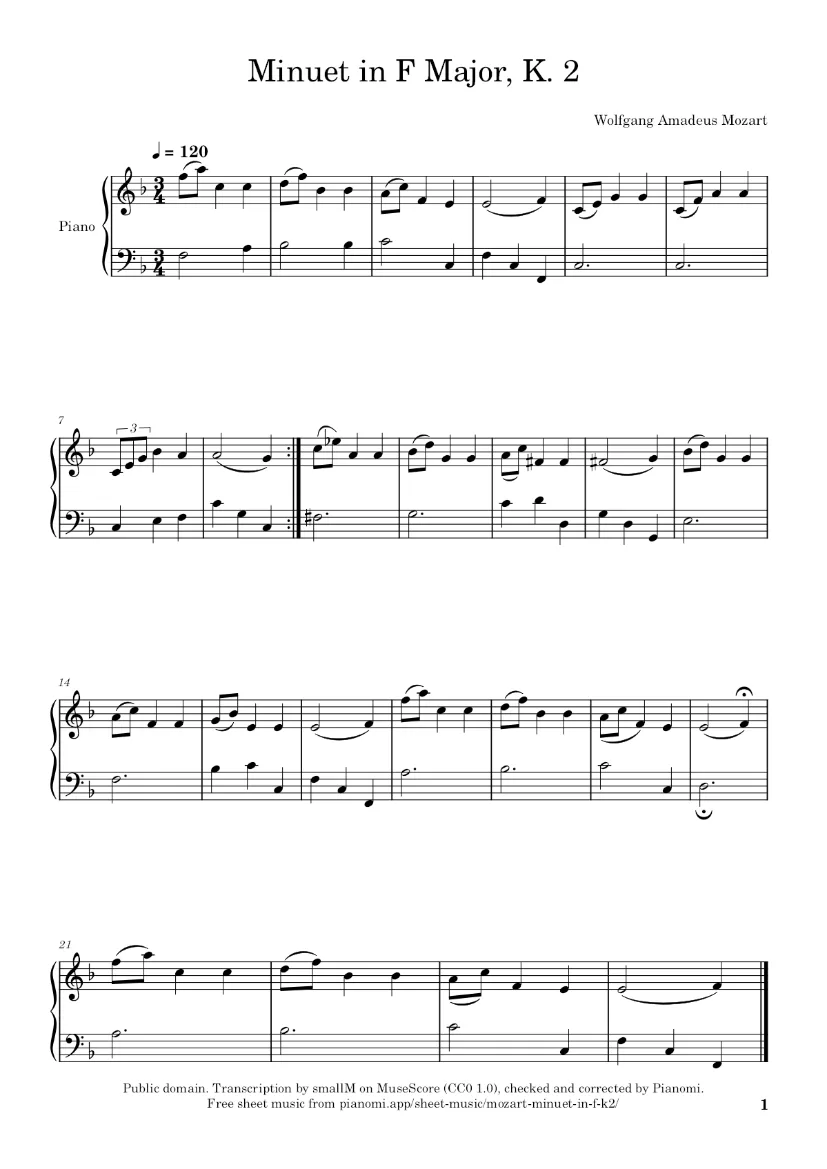
Minuet in F, K. 2 letter notes
The tune’s notes by name, bar by bar (the right hand’s top line), bars 1–16. ♯ is a sharp, ♭ a flat: play the black key just above or below.
- F A C C
- D F B♭ B♭
- A C F E
- E F
- C E G G
- C F A A
- C E G B♭ A
- A G
- C E♭ A A
- B♭ D G G
- A C F♯ F♯
- F♯ G
- B♭ D G G
- A C F F
- G B♭ E E
- E F
The names alone leave out the rhythm and the left hand: the music above has both, and the score with note names prints every note’s name under it.
About Minuet in F, K. 2
Mozart was born in January 1756 and the minuet is dated 1762, so he was five or six. His father, Leopold, taught him and his sister Nannerl, and the minuet is one of the pieces in the music book Leopold kept for her. Leopold is thought to have written it down as his son played it.
A minuet is a dance in three beats to the bar. This one is 24 bars long, in F major. The second part (bars 9 to 12) turns to G minor before the music comes home, and in bar 20 there is a pause (a fermata) before the opening four bars return to finish. This edition repeats only the first part, as the Alte Mozart-Ausgabe does. Some editions repeat the second part too.
How hard is Minuet in F, K. 2?
No. It is one of the easiest pieces by a great composer: one note at a time in each hand, short phrases and a gentle dance beat. Many students play it in their first year or two of lessons.
It reads like level 30 of 44, “Accidentals”: grade 1 to 2 in graded exams’ sight reading, roughly. Its hands, chords and rhythm read like level 13, eighth notes. On top of that: accidentals, moving out of position, left-hand jumps and one flat. The hardest bars are 7 and 17. Practise reading at that level with the free sight-reading exercises.
How to practise it
Learn the right hand first. It plays one note at a time, and the tune leaps in the first bar, from A down to C, so keep your hand loose and play the notes after the leap lightly. Count three beats to the bar, and let the first beat of each bar be the gentlest push.
The left hand plays one or two notes a bar, mostly on the first and third beats. Practise placing them exactly with the right hand’s notes. Bar 7 has three quick notes (C, E, G) played as a triplet: count them evenly across one beat.
Play it lightly and clearly, like a dance. Mozart wrote no tempo word, so choose a steady, easy pace and keep each four-bar phrase flowing to its last note.
The score
- Composer
- Wolfgang Amadeus Mozart (1756–1791)
- Catalogue
- K. 2
- Written
- 1762
- Key
- F major
- Time
- 3/4
- Tempo
- ♩ = 120
- Length
- 24 bars, under a minute with its repeats
- Range
- F2 to A5
Transcribed by smallM on MuseScore and given to the public domain (CC0 1.0). We compared every note with other transcriptions and early editions and corrected it where it was wrong.