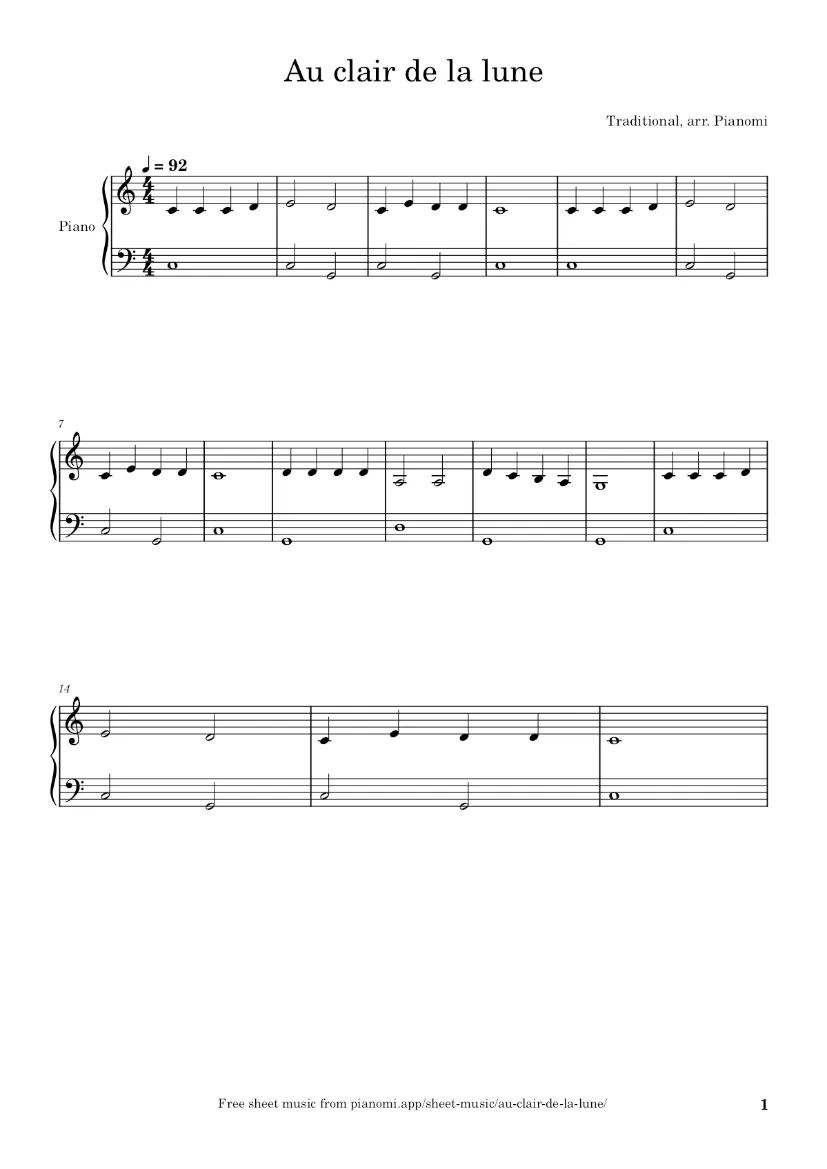
Au clair de la lune letter notes
The tune’s notes by name, bar by bar (the right hand’s top line), bars 1–16. ♯ is a sharp, ♭ a flat: play the black key just above or below.
- C C C D
- E D
- C E D D
- C
- C C C D
- E D
- C E D D
- C
- D D D D
- A A
- D C B A
- G
- C C C D
- E D
- C E D D
- C
The names alone leave out the rhythm and the left hand: the music above has both, and the score with note names prints every note’s name under it.
About Au clair de la lune
Au clair de la lune (By the light of the moon) is a French folk song from the 1700s; nobody knows who wrote it. In the words, someone at Pierrot’s door by moonlight asks to borrow his pen to write a word: their candle has gone out. In 1860 the inventor Édouard-Léon Scott de Martinville recorded a voice, probably his own, singing its opening on his phonautograph, a machine that drew sound as a line on paper. It couldn’t be heard until 2008, when researchers turned the line back into sound: it’s the oldest recording of a human voice that can be recognised.
The arrangement is sixteen bars: the same four-bar line three times, with a new line in third place that goes below middle C. The right hand plays the tune, and the left hand plays long notes, mostly the C below middle C and the G below that.
How hard is Au clair de la lune?
No. The tune moves gently, mostly by step, and the left hand plays long notes. The one thing to learn is moving the right hand down for the middle line and back.
It reads like level 9 of 44, “Left hand in halves”: before grade 1 in graded exams’ sight reading, roughly. Its hands, chords and rhythm read like level 9, left hand in halves. Practise reading at that level with the free sight-reading exercises.
How to practise it
The opening line uses only C, D and E: put your thumb on middle C and play them with fingers 1, 2 and 3. Bars 9 to 12 go lower, down to the G below middle C, so at bar 9 move your right hand down, thumb on G and fifth finger on D. Move it back to middle C for the last line.
The left hand plays C and G, with a D in bar 10, each held for two or four beats. Learn it on its own, counting out loud, then put the hands together slowly. The tune is calm, so keep it smooth and quiet, joining each note to the next.
The score
- Composer
- Traditional
- Key
- C major
- Time
- 4/4
- Tempo
- ♩ = 92
- Length
- 16 bars, under a minute with its repeats
- Range
- G2 to E4
Arranged for piano by Pianomi, from a tune in the public domain.