Old MacDonald Had a Farm letter notes
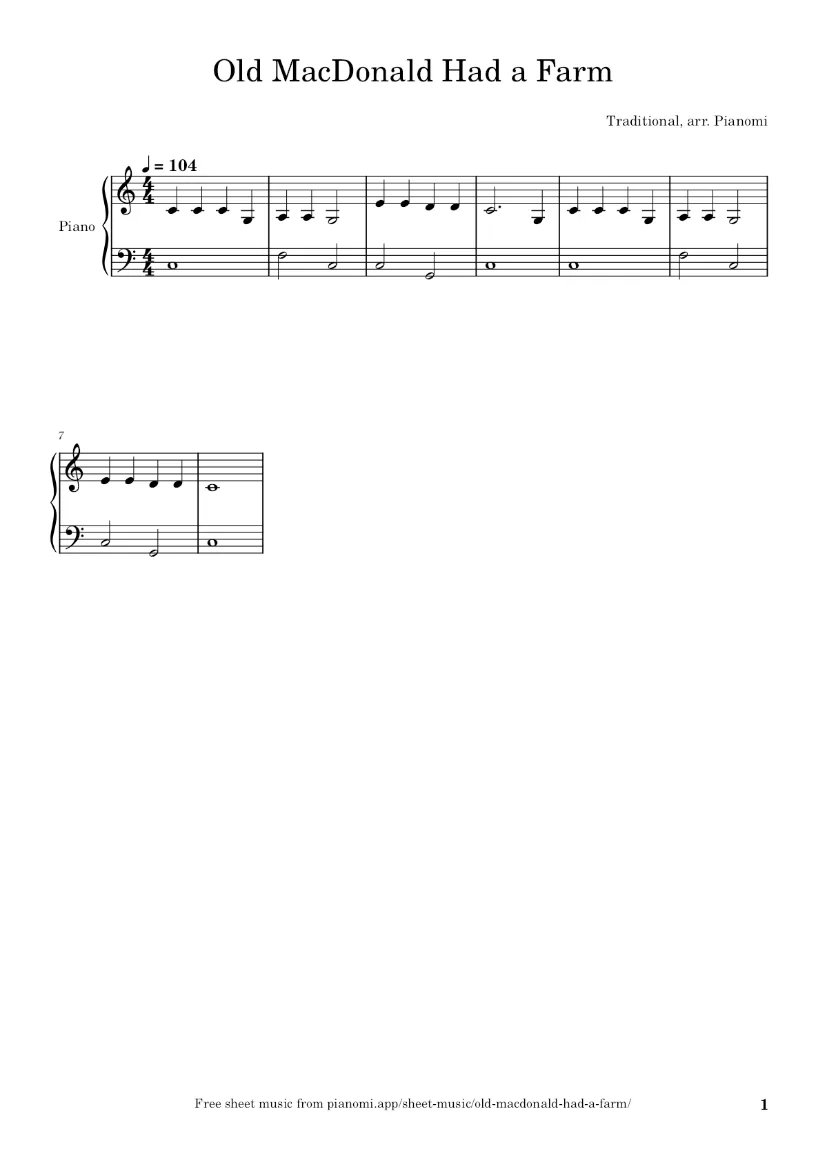
The tune’s notes by name, bar by bar (the right hand’s top line), bars 1–8. ♯ is a sharp, ♭ a flat: play the black key just above or below.
- C C C G
- A A G
- E E D D
- C G
- C C C G
- A A G
- E E D D
- C
The names alone leave out the rhythm and the left hand: the music above has both, and the score with note names prints every note’s name under it.
About Old MacDonald Had a Farm
Old MacDonald Had a Farm is a traditional children’s song. It was sung in many versions in Britain, Ireland and North America, the farmer going by other names, before it settled into the one known today in the twentieth century. Each verse brings a new animal and its noise, and in many versions the noises pile up, verse by verse.
This arrangement is the tune of a verse’s two lines, “Old MacDonald had a farm, E-I-E-I-O” and the line that brings in the animal; the part with the animal’s noises is left out, so it’s eight bars. The right hand plays from the G below middle C to the E above it, and the left hand plays the C and F below middle C and the G below them.
How hard is Old MacDonald Had a Farm?
No. It’s eight bars, the right hand stays in one place, and the left hand plays long notes. The only thing to learn is which finger plays which note, since the hand covers six keys with five fingers.
It reads like level 14 of 44, “G position”: about grade 1 in graded exams’ sight reading, roughly. Its hands, chords and rhythm read like level 9, left hand in halves. On top of that: moving out of position. Practise reading at that level with the free sight-reading exercises.
How to practise it
Play the right hand alone first. Put your thumb on the G below middle C: your second finger plays A, and your third, fourth and fifth fingers play C, D and E, skipping B. The tune starts on three Cs, so play them evenly, and hold the long C in bar 4 for three beats before the G that leads into the second line.
The left hand changes note halfway through bars 2, 3, 6 and 7, and holds a whole bar in the others. Learn it alone, counting four in a bar, then join the hands slowly. Once it’s steady, sing along: it helps keep the rhythm.
The score
- Composer
- Traditional
- Key
- C major
- Time
- 4/4
- Tempo
- ♩ = 104
- Length
- 8 bars, under a minute with its repeats
- Range
- G2 to E4
Arranged for piano by Pianomi, from a tune in the public domain.