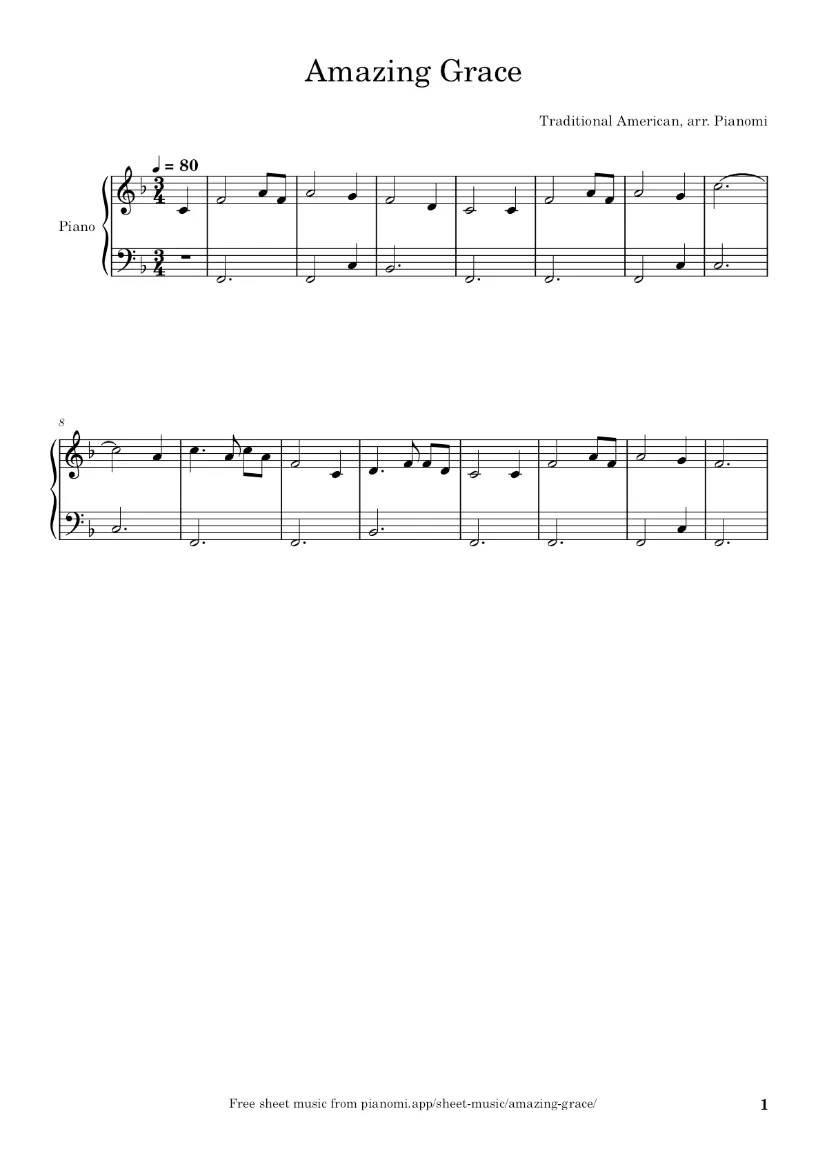
Amazing Grace letter notes
The tune’s notes by name, bar by bar (the right hand’s top line), bars 0–15. ♯ is a sharp, ♭ a flat: play the black key just above or below.
- C
- F A F
- A G
- F D
- C C
- F A F
- A G
- C
- A
- C A C A
- F C
- D F F D
- C C
- F A F
- A G
- F
The names alone leave out the rhythm and the left hand: the music above has both, and the score with note names prints every note’s name under it.
About Amazing Grace
John Newton, a former slave-ship captain who became a clergyman in Olney, England, wrote the words of Amazing Grace, and they were published in the Olney Hymns in 1779. The tune came later and from America: an anonymous melody known as New Britain, first printed in 1829 with other words, and first set to Newton’s in William Walker’s Southern Harmony in 1835.
The form of the tune sung today was settled by Edwin O. Excell’s arrangement of 1900, and this arrangement follows Excell’s notes as printed in his Coronation Hymns (1910), in F major instead of his G. The one change is the word “me”, held over a second bar as it’s usually sung now. No words are printed here.
How hard is Amazing Grace?
No. The tune stays within an octave, from middle C to the C above it, and the left hand plays one or two notes a bar. The long held notes and the dotted rhythms in bars 9 and 11 are the things to count.
It reads like level 29 of 44, “Dotted rhythms”: grade 1 to 2 in graded exams’ sight reading, roughly. Its hands, chords and rhythm read like level 13, eighth notes. On top of that: dotted rhythms, moving out of position and one flat. Practise reading at that level with the free sight-reading exercises.
How to practise it
The tune starts on a pick-up: middle C on beat 3, “A-”, then F on the first beat of bar 1. Most bars are a half note and a quarter, “long, short”, which carries the words. Watch the pairs of eighth notes in bars 1, 5 and 13 (A, F) and the dotted rhythms in bars 9 and 11, counted “1, 2 and 3 and”.
In bar 7 the tune climbs to the C above middle C and holds it into bar 8: count all five beats before the A. The left hand plays a low F, C and B flat, the key’s one flat: the tune has no B at all. Learn it alone, then put the hands together slowly. It sounds best calm and smooth, at about 80 beats a minute.
The score
- Composer
- Traditional American
- Key
- F major
- Time
- 3/4
- Tempo
- ♩ = 80
- Length
- 16 bars, under a minute with its repeats
- Range
- F2 to C5
Arranged for piano by Pianomi, from a tune in the public domain.