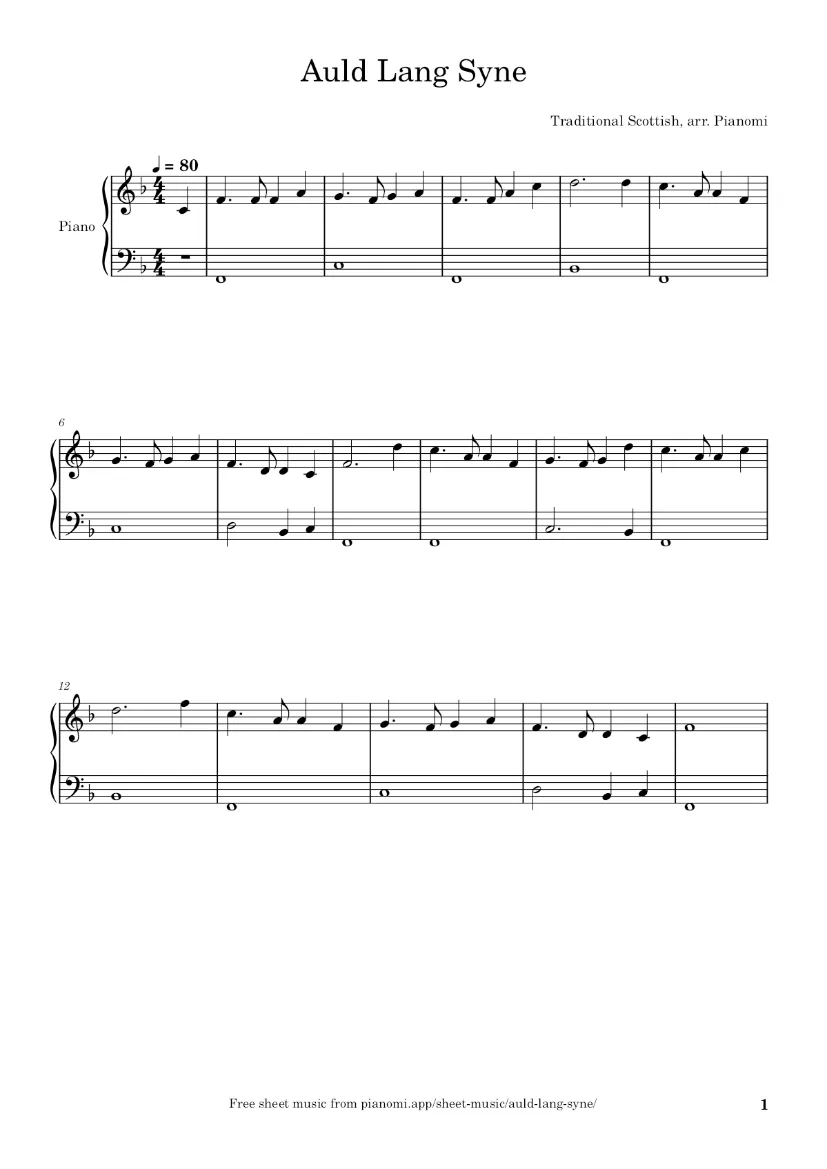
Auld Lang Syne letter notes
The tune’s notes by name, bar by bar (the right hand’s top line), bars 0–16. ♯ is a sharp, ♭ a flat: play the black key just above or below.
- C
- F F F A
- G F G A
- F F A C
- D D
- C A A F
- G F G A
- F D D C
- F D
- C A A F
- G F G D
- C A A C
- D F
- C A A F
- G F G A
- F D D C
- F
The names alone leave out the rhythm and the left hand: the music above has both, and the score with note names prints every note’s name under it.
About Auld Lang Syne
Robert Burns sent the words of Auld Lang Syne, “old long since”, the days long past, to the Scots Musical Museum in 1788; he later wrote that he had taken it down from an old man’s singing. The tune it’s sung to now is an old Scottish air; it was first printed with his words in 1799, after his death, in George Thomson’s Select Collection of Original Scottish Airs, with a piano part by Leopold Kozeluch.
Scots sang it at Hogmanay, the last night of the year, and emigrants took the custom around the world. This arrangement follows the tune as The Golden Book of Favorite Songs (Chicago, 1915) prints it, in the rhythm sung today; the 1799 print snaps the rhythm, short-long, in the Scottish way, and differs in a note or two. No words are printed here.
How hard is Auld Lang Syne?
No: it’s a slow song, the left hand plays one note in most bars, and the right hand has no black keys. The things to watch are the dotted rhythm in nearly every bar and the leaps up to the high D and F, which need a move of the hand.
It reads like level 29 of 44, “Dotted rhythms”: grade 1 to 2 in graded exams’ sight reading, roughly. Its hands, chords and rhythm read like level 13, eighth notes. On top of that: dotted rhythms, moving out of position and one flat. Practise reading at that level with the free sight-reading exercises.
How to practise it
The tune starts on a pick-up: middle C on the fourth beat, “Should”, then F on the first beat of bar 1. Nearly every bar starts with a dotted quarter and an eighth, “long, short”: count “1, and 2” and let the eighth fall on the “and”. The verse ends on “syne”, a long F in bar 8, and the chorus starts on the high D right after it.
The tune uses only five notes, F, G, A, C and D: no B flat and no E, so the right hand never plays a black key. It reaches from middle C up to the second F above it, so move the hand up for the high D in bar 4 and the high F in bar 12. The left hand plays F, C, B flat and D: one note in most bars, two in bar 10 and three in bars 7 and 15 under “days o’ lang syne”: learn it alone first.
The score
- Composer
- Traditional Scottish
- Key
- F major
- Time
- 4/4
- Tempo
- ♩ = 80
- Length
- 17 bars, under a minute with its repeats
- Range
- F2 to F5
Arranged for piano by Pianomi, from a tune in the public domain.