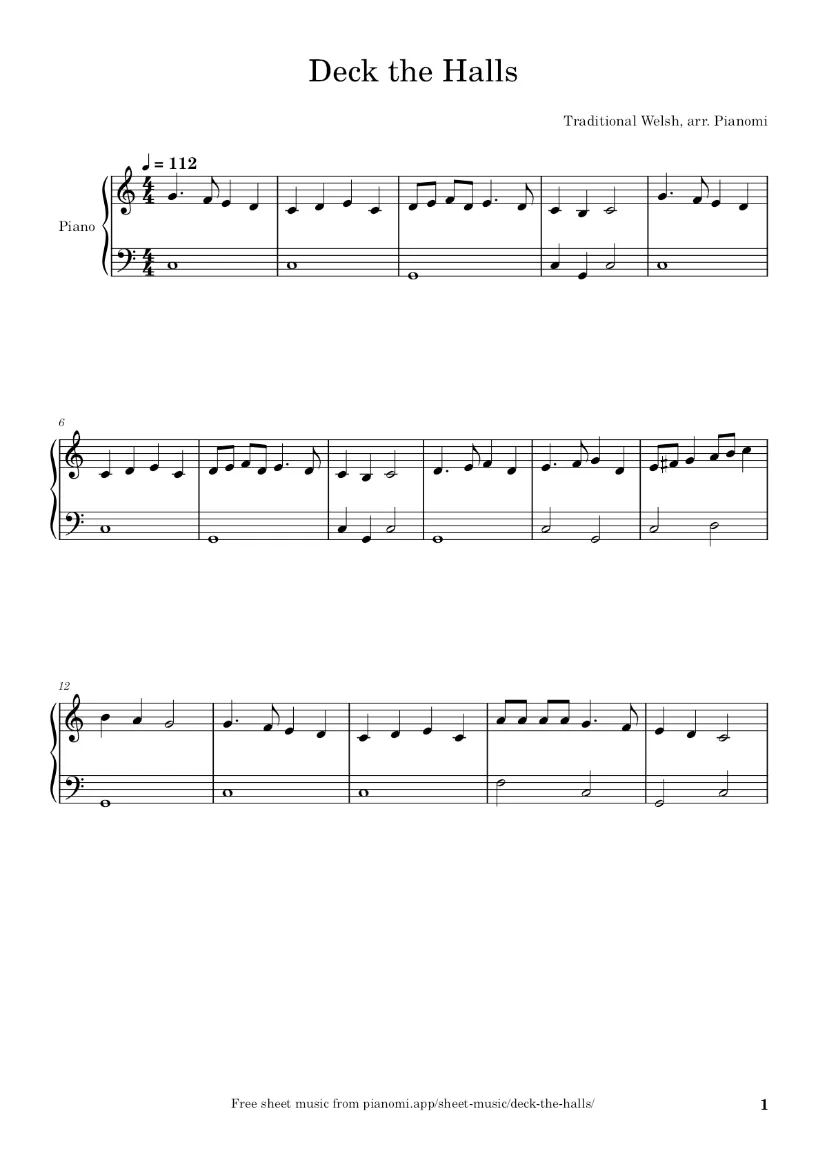
Deck the Halls letter notes
The tune’s notes by name, bar by bar (the right hand’s top line), bars 1–16. ♯ is a sharp, ♭ a flat: play the black key just above or below.
- G F E D
- C D E C
- D E F D E D
- C B C
- G F E D
- C D E C
- D E F D E D
- C B C
- D E F D
- E F G D
- E F♯ G A B C
- B A G
- G F E D
- C D E C
- A A A A G F
- E D C
The names alone leave out the rhythm and the left hand: the music above has both, and the score with note names prints every note’s name under it.
About Deck the Halls
The tune is a Welsh air, Nos Galan (New Year’s Eve), first printed in 1794 by the harpist Edward Jones in his collection of Welsh music, though it’s older than that. The English words are by the Scottish musician Thomas Oliphant, published in 1862 as “Deck the hall with boughs of holly”, with “Troll the ancient Christmas carol” where “Yuletide” is sung now.
The tune sung today has one change from the old one: after “Don we now our gay apparel” comes an extra “fa la la, la la la, la la la”. American songbooks were printing it that way by 1917, and this arrangement follows them. It’s 16 bars in C major: the first four bars are played twice, then the new tune of bars 9 to 12, then the first line again with a different ending.
How hard is Deck the Halls?
No. The tune stays within a few keys of middle C and the left hand plays long notes. The quick eighth notes of the “fa la la”s and the climb in bar 11 are the parts to practise slowly first.
It reads like level 29 of 44, “Dotted rhythms”: grade 1 to 2 in graded exams’ sight reading, roughly. Its hands, chords and rhythm read like level 13, eighth notes. On top of that: dotted rhythms and moving out of position. The hardest bar is 11. Practise reading at that level with the free sight-reading exercises.
How to practise it
Each “fa la la” is quick: in bars 3 and 7 count four eighth notes, D, E, F, D, then a long E and a short D: count “1 and 2 and 3, 4 and”, the D on the last “and”. Bars 4 and 8 dip down to the B below middle C: let your thumb move down for it and come straight back to C.
Bar 11 has the only sharp, F sharp, as the tune climbs E, F sharp, G, A, B, C: play the first three with fingers 1, 2 and 3, pass your thumb under to A, and carry on. Bar 15 repeats A four times before coming home: keep the four eighths even.
The left hand plays the C below middle C and the G below that nearly all the way, with a D and an F near them in bars 11 and 15, mostly one or two notes a bar. Learn it alone, put the hands together slowly, then take it at a bright, bouncing speed.
The score
- Composer
- Traditional Welsh
- Key
- C major
- Time
- 4/4
- Tempo
- ♩ = 112
- Length
- 16 bars, under a minute with its repeats
- Range
- G2 to C5
Arranged for piano by Pianomi, from a tune in the public domain.