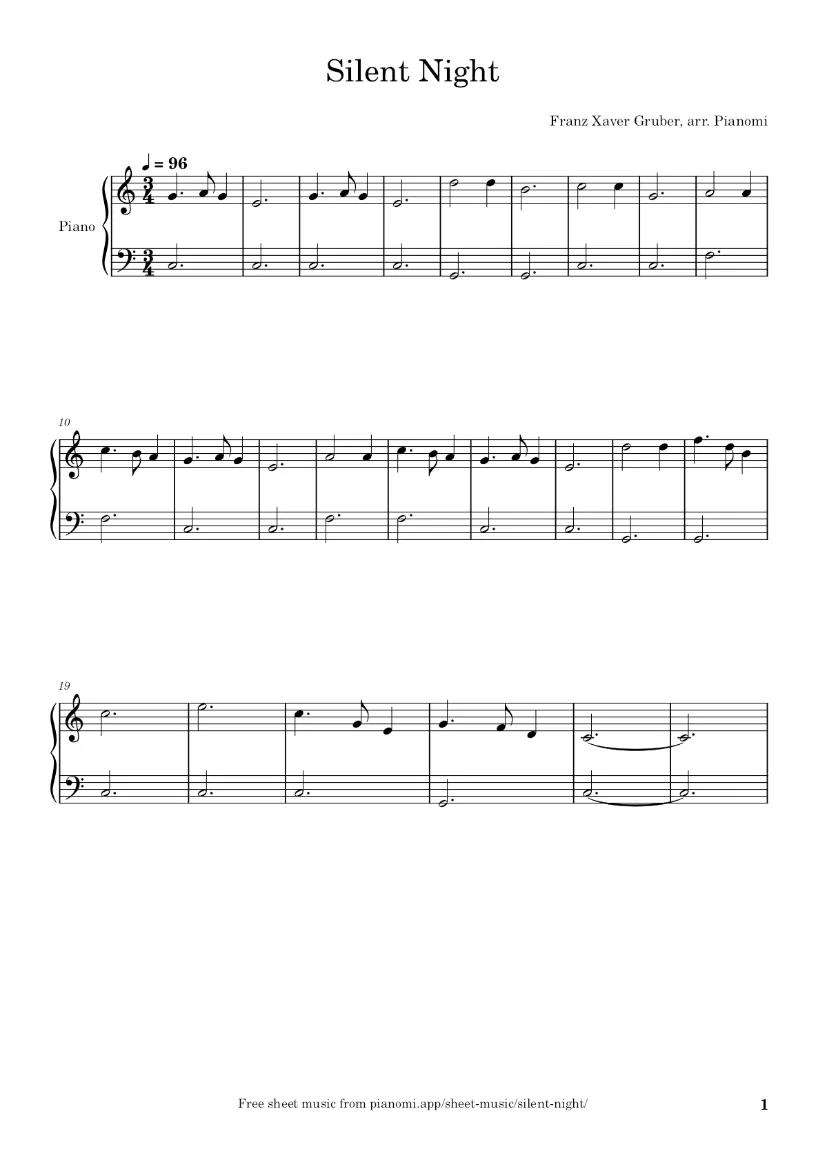
Silent Night letter notes
The tune’s notes by name, bar by bar (the right hand’s top line), bars 1–24. ♯ is a sharp, ♭ a flat: play the black key just above or below.
- G A G
- E
- G A G
- E
- D D
- B
- C C
- G
- A A
- C B A
- G A G
- E
- A A
- C B A
- G A G
- E
- D D
- F D B
- C
- E
- C G E
- G F D
- C
- held
The names alone leave out the rhythm and the left hand: the music above has both, and the score with note names prints every note’s name under it.
About Silent Night
Joseph Mohr, a young priest, wrote the words of Stille Nacht in 1816. On Christmas Eve 1818 in Oberndorf, near Salzburg, he asked Franz Xaver Gruber, a schoolteacher and organist, to set them to music with a guitar accompaniment for that night’s Mass. Travelling families of singers from the Zillertal took the carol on tour, and by the 1840s it was known across Germany. On the way the tune changed a little, into the one sung today.
This arrangement is the tune as it’s sung today. Gruber wrote it in 6/8 time; here it’s in 3/4 with every note twice as long, which is the same music written without sixteenth notes, so it’s easier to read. It’s 24 bars. The right hand plays the tune, from the D above middle C to the F at the top of the treble staff, and the left hand holds one note a bar, C, F or G, on the chord under the tune.
How hard is Silent Night?
No. The tune moves mostly by step, and the left hand plays one long note a bar. The dotted rhythm that starts most bars is the thing to count carefully.
It reads like level 29 of 44, “Dotted rhythms”: grade 1 to 2 in graded exams’ sight reading, roughly. Its hands, chords and rhythm read like level 13, eighth notes. On top of that: dotted rhythms and moving out of position. Practise reading at that level with the free sight-reading exercises.
How to practise it
The rhythm of the first bar comes back all through the carol: a dotted quarter note, an eighth and a quarter, “Si-lent night”. Count it “1, 2 and 3”, with the eighth on the “and”. The long notes in bars 2, 4, 6 and 8 last the whole bar: hold them for all three beats.
The tune climbs higher twice: to D in bar 5 (“All is calm”) and to F in bar 18, its highest note. Move your hand up for them rather than stretching. Learn the left hand on its own first: it only has the C and F below middle C and the G below them. Then put the hands together slowly, the left hand’s note going down with the first beat of each bar.
Silent Night should sound calm and unhurried. Once it’s steady, play it at about 96 quarter notes a minute, and let the last C ring through bars 23 and 24.
The score
- Composer
- Franz Xaver Gruber
- Key
- C major
- Time
- 3/4
- Tempo
- ♩ = 96
- Length
- 24 bars, under a minute with its repeats
- Range
- G2 to F5
Arranged for piano by Pianomi, from a tune in the public domain.