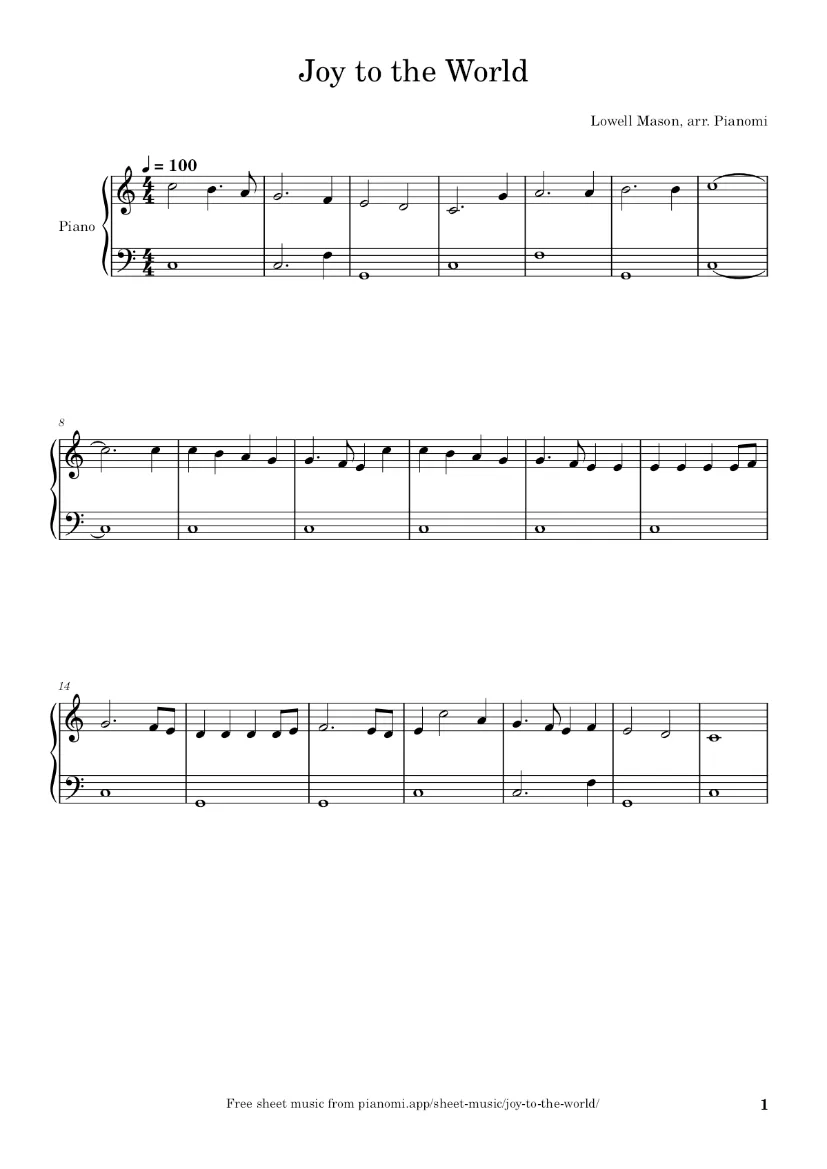
Joy to the World letter notes
The tune’s notes by name, bar by bar (the right hand’s top line), bars 1–20. ♯ is a sharp, ♭ a flat: play the black key just above or below.
- C B A
- G F
- E D
- C G
- A A
- B B
- C
- C
- C B A G
- G F E C
- C B A G
- G F E E
- E E E E F
- G F E
- D D D D E
- F E D
- E C A
- G F E F
- E D
- C
The names alone leave out the rhythm and the left hand: the music above has both, and the score with note names prints every note’s name under it.
About Joy to the World
Isaac Watts wrote the words in 1719, as a hymn based on Psalm 98. The tune came more than a century later, from the American Lowell Mason, who first published it in 1836 under the name Antioch, marked “from Handel”. Its first four notes are those of the chorus Lift Up Your Heads in Handel’s Messiah, but little else is, and similar tunes were printed in the early 1830s, so nobody knows quite where it began. Mason’s version is the one sung today.
This arrangement follows Mason’s tune as he printed it in 1839. He wrote it in 2/4 time; here it’s in 4/4 with every note twice as long, so its quickest notes are eighths, not sixteenths. It’s 20 bars in C major, and the right hand never goes below middle C or above the C an octave higher. The left hand plays the C and F below middle C and the G below them, mostly one note a bar.
How hard is Joy to the World?
No. The tune is mostly scales, and the left hand plays one long note a bar. The dotted rhythms and the leap in bar 17 are the places to slow down for.
It reads like level 29 of 44, “Dotted rhythms”: grade 1 to 2 in graded exams’ sight reading, roughly. Its hands, chords and rhythm read like level 13, eighth notes. On top of that: dotted rhythms, moving out of position and left-hand jumps. Practise reading at that level with the free sight-reading exercises.
How to practise it
The first four bars are the C major scale walking down from the C above middle C to middle C: “Joy to the world, the Lord is come”. Start with your fifth finger on the high C, and when you reach F with your thumb, cross your third finger over it onto E. Bar 1 is long, shorter, shortest: count “1, 2, 3, 4 and”, with the A on the last “and”.
Bars 9 to 12 come down from C twice. Bars 13 to 16 repeat one note: four Es climbing to G, then four Ds climbing to F. Count the eighth notes at the end of bars 13 and 15 so they don’t rush.
In bar 17 the tune jumps from E up to the high C, its biggest leap. Look at the C before you play it, then walk home to middle C. Learn the left hand alone, put the hands together slowly, and then bring it up to a bright, steady speed.
The score
- Composer
- Lowell Mason
- Key
- C major
- Time
- 4/4
- Tempo
- ♩ = 100
- Length
- 20 bars, under a minute with its repeats
- Range
- G2 to C5
Arranged for piano by Pianomi, from a tune in the public domain.