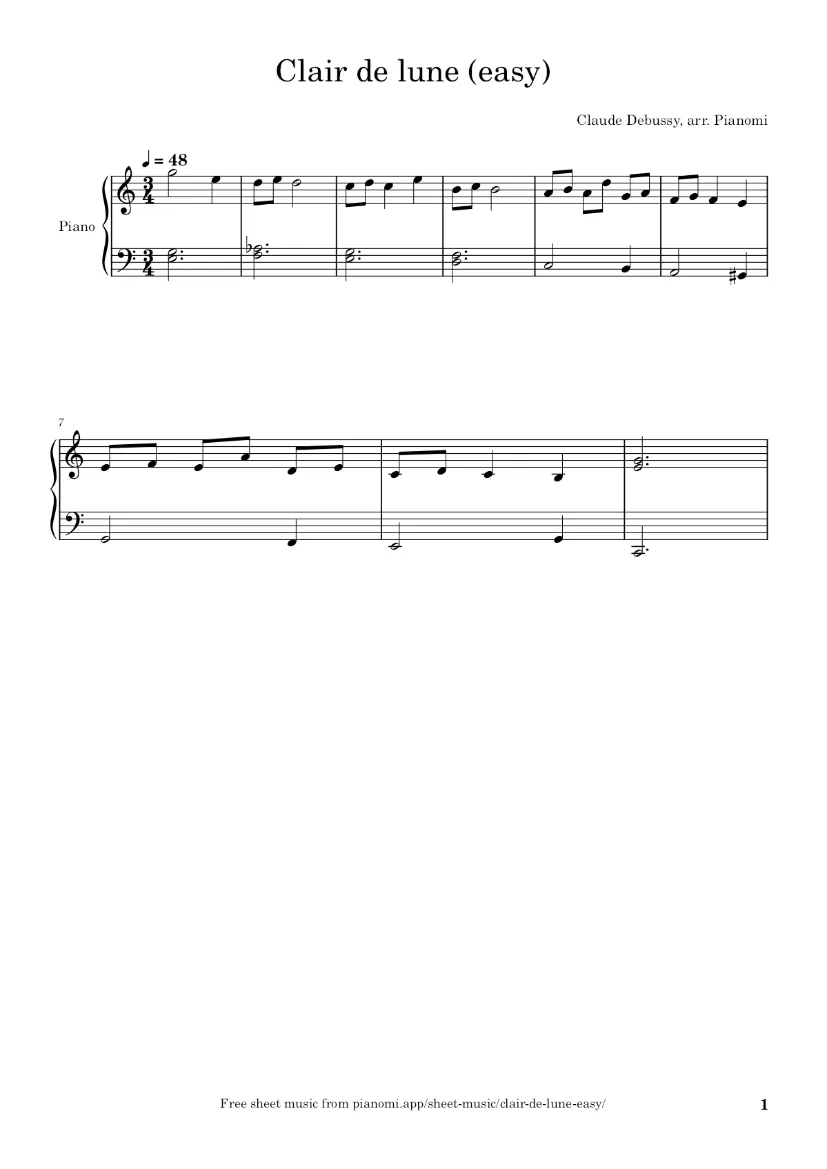
Easy Clair de lune letter notes
The tune’s notes by name, bar by bar (the right hand’s top line), bars 1–8. ♯ is a sharp, ♭ a flat: play the black key just above or below.
- G E
- D E D
- C D C E
- B C B
- A B A D G A
- F G F E
- E F E A D E
- C D C B
The names alone leave out the rhythm and the left hand: the music above has both, and the score with note names prints every note’s name under it.
About Easy Clair de lune
Clair de lune is the third movement of Debussy’s Suite bergamasque, begun around 1890 and published in 1905. It opens very softly, in D♭ major and 9/8 time, with pairs of notes that drift down from high in the treble, starting off the beat so the music seems to float.
This arrangement is Pianomi’s own: the first eight bars, ending on the chord bar 9 begins with. It’s in C major and 3/4 rather than D♭ major and 9/8, so there are no tied notes and only one flat, the A♭ in bar 2’s left hand: each of Debussy’s slow beats is a quarter note, and where he has three eighth notes in a beat, two are kept. The right hand plays the top note of each of his pairs, and the left hand plays his left-hand notes, an octave lower in the first four bars. The whole piece, as Debussy wrote it, has a page of its own.
How hard is Easy Clair de lune?
It’s an easy piece for someone who has played a few pieces with both hands: the rhythm is simple, the left hand slow, and the tune moves by small steps. The high start and the running eighth notes in bars 5 and 7 are the things to watch. The whole Clair de lune is a late intermediate piece.
It reads like level 30 of 44, “Accidentals”: grade 1 to 2 in graded exams’ sight reading, roughly. Its hands, chords and rhythm read like level 18, right-hand intervals. On top of that: accidentals and moving out of position. Practise reading at that level with the free sight-reading exercises.
How to practise it
The tune starts on the G just above the treble staff and falls a little in each bar: G and E, then D, E, D, then C, D, C and E. In bars 2 to 4 each bar starts with two quick notes: play them softly, leading into the longer notes after them. In bars 5 and 7 eighth notes run through the whole bar, so count “1 and 2 and 3 and” and keep them even. By bar 8 the tune has come down to middle C and the B below it.
The left hand holds two notes together for a whole bar in bars 1 to 4, then plays single notes that step down: C, B, A, G♯, G, F, E, G and a low C to end. The piece has two black keys, both in the left hand: the A♭ in bar 2 and the G♯ in bar 6. Learn each hand alone, then together slowly, changing the pedal with each new left-hand note.
The score
- Composer
- Claude Debussy (1862–1918)
- Key
- C major
- Time
- 3/4
- Tempo
- ♩ = 48
- Length
- 9 bars, under a minute with its repeats
- Range
- C2 to G5
Arranged for piano by Pianomi, from a tune in the public domain.