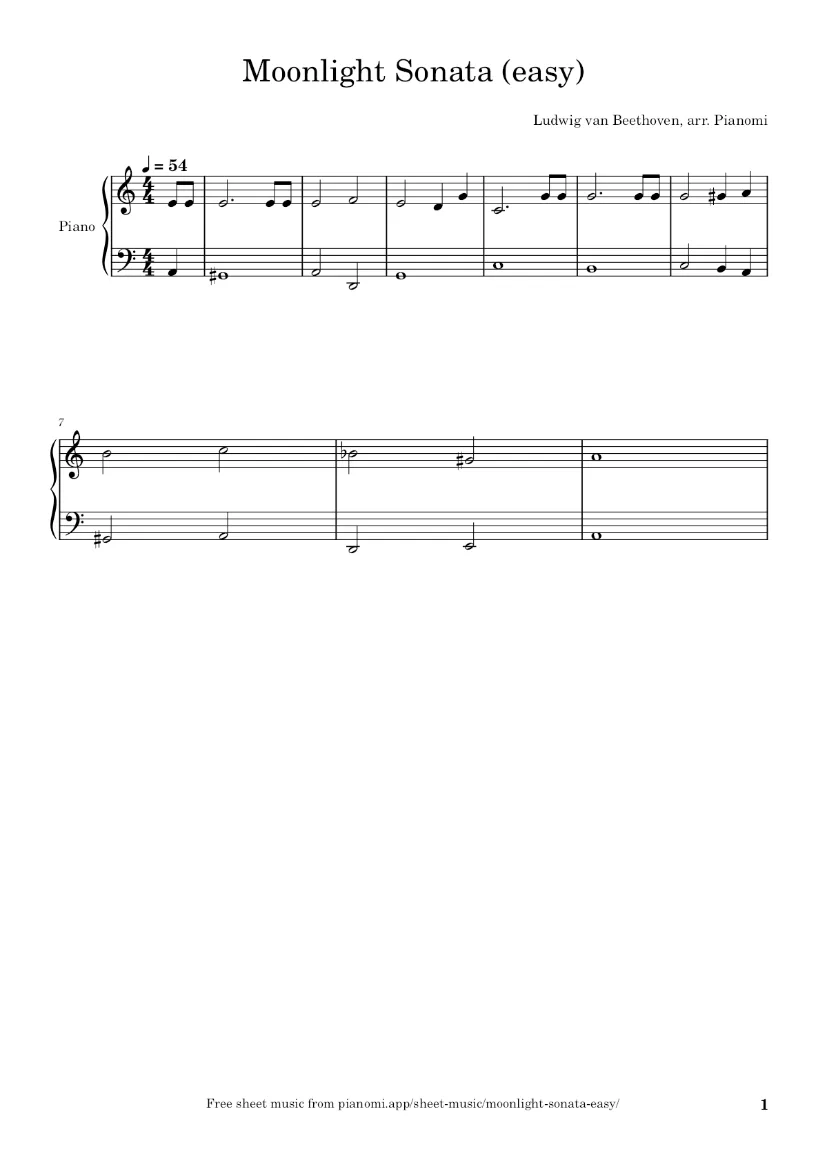
Easy Moonlight Sonata letter notes
The tune’s notes by name, bar by bar (the right hand’s top line), bars 0–9. ♯ is a sharp, ♭ a flat: play the black key just above or below.
- E E
- E E E
- E F
- E D G
- C G G
- G G G
- G G♯ A
- B C
- B♭ G♯
- A
The names alone leave out the rhythm and the left hand: the music above has both, and the score with note names prints every note’s name under it.
About Easy Moonlight Sonata
Beethoven wrote his Piano Sonata No. 14 in C♯ minor, Op. 27 No. 2, in 1801. The name Moonlight came later, from the critic Ludwig Rellstab, who compared its first movement to moonlight on a lake. In that movement the right hand plays quiet triplets all the way through, the left hand slow octaves, and over them comes a plain tune that hardly moves.
This arrangement is Pianomi’s own and keeps the tune and the bass. It takes them from bars 42 to 51, where the tune comes back as it first came in (bars 5 to 8) and then turns home, so it ends on the home chord. It’s in A minor rather than C♯ minor, so there are no sharps in the key signature. The triplets are left out, and Beethoven’s dotted rhythm on the repeated notes is written as two even eighth notes. The whole first movement, as Beethoven wrote it, has a page of its own.
How hard is Easy Moonlight Sonata?
No: the tune is slow, moves mostly by step and stays under one hand, and the left hand plays one long note at a time. Count the long notes carefully and watch the black keys near the end. The whole movement, with its triplets all the way through, is a late intermediate piece.
It reads like level 30 of 44, “Accidentals”: grade 1 to 2 in graded exams’ sight reading, roughly. Its hands, chords and rhythm read like level 13, eighth notes. On top of that: accidentals. Practise reading at that level with the free sight-reading exercises.
How to practise it
The right hand starts on the E above middle C and the tune stays close by: E, F, D and G at first, then up through G, A and B to C. Count four slow beats in every bar. The two quick notes at the end of the pick-up and of bars 1, 4 and 5 lead into the next long note: keep them soft and even. The only black keys in the right hand are the G♯ in bars 6 and 8 and the B♭ in bar 8.
The left hand plays Beethoven’s bass one note at a time, most of them held for a whole bar or half of one, with a G♯ in bars 1 and 7. Learn it alone, then put the hands together slowly. Play quietly and hold each note its full length: it should sound calm, never hurried.
The score
- Composer
- Ludwig van Beethoven (1770–1827)
- Key
- A minor
- Time
- 4/4
- Tempo
- ♩ = 54
- Length
- 10 bars, under a minute with its repeats
- Range
- D2 to C5
Arranged for piano by Pianomi, from a tune in the public domain.