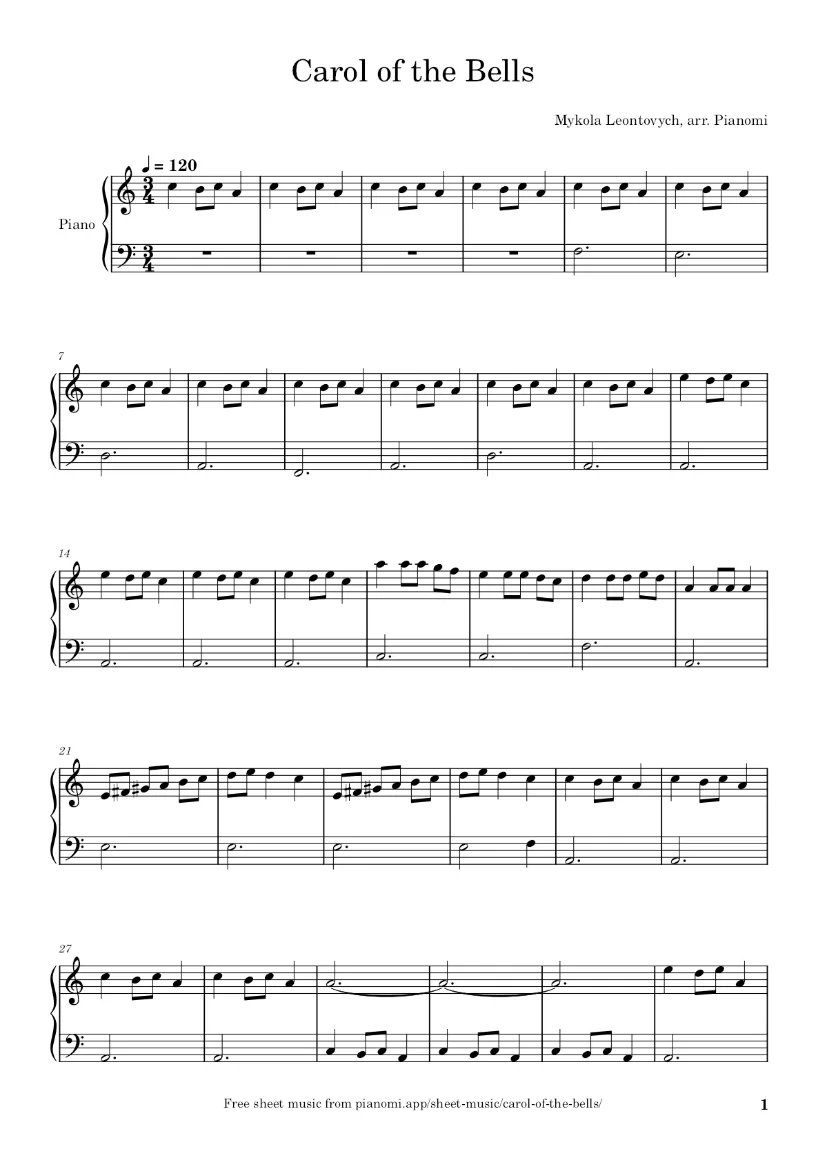
Carol of the Bells letter notes
The tune’s notes by name, bar by bar (the right hand’s top line), bars 1–24. ♯ is a sharp, ♭ a flat: play the black key just above or below.
- C B C A
- C B C A
- C B C A
- C B C A
- C B C A
- C B C A
- C B C A
- C B C A
- C B C A
- C B C A
- C B C A
- C B C A
- E D E C
- E D E C
- E D E C
- E D E C
- A A A G F
- E E E D C
- D D D E D
- A A A A
- E F♯ G♯ A B C
- D E D C
- E F♯ G♯ A B C
- D E D C
The names alone leave out the rhythm and the left hand: the music above has both, and the score with note names prints every note’s name under it.
About Carol of the Bells
Shchedryk is a Ukrainian New Year song: a swallow flies into a house and sings of the good year the family will have. The Ukrainian composer Mykola Leontovych built a piece for choir on its four notes, repeated again and again over changing harmonies, and it was first sung in Kyiv in December 1916. The Ukrainian National Chorus took it on tour, and after a concert at Carnegie Hall in New York in 1922 it became known in America. In 1936 Peter Wilhousky wrote English words for it about bells, and as Carol of the Bells it became a Christmas song.
This is our own arrangement of Leontovych’s music, without the English words, which are still under copyright. His choir sings it in G minor; here it’s a tone higher, in A minor, so the key signature has no sharps or flats. It plays the piece through once, without the repeat and with four of the opening bars left out, in 32 bars: the bells alone, then with the left hand moving below them, a higher tune, two scales rising, the bells again, and at the end the bells pass to the left hand while the right holds a long A.
How hard is Carol of the Bells?
Not very. The right hand repeats one small figure for much of the piece, and the left hand plays long notes. The rising scales in bars 21 and 23, and keeping the bells even once the tempo picks up, are the hard parts.
It reads like level 28 of 44, “Changing positions”: grade 1 to 2 in graded exams’ sight reading, roughly. Its hands, chords and rhythm read like level 13, eighth notes. On top of that: moving out of position. The hardest bars are 21 and 23. Practise reading at that level with the free sight-reading exercises.
How to practise it
The bell figure is the heart of the piece: C, B, C, A, a quarter note, two eighths and a quarter. Put your thumb on A, your second finger on B and your third on C, and play it until it’s light and even, counting “1, 2 and 3”.
In bars 13 to 16 the hand moves up to E, D, E, C, and bar 17 starts on the high A, the top of the piece. Bars 21 and 23 are a scale running up from E with F sharp and G sharp in it: take them slowly, with your thumb on E, then 2 and 3, the thumb passing under to A, then 2 and 3 again.
The left hand rests for the first four bars, then plays long notes, mostly one a bar. In bars 29 to 31 it plays the bell figure itself, two octaves lower, under the right hand’s long A: practise it alone until it’s as even as the right hand was. Then let the whole piece run at a lively, steady speed.
The score
- Composer
- Mykola Leontovych
- Key
- A minor
- Time
- 3/4
- Tempo
- ♩ = 120
- Length
- 32 bars, under a minute with its repeats
- Range
- F2 to A5
Arranged for piano by Pianomi, from a tune in the public domain.