Ave Maria (Schubert) letter notes
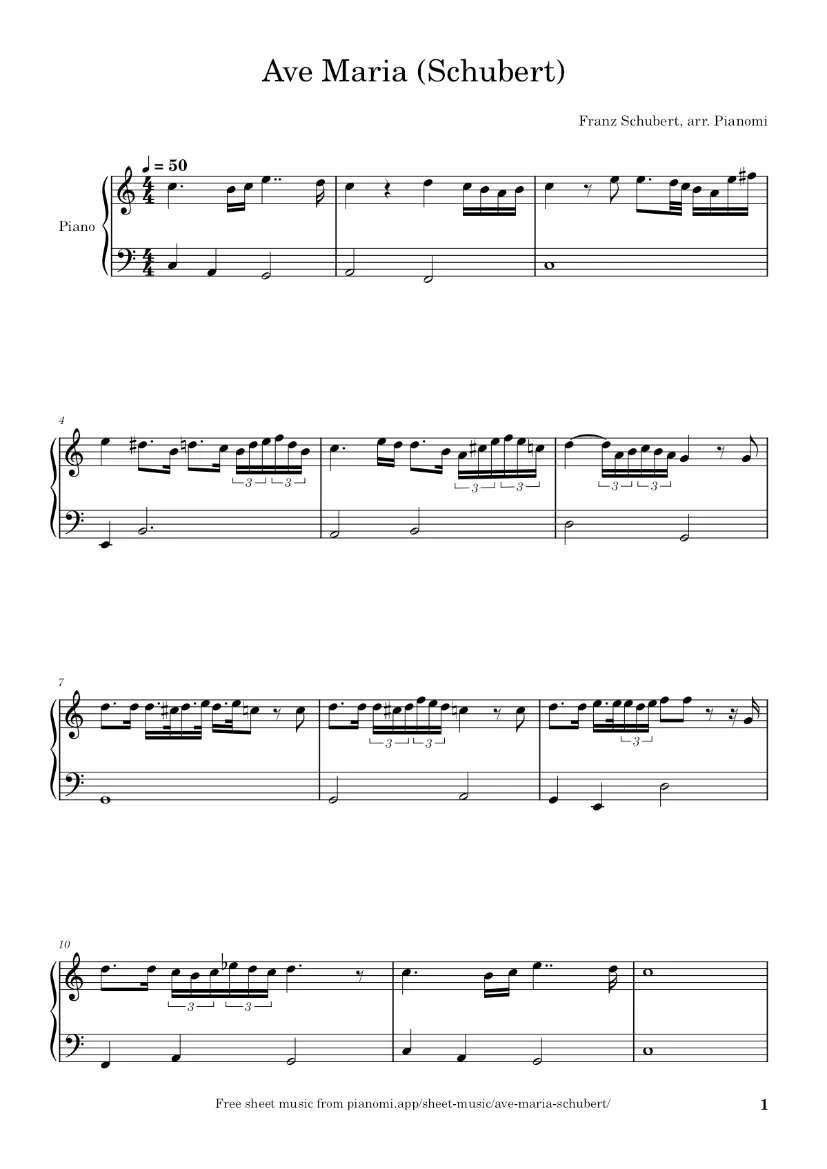
The tune’s notes by name, bar by bar (the right hand’s top line), bars 1–12. ♯ is a sharp, ♭ a flat: play the black key just above or below.
- C B C E D
- C D C B A B
- C E E D C B A E F♯
- E D♯ B D C B D E F D B
- C E D D B A C♯ E F E C
- D A B C B A G G
- D D D C♯ D E D E C C
- D D D C♯ D F E D C C
- D D E E E D E F F G
- D D C B C E♭ D C D
- C B C E D
- C
The names alone leave out the rhythm and the left hand: the music above has both, and the score with note names prints every note’s name under it.
About Ave Maria (Schubert)
Franz Schubert wrote the song in 1825: Ellens dritter Gesang (Ellen’s third song), also called Hymne an die Jungfrau (Hymn to the Virgin), his Op. 52 No. 6, D. 839. Its words come from Walter Scott’s poem The Lady of the Lake, in Adam Storck’s German translation, where Ellen sings it. Its first words are “Ave Maria! Jungfrau mild”, and it’s marked Sehr langsam, very slow. The verse ends with its opening “Ave Maria” phrase again. It’s a different piece from the Bach–Gounod Ave Maria.
This arrangement is Pianomi’s own and follows the voice’s melody in the first verse as two editions print it, Edition Peters’ Schubert-Album (Leipzig, about 1890) and G. Schirmer’s (New York, 1902), which agree on every note. It’s a tone higher than their B♭ major, in C. The piano’s two-bar introduction is left out, and so are the grace notes and the trill in bar 9; the last C is held. The left hand plays the roots of Schubert’s bass, one to three long notes a bar. No words are printed here.
How hard is Ave Maria (Schubert)?
It’s harder than a first piece: the tune is slow but full of quick notes, dotted rhythms, 32nds and triplets, with sharps and a flat the key doesn’t show. The left hand is easy, long notes only.
It reads like level 41 of 44, “Triplets”: grade 2 to 3 in graded exams’ sight reading, roughly. Its hands, chords and rhythm read like level 41, triplets. On top of that: rests, accidentals, dotted rhythms, moving out of position and left-hand jumps. Practise reading at that level with the free sight-reading exercises.
How to practise it
It’s very slow, so count in sixteenths: “1 e and a, 2 e and a”. The melody keeps Schubert’s quick figures: dotted rhythms, 32nd notes in bars 3, 7 and 9, and triplets of sixteenths, three in the time of two, in bars 4, 5, 6, 8, 9 and 10. Learn each bar slowly, with a steady count, before you join them up.
The tune stays between the G above middle C and the F♯ on the top line of the treble staff. Watch the sharps and the flat the key doesn’t show: F♯ in bar 3, D♯ in bar 4, C♯ in bars 5, 7 and 8, and E♭ in bar 10, each only to the end of its bar. Bar 11 is bar 1 again, the opening coming back to end the verse. The left hand plays long notes: learn it alone, then put the hands together very slowly.
The score
- Composer
- Franz Schubert (1797–1828)
- Key
- C major
- Time
- 4/4
- Tempo
- ♩ = 50
- Length
- 12 bars, about 1 minute with its repeats
- Range
- E2 to F♯5
Arranged for piano by Pianomi, from a tune in the public domain.