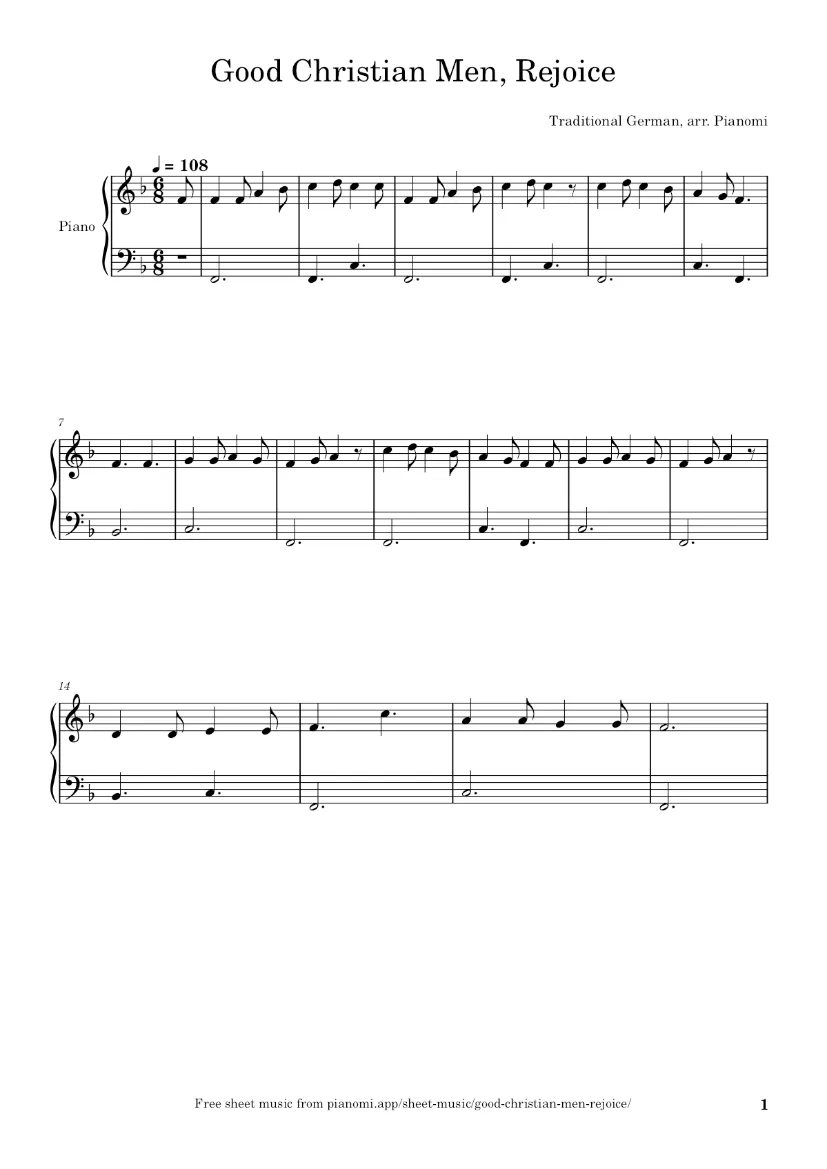
Good Christian Men, Rejoice letter notes
The tune’s notes by name, bar by bar (the right hand’s top line), bars 0–17. ♯ is a sharp, ♭ a flat: play the black key just above or below.
- F
- F F A B♭
- C D C C
- F F A B♭
- C D C
- C D C B♭
- A G F
- F F
- G G A G
- F G A
- C D C B♭
- A G F F
- G G A G
- F G A
- D D E E
- F C
- A A G G
- F
The names alone leave out the rhythm and the left hand: the music above has both, and the score with note names prints every note’s name under it.
About Good Christian Men, Rejoice
Good Christian Men, Rejoice is sung to In dulci jubilo, a German carol from the Middle Ages whose words mix Latin and German; they are traditionally credited to Heinrich Seuse, around 1328. The tune was printed in 1582 in Piae Cantiones. John Mason Neale wrote the English carol, which begins “Good Christian men, rejoice”, and published it with Thomas Helmore in Carols for Christmas-tide (1853). Its famous shout, “News! News!”, held on one note twice, is said to come from Helmore misreading the long notes of the old notation in Piae Cantiones.
This arrangement follows the tune as Bramley and Stainer printed it in Christmas Carols New and Old in the 1870s, in their key, F major, with one flat, and in 6/8 time: the whole verse once, 17 bars after a one-note pick-up. The right hand stays between the D above middle C and the D an octave higher.
How hard is Good Christian Men, Rejoice?
Not hard, but it’s in 6/8, which reads harder than the carols here in 3/4 and 4/4. Once the long-short swing of the quarter and the eighth is in your fingers, the tune moves mostly by step, and the left hand plays long notes.
It reads like level 42 of 44, “Six-eight time”: grade 2 to 3 in graded exams’ sight reading, roughly. Its hands, chords and rhythm read like level 42, six-eight time. On top of that: rests, moving out of position and one flat. Practise reading at that level with the free sight-reading exercises.
How to practise it
Count two beats in every bar, each a dotted quarter split into three eighths: “1 and a, 2 and a”. Most of the tune is a quarter note and an eighth, long and short, on each beat: bar 1 is F and F, then A and B flat.
Bar 7 is “News! News!”: two Fs, each held for a whole beat. Bars 4, 9 and 13 end with an eighth-note rest. Bar 14 drops to the D above middle C and climbs D, E to the F of bar 15, which leaps up to C; bar 17 holds F for the whole bar.
The left hand plays low F in most bars, the C below middle C, and B flat under “News! News!”: one long note for the bar, or two dotted quarters. Learn it alone, then put the hands together slowly, at a bright two, about 72 dotted quarter notes a minute.
The score
- Composer
- Traditional German
- Key
- F major
- Time
- 6/8
- Tempo
- ♩. = 72
- Length
- 18 bars, under a minute with its repeats
- Range
- F2 to D5
Arranged for piano by Pianomi, from a tune in the public domain.