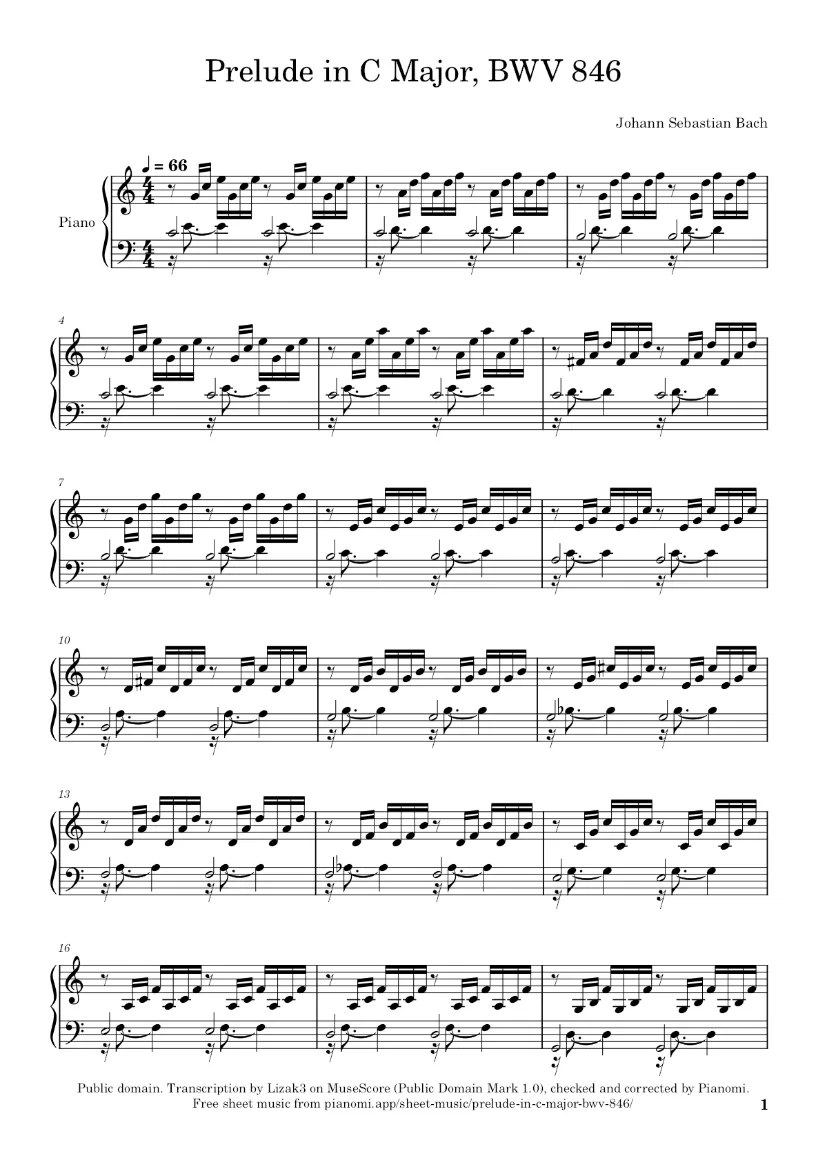
About Prelude in C Major, BWV 846
Bach finished the first book of The Well-Tempered Clavier in 1722: 24 preludes and fugues, one in every major and minor key, starting with C major. A shorter, earlier version of this prelude is in the little keyboard book he began in 1720 for his eldest son, Wilhelm Friedemann.
Every bar is one chord, spread out the same way twice. The left hand plays the two lowest notes and holds them, and the right hand plays the three notes above, twice over. Only the harmony moves, away from C major and back. From bar 24 the bass stays on a low G for eight bars, then settles on a low C, and in bars 33 and 34 the pattern gives way to a run up and down over the held C before the last chord.
In the 1850s Charles Gounod wrote a melody to sing over it, which became his Ave Maria. Some old editions, Czerny’s among them, have an extra bar after bar 22 that the editor Christian Schwencke added, so they count 36 bars. This is Bach’s own text, 35 bars.
How hard is Prelude in C Major, BWV 846?
Not very. There’s one pattern from start to finish and no fast notes, so the notes come quickly; what takes work is keeping the sixteenths even and soft and the held notes held. It suits a pianist in their second or third year, and it’s a good first piece of Bach.
It reads like level 40 of 44, “Sixteenth notes”: grade 2 to 3 in graded exams’ sight reading, roughly. Its hands, chords and rhythm read like level 40, sixteenth notes. On top of that: rests, accidentals, moving out of position and left-hand jumps. The hardest bars are 21 and 32. Practise reading at that level with the free sight-reading exercises.
How to practise it
Play each bar as a chord first, all five notes at once, so your hands learn the shapes and you hear where the harmony goes. Then spread it out. The pattern never changes, so once the first bar is under your fingers, the work is finding each new chord.
Hold the left hand’s two notes through to the middle of the bar and again to the end, as they’re written: they keep the harmony sounding while the right hand moves. On a piano, a little pedal, changed with each new bar, helps too.
Keep the sixteenth notes even and quiet, and let the sound grow and fall with the harmony instead of playing every bar alike. Learn bars 33 and 34 on their own: the run climbs and falls over the held C, and part of bar 33 is written in the bass clef.
The score
- Composer
- Johann Sebastian Bach (1685–1750)
- Catalogue
- BWV 846
- Written
- 1722
- Key
- C major
- Time
- 4/4
- Tempo
- ♩ = 66
- Length
- 35 bars, about 2 minutes with its repeats
- Range
- C2 to A5
Transcribed by Lizak3 on MuseScore and given to the public domain (Public Domain Mark 1.0). We compared every note with other transcriptions and early editions and corrected it where it was wrong.