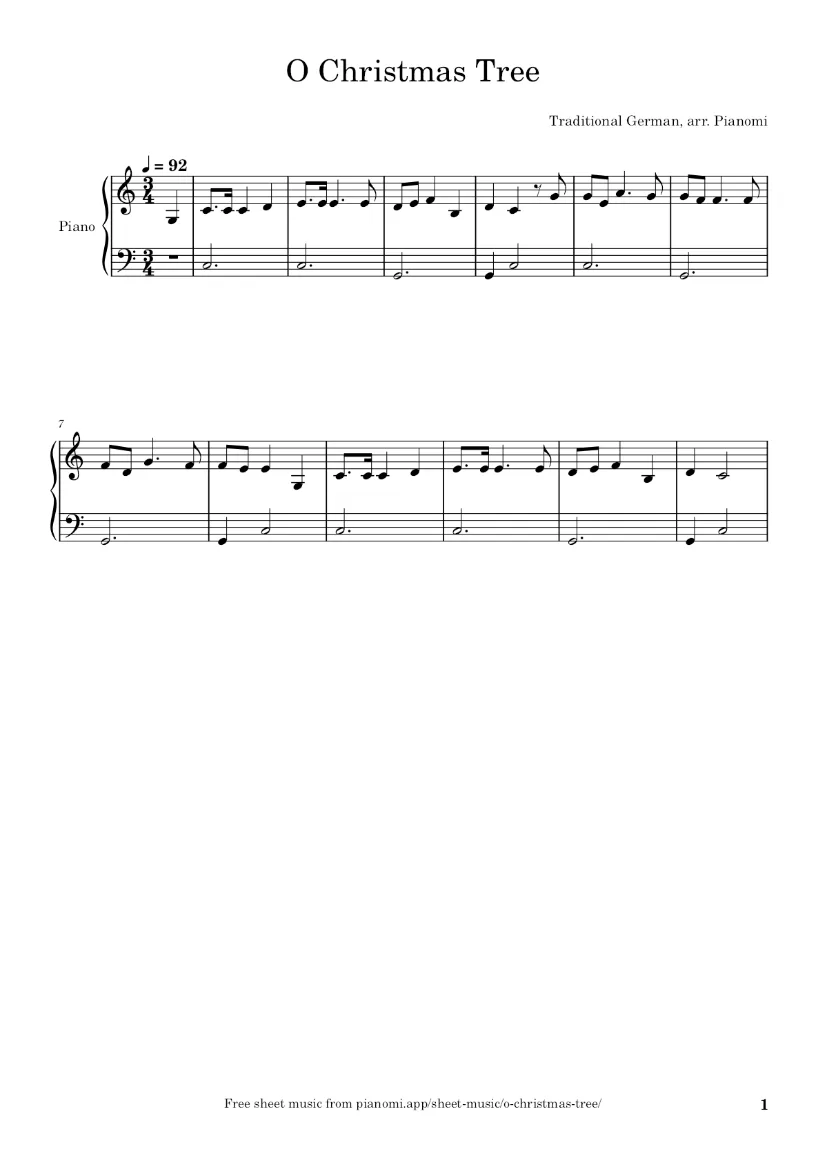
O Christmas Tree letter notes
The tune’s notes by name, bar by bar (the right hand’s top line), bars 0–12. ♯ is a sharp, ♭ a flat: play the black key just above or below.
- G
- C C C D
- E E E E
- D E F B
- D C G
- G E A G
- G F F F
- F D G F
- F E E G
- C C C D
- E E E E
- D E F B
- D C
The names alone leave out the rhythm and the left hand: the music above has both, and the score with note names prints every note’s name under it.
About O Christmas Tree
O Tannenbaum is a German Christmas song sung to a German folk tune. The Christmas words are by Ernst Anschütz, a teacher and organist in Leipzig, who published them in 1824 in his Musikalisches Schulgesangbuch, a songbook for schools. He kept the first verse of an older folk song about a fir tree, which August Zarnack had published in 1820, and wrote the rest himself.
This arrangement follows the tune as Eduardo Marzo printed it with English words in his Fifty Christmas Carols of All Nations (Cincinnati, 1923), moved down a fifth from his G major to C major. It’s 12 bars in 3/4 after a one-note pick-up: the first phrase, the middle, and the first phrase again. The rhythm of “Christ-mas”, a dotted eighth and a sixteenth, is kept as it’s sung. The right hand runs from the G below middle C to the A above it.
How hard is O Christmas Tree?
It’s short and the notes lie close together, but the dotted rhythm of “Christ-mas” uses a sixteenth note, which makes it read harder than most carols here. Count it slowly with a metronome first; the rest is easy.
It reads like level 40 of 44, “Sixteenth notes”: grade 2 to 3 in graded exams’ sight reading, roughly. Its hands, chords and rhythm read like level 40, sixteenth notes. On top of that: dotted rhythms and moving out of position. Practise reading at that level with the free sight-reading exercises.
How to practise it
The tune starts on a pick-up, the G below middle C on beat 3, and leaps up a perfect fourth to middle C. In bars 1, 2, 9 and 10 the first beat is a dotted eighth and a sixteenth, the “Christ-mas” of “O Christmas tree”: count “1 e and a” and play the short note on the “a”, just before beat 2.
Bars 3 and 11 dip to the B below middle C. Bar 4 ends with an eighth-note rest and a G, which leads into the middle of the song: in bars 5 to 7 each bar is two eighth notes and a dotted quarter, then an eighth, counted “1 and 2, 3 and”.
The left hand plays the C below middle C in most bars, the G below it in bars 3, 6, 7 and 11, and G then C in bars 4, 8 and 12. Learn it alone, then put the hands together slowly, at about 92 quarter notes a minute.
The score
- Composer
- Traditional German
- Key
- C major
- Time
- 3/4
- Tempo
- ♩ = 92
- Length
- 13 bars, under a minute with its repeats
- Range
- G2 to A4
Arranged for piano by Pianomi, from a tune in the public domain.