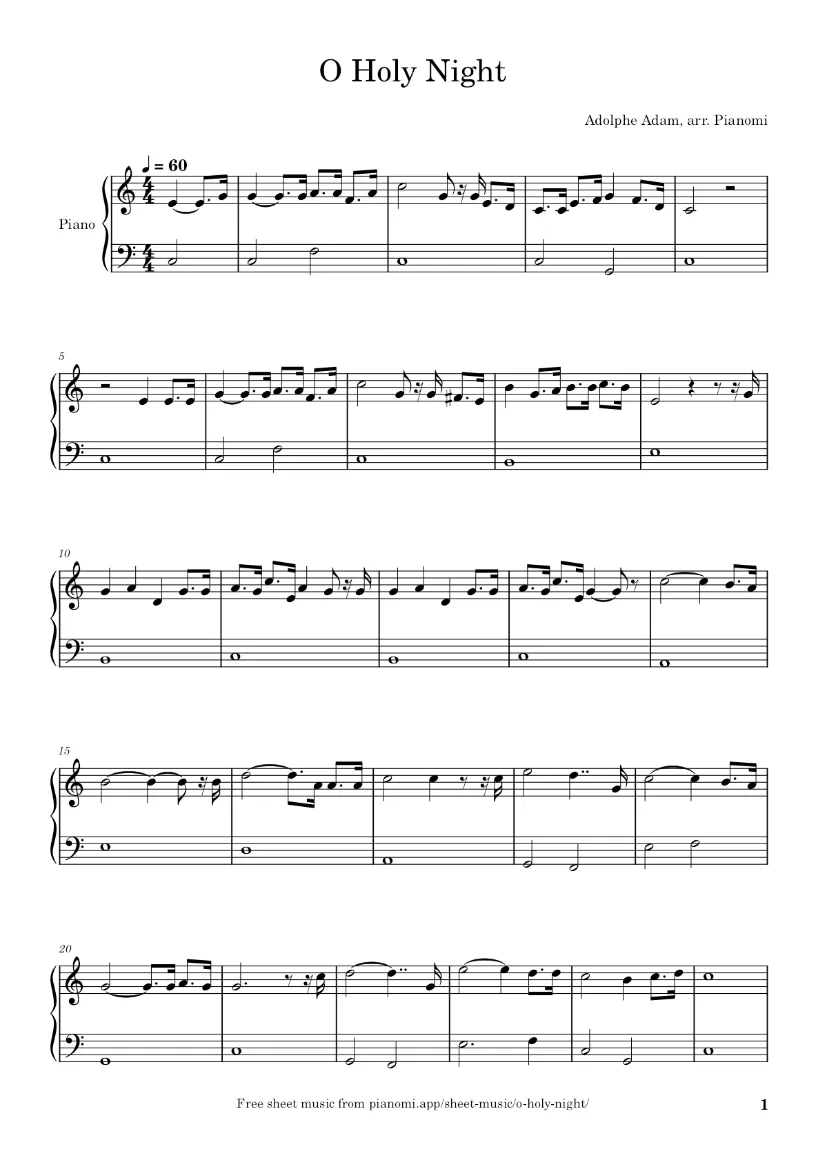
O Holy Night letter notes
The tune’s notes by name, bar by bar (the right hand’s top line), bars 0–13. ♯ is a sharp, ♭ a flat: play the black key just above or below.
- E G
- G G A A F A
- C G G E D
- C C E F G F D
- C
- E E E
- G G A A F A
- C G G F♯ E
- B G A B B C B
- E G
- G A D G G
- A G C E A G G
- G A D G G
- A G C E G
The names alone leave out the rhythm and the left hand: the music above has both, and the score with note names prints every note’s name under it.
About O Holy Night
In 1847 the parish priest of Roquemaure, a small town in the south of France, asked a local poet, Placide Cappeau, for a Christmas poem to mark the church’s restored stained glass. Cappeau wrote Minuit, chrétiens (Midnight, Christians), and Adolphe Adam, the composer of the ballet Giselle, set it to music within days. It was first sung at Midnight Mass in Roquemaure that Christmas. The English words most people sing, “O holy night, the stars are brightly shining”, are by the American minister and music critic John Sullivan Dwight, from 1855.
This arrangement follows the tune as G. Schirmer printed it in New York in 1871, in C major, and was checked against a printing from 1900. The singer’s grace notes are left out. It’s 26 bars counting the pick-up, slow and singing, in 4/4: the right hand stays between middle C and the E an octave and a third above it, and the left hand mostly holds one low note a bar.
How hard is O Holy Night?
It’s the hardest of the carols here, though still within reach of a beginner who has met sixteenth notes. The left hand is easy; the right hand’s dotted rhythms, and holding a slow tempo steady, are what take practice.
It reads like level 40 of 44, “Sixteenth notes”: grade 2 to 3 in graded exams’ sight reading, roughly. Its hands, chords and rhythm read like level 40, sixteenth notes. On top of that: rests, moving out of position and left-hand jumps. Practise reading at that level with the free sight-reading exercises.
How to practise it
The tune moves in sixteenth notes, so count four to a beat, “1 e and a”, and keep the speed slow, about 60 quarter notes a minute. Most beats are a dotted eighth and a sixteenth: the short note falls on the “a” and leads into the next beat. In bars 3, 8, 10 and 12 that short note is the same key played again: lift and strike it, don’t hold it over.
Bar 7 has the only sharp, F sharp, on the way to the climb of bar 8. In bars 10 and 12 the tune drops from A to D and leaps back up to G: keep your hand over the five keys from D to A, thumb on D, and the leap is only a stretch.
The refrain, “Fall on your knees”, starts on the long high C in bar 14 and climbs, to D in bar 16 and to E in bar 18, the top of the piece. Give the long notes their full length while the left hand changes under them. Learn the left hand alone first: one or two long notes a bar, on the white keys from F up to the F an octave higher, all below middle C.
The score
- Composer
- Adolphe Adam
- Key
- C major
- Time
- 4/4
- Tempo
- ♩ = 60
- Length
- 26 bars, about 1½ minutes with its repeats
- Range
- F2 to E5
Arranged for piano by Pianomi, from a tune in the public domain.