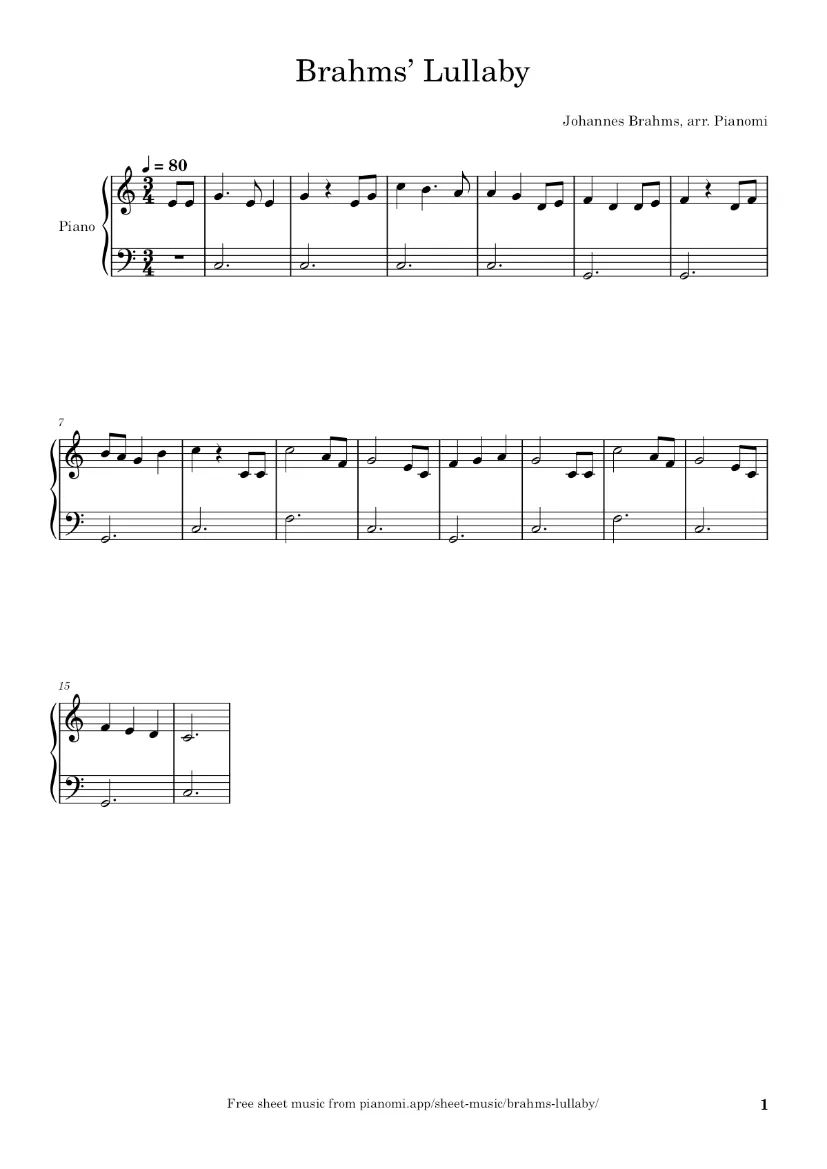
Brahms’ Lullaby letter notes
The tune’s notes by name, bar by bar (the right hand’s top line), bars 0–16. ♯ is a sharp, ♭ a flat: play the black key just above or below.
- E E
- G E E
- G E G
- C B A
- A G D E
- F D D E
- F D F
- B A G B
- C C C
- C A F
- G E C
- F G A
- G C C
- C A F
- G E C
- F E D
- C
The names alone leave out the rhythm and the left hand: the music above has both, and the score with note names prints every note’s name under it.
About Brahms’ Lullaby
Johannes Brahms wrote his Wiegenlied (“cradle song”), Op. 49 No. 4, for voice and piano, and Simrock in Berlin published it in 1868, the fourth of his Five Songs, Op. 49. It’s headed “An B. F. in Wien”, to B. F. in Vienna: Bertha Faber, for the birth of her son. The words of its first verse, beginning “Guten Abend, gut’ Nacht”, come from the folk-song collection Des Knaben Wunderhorn. The first edition has only that verse; later prints add a second.
In the song the voice sings the tune, marked Zart bewegt, “gently moving”, over a rocking piano part and a low held bass note. This arrangement is Pianomi’s own: the voice part as the 1868 print has it, a minor third lower, in C major rather than E♭, so there are no flats. The two small grace notes in bars 12 and 15 are left out, and the last C is held. The left hand plays one note a bar on the song’s chords: C, G and F. No words are printed here.
How hard is Brahms’ Lullaby?
No: it’s slow, it stays within an octave, from middle C to the C above, and it has no black keys. The left hand plays one note a bar. The rests and the eighth-note pick-ups are the things to count.
It reads like level 31 of 44, “Rests”: grade 1 to 2 in graded exams’ sight reading, roughly. Its hands, chords and rhythm read like level 13, eighth notes. On top of that: rests, dotted rhythms and moving out of position. Practise reading at that level with the free sight-reading exercises.
How to practise it
The tune starts on a pick-up: two Es, “Gu-ten”, on the last beat, then G on the first beat of bar 1. Count “1, 2, 3” in every bar and let the pairs of eighth notes fall evenly. Watch the rests in bars 2, 6 and 8: a beat of silence each, where the singer breathes.
At the end of bar 8 the tune drops to middle C, then climbs back to the high C, held for two beats, in bars 9 and 13. Bars 13 and 14 are bars 9 and 10 again; then the tune steps down F, E, D to end on middle C. There are no black keys at all. The left hand plays C, G and F, one note a bar: learn it alone, then put the hands together slowly and play softly.
The score
- Composer
- Johannes Brahms (1833–1897)
- Key
- C major
- Time
- 3/4
- Tempo
- ♩ = 80
- Length
- 17 bars, under a minute with its repeats
- Range
- G2 to C5
Arranged for piano by Pianomi, from a tune in the public domain.