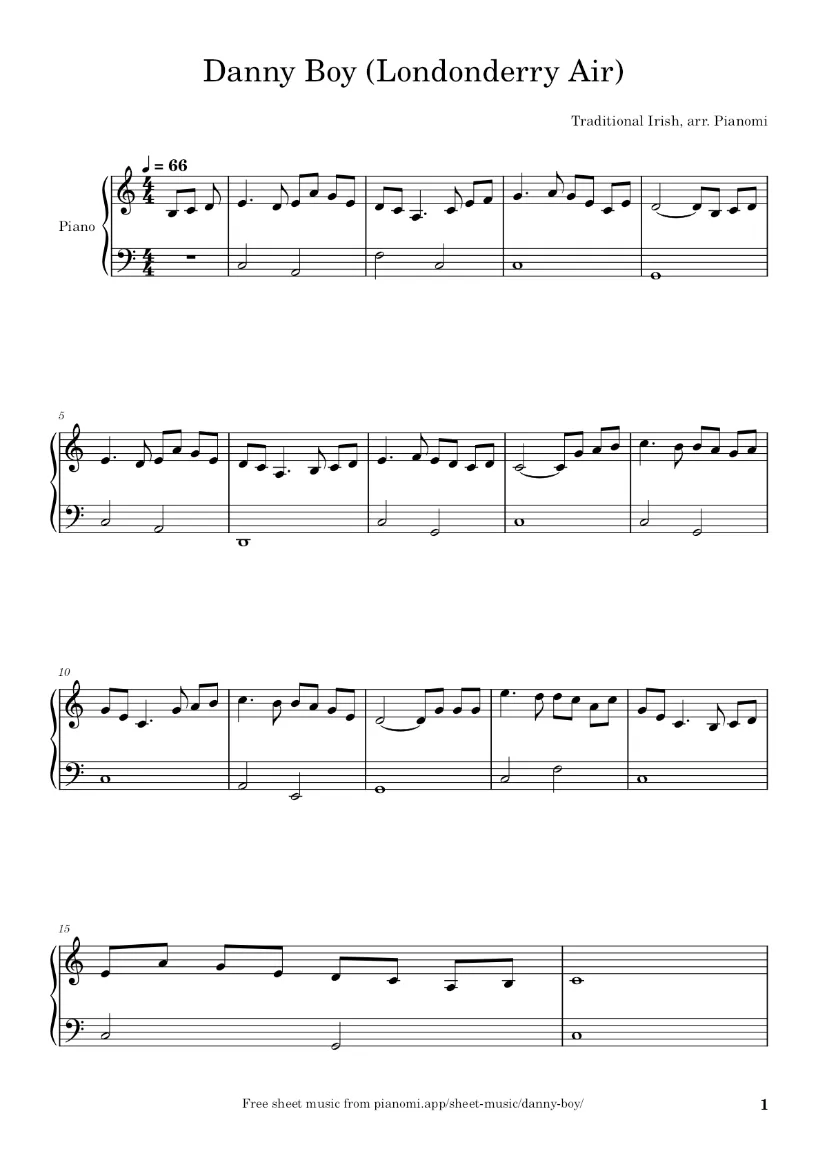
Danny Boy (Londonderry Air) letter notes
The tune’s notes by name, bar by bar (the right hand’s top line), bars 0–16. ♯ is a sharp, ♭ a flat: play the black key just above or below.
- B C D
- E D E A G E
- D C A C E F
- G A G E C E
- D B C D
- E D E A G E
- D C A B C D
- E F E D C D
- C G A B
- C B B A G A
- G E C G A B
- C B B A G E
- D G G G
- E D D C A C
- G E C B C D
- E A G E D C A B
- C
The names alone leave out the rhythm and the left hand: the music above has both, and the score with note names prints every note’s name under it.
About Danny Boy (Londonderry Air)
The air is traditional Irish, and nobody knows who made it. It was first printed in Dublin in 1855, in The Petrie Collection of the Ancient Music of Ireland, edited by George Petrie, without a name: Petrie headed it “Name unknown”. His note says it came from Miss J. Ross of Newtown Limavady, in County Londonderry, who had collected a great many of the county’s popular tunes that had never been published.
In 1913 Boosey & Co. published the song “Danny Boy” to it, with words by Fred. E. Weatherly, “adapted from an Old Irish Air”. This page has the air as it’s sung in “Danny Boy” (Boosey & Co., 1913), a tone lower than the song’s print in D major, in C, with the long notes at the ends of phrases held on. Petrie’s print differs in a few places: a turn in bar 6, an E for the A at the end of bar 9, and short rests where the song holds on. This arrangement is Pianomi’s own: the last C is held for the whole bar, and the left hand plays the roots of the chords. No words are printed here.
How hard is Danny Boy (Londonderry Air)?
No: it’s slow, it has no black keys, and the left hand plays long notes. The things to watch are the pick-ups that start each phrase, the held notes at their ends, and the climb to the high E in bar 13.
It reads like level 29 of 44, “Dotted rhythms”: grade 1 to 2 in graded exams’ sight reading, roughly. Its hands, chords and rhythm read like level 13, eighth notes. On top of that: dotted rhythms, moving out of position and left-hand jumps. Practise reading at that level with the free sight-reading exercises.
How to practise it
The air starts on a pick-up of three eighth notes, B, C, D, rising into the first beat, and every phrase after it starts the same way, on the last beat and a half of the bar before. Count “1 and 2 and 3 and 4 and”, play the pick-ups lightly and lean on the long note that follows: a dotted quarter at the start of bars 1, 3, 5, 7, 9, 11 and 13.
The first half stays low, between the A below middle C and the A above it. From bar 9 the tune climbs, and bar 13 reaches its top note, the E in the top space of the treble staff, before the last phrase comes home to middle C. The long notes at the ends of phrases, in bars 2, 4, 8, 10, 12 and 14, are held right up to the next pick-up: count them out. There are no black keys. The left hand plays one or two long notes a bar: learn it alone, then put the hands together slowly.
The score
- Composer
- Traditional Irish
- Key
- C major
- Time
- 4/4
- Tempo
- ♩ = 66
- Length
- 17 bars, about 1 minute with its repeats
- Range
- D2 to E5
Arranged for piano by Pianomi, from a tune in the public domain.