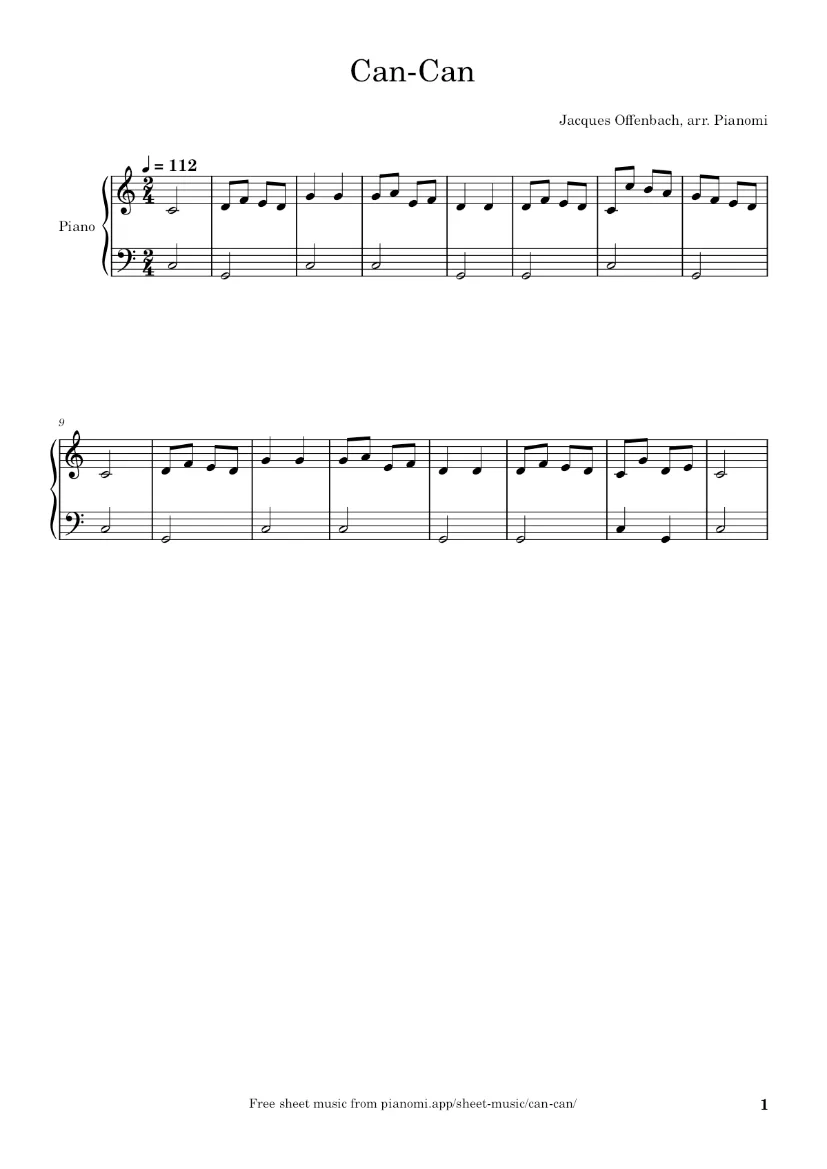
Can-Can letter notes
The tune’s notes by name, bar by bar (the right hand’s top line), bars 1–16. ♯ is a sharp, ♭ a flat: play the black key just above or below.
- C
- D F E D
- G G
- G A E F
- D D
- D F E D
- C C B A
- G F E D
- C
- D F E D
- G G
- G A E F
- D D
- D F E D
- C G D E
- C
The names alone leave out the rhythm and the left hand: the music above has both, and the score with note names prints every note’s name under it.
About Can-Can
The tune everyone knows as the can-can is the Galop infernal from Jacques Offenbach’s comic opera Orphée aux enfers (Orpheus in the Underworld), with words by Hector Crémieux and Ludovic Halévy, first staged at the Théâtre des Bouffes-Parisiens in Paris in 1858. Near the end the gods dance a wild galop in the underworld: the whole company sings “Ce bal est original, d’un galop infernal”, then “la la la” to the tune, while the orchestra plays it. When Offenbach revised the opera in 1874 as a four-act opéra-féerie, it came in Act IV, as “Menuet et Galop infernal”. Later it became the usual music for the can-can, the dance of the Paris music halls.
This arrangement is Pianomi’s own and follows the theme as the piano part of Heugel’s 1874 vocal score plays it, the orchestra’s line: two eight-bar halves that start alike, the first running down to D at the end of bar 8, the second coming home to C. It’s a tone lower than Offenbach’s D major, in C, and the last C is held where the score goes back to repeat. The left hand plays one note a bar, C or G, the roots of the score’s chords.
How hard is Can-Can?
No: the tune stays within an octave and the left hand plays one note a bar. What makes it a little harder is the speed: steady eighth notes all the way through, and the octave leap in bar 7. Learn it slowly first.
It reads like level 28 of 44, “Changing positions”: grade 1 to 2 in graded exams’ sight reading, roughly. Its hands, chords and rhythm read like level 13, eighth notes. On top of that: moving out of position. Practise reading at that level with the free sight-reading exercises.
How to practise it
Each half starts on a C held for the whole bar, then runs of four eighth notes: D, F, E, D, then two Gs, then G, A, E, F. Count “1 and 2 and” in every bar and keep the eighth notes even and light. In bar 7 the tune leaps an octave, from middle C to the C above, and runs down B, A, G, F, E, D.
The right hand stays between middle C and the C above, with no black keys, and moves only for the leap in bar 7. The left hand has just two notes, the C below middle C and the G below that, both of them in bar 15. Learn it alone, then put the hands together at a slow, even tempo, and speed up only when every bar is steady: the galop is fast.
The score
- Composer
- Jacques Offenbach
- Key
- C major
- Time
- 2/4
- Tempo
- ♩ = 112
- Length
- 16 bars, under a minute with its repeats
- Range
- G2 to C5
Arranged for piano by Pianomi, from a tune in the public domain.