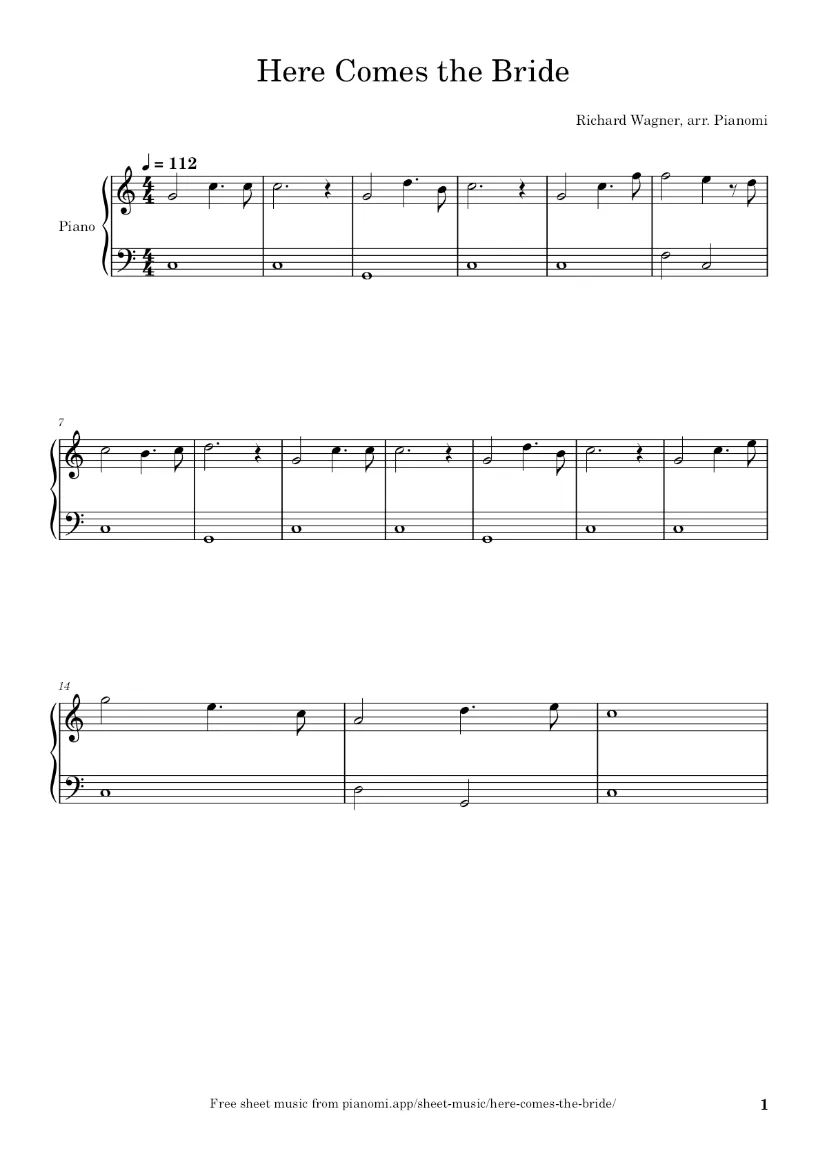
Here Comes the Bride letter notes
The tune’s notes by name, bar by bar (the right hand’s top line), bars 1–16. ♯ is a sharp, ♭ a flat: play the black key just above or below.
- G C C
- C
- G D B
- C
- G C F
- F E D
- C B C
- D
- G C C
- C
- G D B
- C
- G C E
- G E C
- A D E
- C
The names alone leave out the rhythm and the left hand: the music above has both, and the score with note names prints every note’s name under it.
About Here Comes the Bride
The tune is the Bridal Chorus from Richard Wagner’s opera Lohengrin, first performed in Weimar in 1850, conducted by Franz Liszt. It comes at the start of Act III, in the bridal chamber: the music is first heard from a distance and comes nearer as the doors open, the ladies leading in Elsa and the King and nobles leading in Lohengrin. Its German first line is “Treulich geführt ziehet dahin”; the English words “Here comes the bride” are a popular rhyme, not Wagner’s.
It became the usual music for the bride’s entrance at weddings in English-speaking countries. Mendelssohn’s Wedding March, on a page of its own, is the one usually played as the couple leave.
This arrangement is Pianomi’s own and follows the sopranos’ tune as two vocal scores print it, G. Schirmer’s (New York, 1897) and Theodor Uhlig’s (Vienna, 1912), a tone higher than Wagner’s B♭ major, in C. Wagner writes it in 2/4; here it’s in 4/4 with every note twice as long, so there are no sixteenth notes. The four bars the orchestra plays before the voices come in are left out, and the last C is held. The left hand plays the roots of the chords. No words are printed here.
How hard is Here Comes the Bride?
No: it’s slow and steady, the tune stays within an octave, from the G above middle C to the G above that, with no black keys, and the left hand plays long notes. Count the rests in the even bars and the long-short rhythm.
It reads like level 31 of 44, “Rests”: grade 1 to 2 in graded exams’ sight reading, roughly. Its hands, chords and rhythm read like level 13, eighth notes. On top of that: rests, dotted rhythms and moving out of position. Practise reading at that level with the free sight-reading exercises.
How to practise it
The tune opens with a leap of a perfect fourth, from G up to C, “Treu-lich”. Every odd-numbered bar, and bar 14, has the same rhythm: a half note, then a dotted quarter and an eighth, counted “1, 2, 3, 4 and”, with the eighth on the last “and”. Bars 2, 4, 8, 10 and 12 hold a long note for three beats, then rest for one: lift the hand there, as the singers breathe.
Bar 6 is the one different bar: F, E, an eighth rest, then D. Bars 9 to 12 are bars 1 to 4 again; then bars 13 and 14 climb to the high G, the top of the tune, and bar 15 comes down to A before the last C. The left hand plays mostly C and G, with F in bar 6 and D in bar 15: learn it alone, then put the hands together slowly.
The score
- Composer
- Richard Wagner
- Key
- C major
- Time
- 4/4
- Tempo
- ♩ = 112
- Length
- 16 bars, under a minute with its repeats
- Range
- G2 to G5
Arranged for piano by Pianomi, from a tune in the public domain.