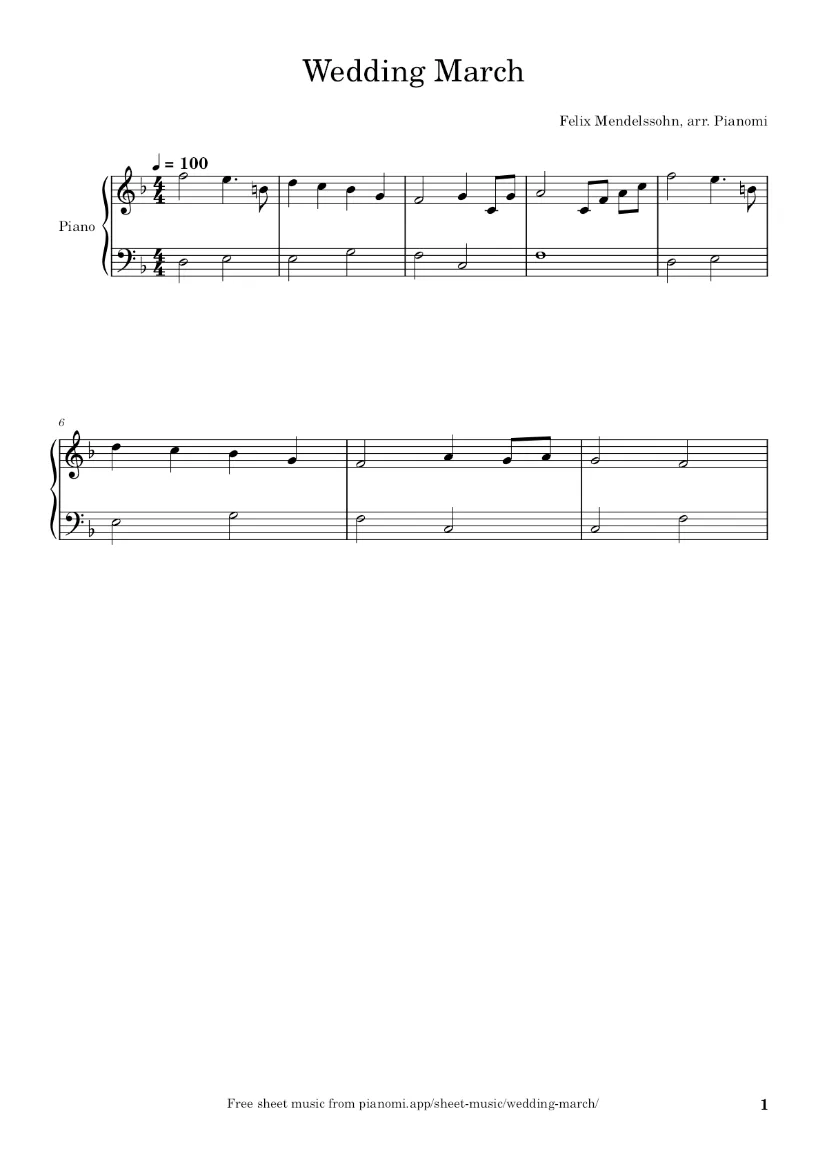
Wedding March letter notes
The tune’s notes by name, bar by bar (the right hand’s top line), bars 1–8. ♯ is a sharp, ♭ a flat: play the black key just above or below.
- F E B
- D C B♭ G
- F G C G
- A C F A C
- F E B
- D C B♭ G
- F A G A
- G F
The names alone leave out the rhythm and the left hand: the music above has both, and the score with note names prints every note’s name under it.
About Wedding March
Felix Mendelssohn wrote the Wedding March in 1842 as part of his music for Shakespeare’s play A Midsummer Night’s Dream, Op. 61, first performed in Potsdam in 1843. It opens with a fanfare of repeated notes, then the famous theme. Victoria, the Princess Royal, Queen Victoria’s eldest daughter, chose it for her wedding in 1858, and it became a favourite at weddings, where it’s usually played as the couple leave. For the bride’s entrance the usual music is Wagner’s Here Comes the Bride, on a page of its own.
This arrangement is Pianomi’s own. It follows the theme as two American piano editions print it (J. F. Browne, New York, 1854, and F. Trifet, Boston, 1896), moved down a fifth from Mendelssohn’s C major into F major, so the tune never climbs above the treble staff. The fanfare is left out, and so are the trills on the long notes in bars 3 and 7; the dotted rhythms in those bars are two even eighth notes, the run up in bar 4 starts from its third note, and the last F is held. The left hand plays the roots of the chords.
How hard is Wedding March?
No: it’s eight bars, and the left hand plays long notes. The high start, the B natural in bars 1 and 5 and the run up in bar 4 are the things to practise.
It reads like level 30 of 44, “Accidentals”: grade 1 to 2 in graded exams’ sight reading, roughly. Its hands, chords and rhythm read like level 13, eighth notes. On top of that: accidentals, dotted rhythms, moving out of position and one flat. Practise reading at that level with the free sight-reading exercises.
How to practise it
The tune starts high, on the F at the top of the treble staff, held for two beats, then E and a quick B: the key has one flat, B♭, but the B in bars 1 and 5 is B natural, marked in the music. Bars 2 and 6 step down D, C, B♭, G, a quarter note each. Count four beats in every bar and keep the march steady.
In bars 3 and 7 the tune comes down to the F above middle C, held for two beats. Bar 4 runs up the F major chord in eighth notes, middle C, F, A, C, to lead back to the high F in bar 5: practise that run on its own. The left hand plays two notes in most bars, on D, E, F, G and C, all on the bass staff: learn it alone, then put the hands together slowly.
The score
- Composer
- Felix Mendelssohn (1809–1847)
- Key
- F major
- Time
- 4/4
- Tempo
- ♩ = 100
- Length
- 8 bars, under a minute with its repeats
- Range
- C3 to F5
Arranged for piano by Pianomi, from a tune in the public domain.