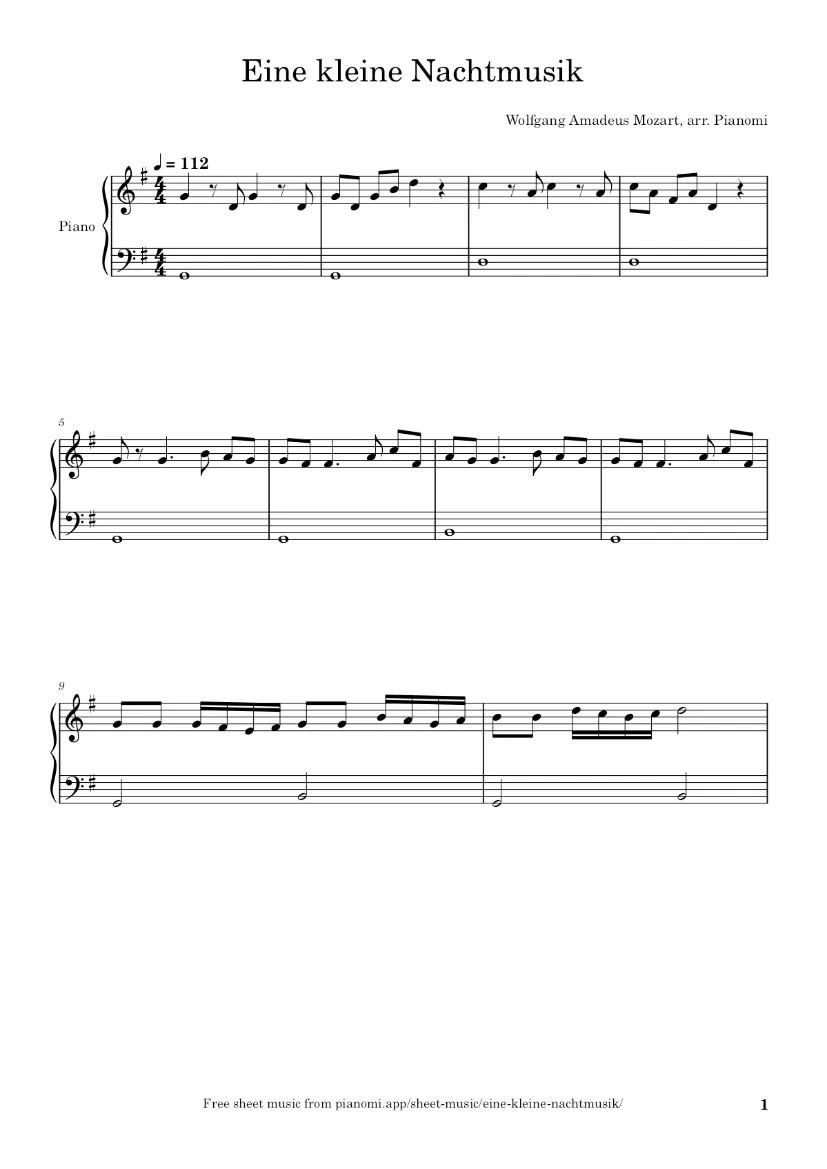
Eine kleine Nachtmusik letter notes
The tune’s notes by name, bar by bar (the right hand’s top line), bars 1–10. ♯ is a sharp, ♭ a flat: play the black key just above or below.
- G D G D
- G D G B D
- C A C A
- C A F♯ A D
- G G B A G
- G F♯ F♯ A C F♯
- A G G B A G
- G F♯ F♯ A C F♯
- G G G F♯ E F♯ G G B A G A
- B B D C B C D
The names alone leave out the rhythm and the left hand: the music above has both, and the score with note names prints every note’s name under it.
About Eine kleine Nachtmusik
Mozart finished his Serenade No. 13 in G major, K. 525, in Vienna in August 1787 and entered it in his own list of works as “Eine kleine Nacht-Musik”, a little serenade. It’s for strings, in four movements, and nobody knows what it was written for. It was published only in 1827, long after his death, and is now among his best-known pieces.
The first movement opens with the whole orchestra playing the same notes: G and D, up and down the G major chord, then the same shape on the D chord. This arrangement is the first ten bars, the first violins’ tune at their own pitch, up to the end of the opening theme. The trills in bars 6 and 8 are left out, and the last D is held. The left hand plays long notes on the chords: G, D and B.
How hard is Eine kleine Nachtmusik?
It’s a little harder than a first piece: the rests in the opening and the sixteenth notes in bars 9 and 10 need careful counting. The notes themselves stay within an octave, and the left hand plays long notes. The whole movement, as Mozart wrote it, is much harder.
It reads like level 40 of 44, “Sixteenth notes”: grade 2 to 3 in graded exams’ sight reading, roughly. Its hands, chords and rhythm read like level 40, sixteenth notes. On top of that: rests, dotted rhythms, moving out of position and one sharp. Practise reading at that level with the free sight-reading exercises.
How to practise it
Bars 1 to 4 are short, crisp notes with rests between them: G, D, G, D, then up the chord to D, and the same on C and A. Count the rests, so the first beat of each bar lands on time. In bars 5 to 8 each bar has the same shape: one or two quick notes, a long one, then three quick notes.
Bars 9 and 10 have sixteenth notes, four to a beat: G, F♯, E, F♯ and B, A, G, A, then D, C, B, C. Practise them slowly, saying “one-e-and-a”, and let your fingers stay close to the keys. The key has one sharp: every F is F♯. The left hand plays one note a bar, two in the last bars: learn it alone first.
The score
- Composer
- Wolfgang Amadeus Mozart (1756–1791)
- Key
- G major
- Time
- 4/4
- Tempo
- ♩ = 112
- Length
- 10 bars, under a minute with its repeats
- Range
- G2 to D5
Arranged for piano by Pianomi, from a tune in the public domain.