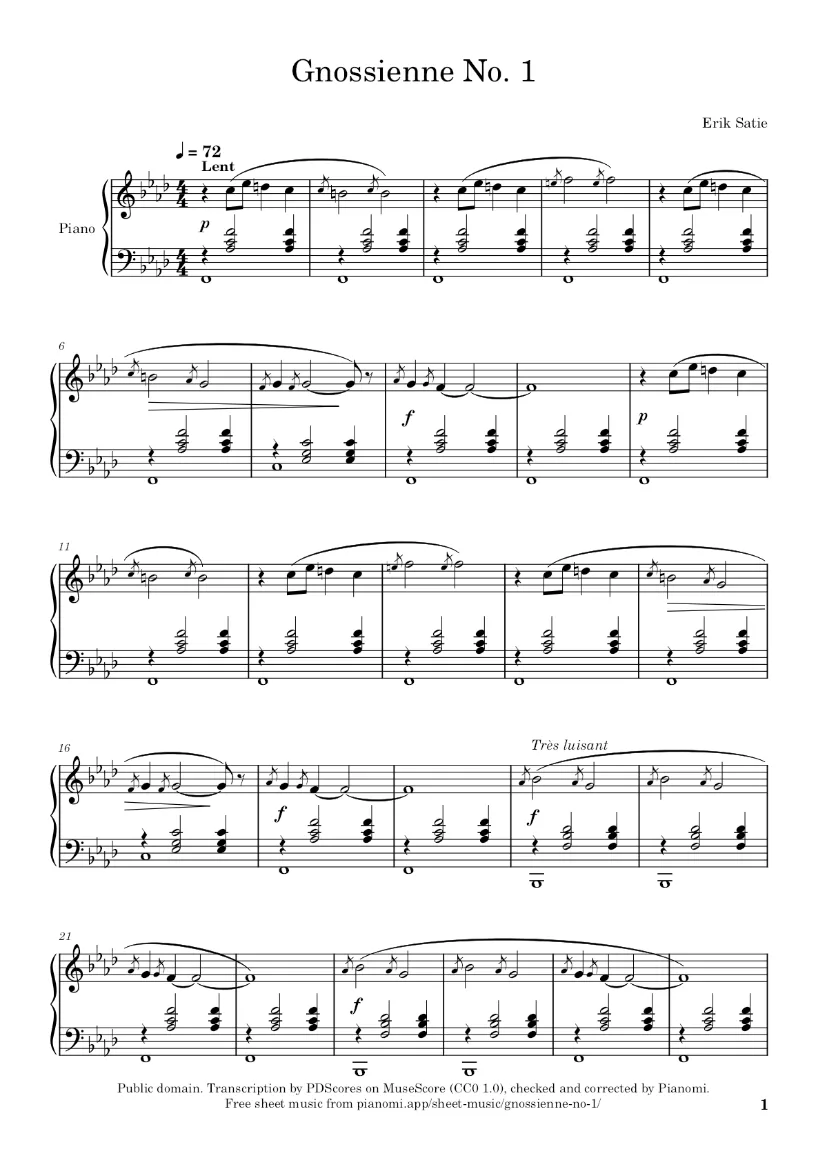
Gnossienne No. 1 letter notes
The tune’s notes by name, bar by bar (the right hand’s top line), bars 1–8. ♯ is a sharp, ♭ a flat: play the black key just above or below.
- C E♭ D C
- B B
- C E♭ D C
- F F
- C E♭ D C
- B G
- G G
- G F
The names alone leave out the rhythm and the left hand: the music above has both, and the score with note names prints every note’s name under it.
About Gnossienne No. 1
Satie wrote it in 1890, but the three Gnossiennes were printed only in 1913, by Rouart, Lerolle and Co. in Paris. This one is dedicated to the composer Roland-Manuel. Satie made up the word gnossienne, and nobody knows for certain what he meant by it: one idea is Knossos, the ancient palace on Crete.
He wrote it without barlines or a time signature. The music still moves in groups of four beats, each starting on the left hand’s low note, so this edition draws a barline every four beats, to make it easier to read and to practise a few bars at a time. The notes are exactly as printed in 1913.
In place of the usual Italian words, Satie wrote odd advice in French above the music: Très luisant (very gleaming), Questionnez (ask questions), Du bout de la pensée (with the tip of your thought), Postulez en vous-même (postulate within yourself), Pas à pas (step by step) and Sur la langue (on the tongue). They can’t be followed like a tempo mark: take them as the mood of each phrase.
How hard is Gnossienne No. 1?
It’s one of the easier pieces of its kind to make sound good: the left hand repeats and the tune moves mostly by step. The grace notes and the accidentals make it harder to read than it sounds, an early intermediate piece.
At sight, it’s harder to read than all 44 of Pianomi’s sight-reading levels, which end at about grade 3 sight reading, at gentle tempos. What takes it past them: big jumps. On top of that: 4 flats, rests, accidentals, moving out of position, chords with sharps or flats and left-hand jumps.
How to practise it
The left hand hardly changes: a low F on the first beat, then a soft chord of A♭, C and F on the second and fourth. Learn it until it runs by itself, quietly, with the jump from the bass to the chord made without looking. In the Très luisant phrase from bar 19 the bass drops to a low B♭, a wider jump.
The tune is full of grace notes, small notes just before the main one. Play each lightly and quickly and land on the main note. The run of eighths in bar 27, C, D, E, F, G, B and G, brings naturals into a key of four flats: read it slowly at first, and again where it returns in bars 33, 63 and 69.
Satie’s only tempo word is Lent, slow. Keep the beat steady through the long notes, and change the pedal with each bass note so the grace notes don’t blur.
The score
- Composer
- Erik Satie (1866–1925)
- Written
- 1890
- Key
- F minor
- Time
- 4/4
- Tempo
- Lent, ♩ = 72
- Length
- 81 bars, about 4½ minutes with its repeats
- Range
- A♯1 to B5
Transcribed by PDScores on MuseScore and given to the public domain (CC0 1.0). We compared every note with other transcriptions and early editions and corrected it where it was wrong.