Canon in D letter notes
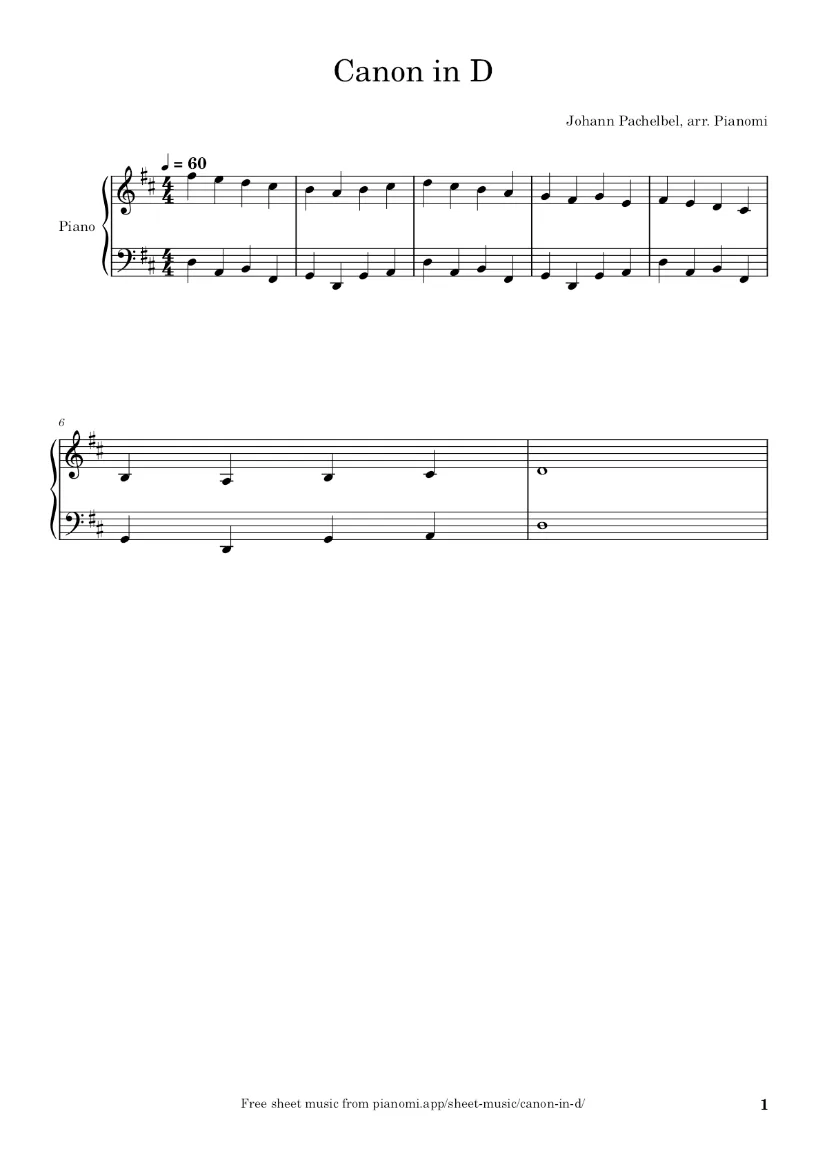
The tune’s notes by name, bar by bar (the right hand’s top line), bars 1–7. ♯ is a sharp, ♭ a flat: play the black key just above or below.
- F♯ E D C♯
- B A B C♯
- D C♯ B A
- G F♯ G E
- F♯ E D C♯
- B A B C♯
- D
The names alone leave out the rhythm and the left hand: the music above has both, and the score with note names prints every note’s name under it.
About Canon in D
The German organist Johann Pachelbel (1653–1706) wrote his Canon in D for three violins and a bass line, with a gigue to follow it. Nobody knows when or for whom: the oldest copy is from around 1840, and it was first printed only in 1919. A recording by Jean-François Paillard’s chamber orchestra in 1968 made it widely known.
The whole canon is built on a bass of eight notes, D, A, B, F♯, G, D, G, A, played 28 times while the three violins play the same music, each two bars behind the one before. This arrangement is its very beginning: the bass line three times in the left hand, and in the right hand the first violin’s first two lines, then the first line again an octave lower, ending on D.
How hard is Canon in D?
This arrangement is short and slow, and fine for a beginner who has played a few pieces with both hands. The hands move together on every beat, and the left hand moves around more than in most first pieces. The whole Canon, with its quick variations, is an intermediate piece on the piano.
It reads like level 32 of 44, “Keys of D and B♭”: early grade 2 in graded exams’ sight reading, roughly. Its hands, chords and rhythm read like level 10, busy left hand. On top of that: 2 sharps and moving out of position. Practise reading at that level with the free sight-reading exercises.
How to practise it
Learn the left hand first, because it’s the harder hand: a note on every beat, leaping around the same eight notes. Say their names as you play until it runs by itself. The right hand moves mostly by step, downwards, and plays its first line again an octave lower in bars 5 and 6, so move your hand down for it. The key has two sharps: every F is F♯ and every C is C♯.
Put the hands together a bar at a time: they play together on every beat, a note each. Keep it slow, smooth and calm, which is how it sounds best. The whole Canon goes on from here into quicker and quicker variations over the same bass, a much longer and harder piece.
The score
- Composer
- Johann Pachelbel
- Key
- D major
- Time
- 4/4
- Tempo
- ♩ = 60
- Length
- 7 bars, under a minute with its repeats
- Range
- D2 to F♯5
Arranged for piano by Pianomi, from a tune in the public domain.