About Chopsticks
Chopsticks began as The Celebrated Chop Waltz, written by Euphemia Allan when she was sixteen and published in 1877 by her brother, the music publisher Mozart Allan, under the name Arthur de Lulli. Its title page asked for it to be played with both hands held sideways, little fingers down, striking the keys with a chopping movement: that’s where the name comes from.
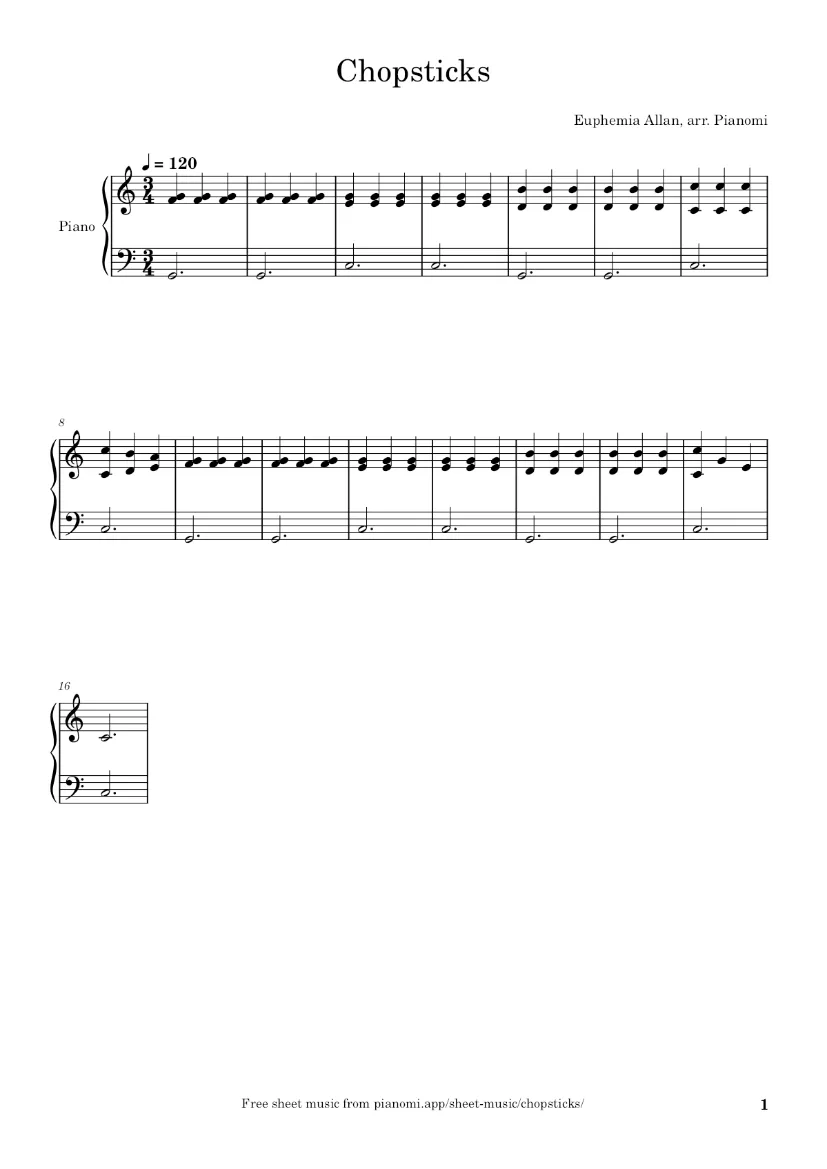
The waltz goes on to other parts, but its first part is the one everyone knows: pairs of notes, three to a bar, that slide down from F and G to an octave C. This arrangement is that first part, as the 1877 print has it, an octave lower (the print itself says to play it lower on the accordion). The left hand plays one note a bar, the G or the C under the chord.
How hard is Chopsticks?
No: it’s a first piece for many people, and the left hand plays one note a bar. The octave in bars 7, 8 and 15 is the one stretch; a small hand can play the two Cs with both hands, the way Chopsticks is often played.
It reads like level 18 of 44, “Right-hand intervals”: about grade 1 in graded exams’ sight reading, roughly. Its hands, chords and rhythm read like level 18, right-hand intervals. On top of that: moving out of position. The hardest bar is 16. Practise reading at that level with the free sight-reading exercises.
How to practise it
The right hand plays two notes together on every beat. Bars 1 and 2 are F and G, bars 3 and 4 E and G, bars 5 and 6 D and B: the lower note steps down while the upper note stays or moves up. In bar 7 the hand opens to an octave, middle C and the C above, and bar 8 closes it again, C and C, D and B, E and A. Practise each pair as one shape, and keep the wrist loose so the notes bounce.
Bars 9 to 14 are bars 1 to 6 again, and the waltz ends with the octave C, then G and E, down to middle C. The left hand has only two notes: the G below the C under middle C, and that C. Change between them every two bars, on the first beat. Count “1, 2, 3” in every bar and keep the beats even: the print marks it staccato, short and light.
The score
- Composer
- Euphemia Allan
- Key
- C major
- Time
- 3/4
- Tempo
- ♩ = 120
- Length
- 16 bars, under a minute with its repeats
- Range
- G2 to C5
Arranged for piano by Pianomi, from a tune in the public domain.