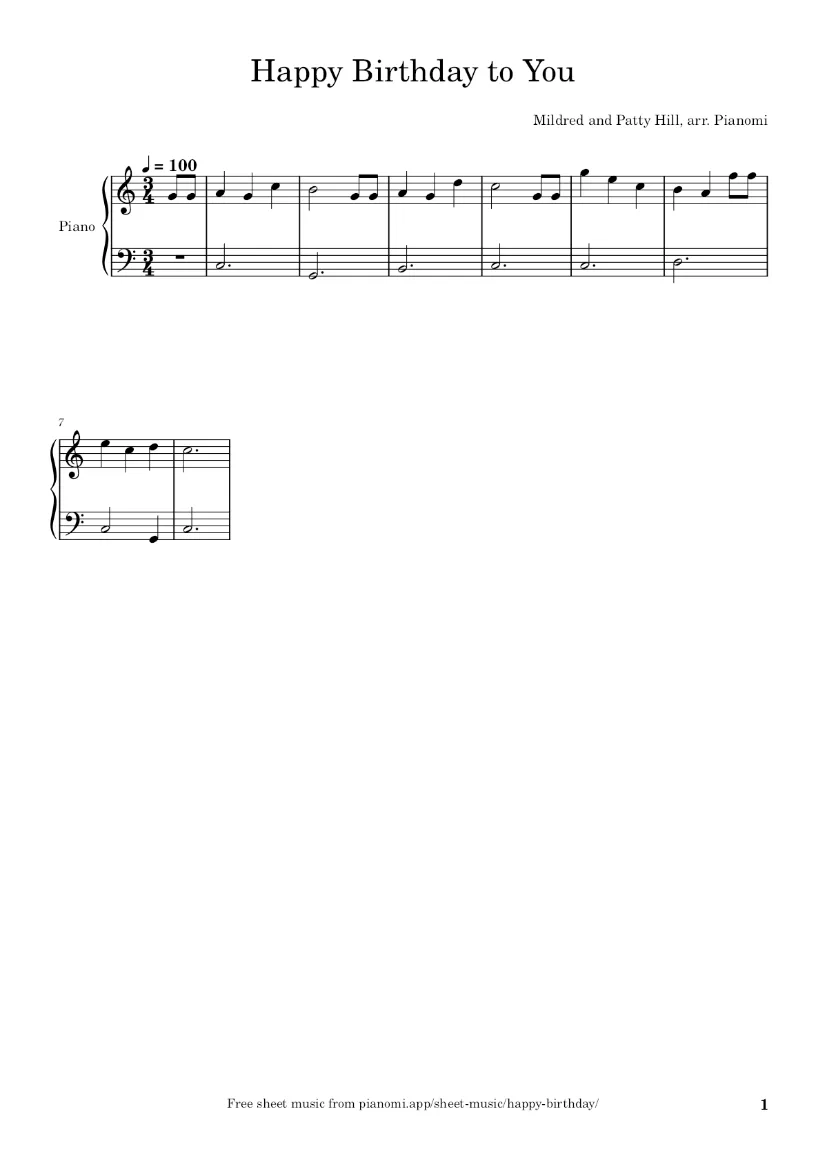
Happy Birthday to You letter notes
The tune’s notes by name, bar by bar (the right hand’s top line), bars 0–8. ♯ is a sharp, ♭ a flat: play the black key just above or below.
- G G
- A G C
- B G G
- A G D
- C G G
- G E C
- B A F F
- E C D
- C
The names alone leave out the rhythm and the left hand: the music above has both, and the score with note names prints every note’s name under it.
About Happy Birthday to You
The tune is older than the words. It comes from Good Morning to All, a song by the sisters Mildred and Patty Hill of Louisville, Kentucky, published in 1893 in their book Song Stories for the Kindergarten: Patty ran a kindergarten, and Mildred was a pianist. Birthday words were sung to it by the early 1900s, and the two appeared together in songbooks from 1912.
For decades a music publisher claimed the song was under copyright and charged for its use. In 2015 a US court ruled that the claim to the words wasn’t valid, and since 2016 the song has been free to use in the United States; in the European Union its copyright ran out at the start of 2017.
This arrangement is in C major. The pick-up, “Happy”, is written as two even eighth notes, as most easy books write it; it’s usually sung with the first a little longer than the second. The left hand plays one low note a bar on the chords under the tune.
How hard is Happy Birthday to You?
No: it’s eight bars, mostly by step. The one hard moment is the octave leap into bar 5. Practise the pick-up into bar 5 a few times on its own until you can find the high G without looking.
It reads like level 28 of 44, “Changing positions”: grade 1 to 2 in graded exams’ sight reading, roughly. Its hands, chords and rhythm read like level 13, eighth notes. On top of that: moving out of position. Practise reading at that level with the free sight-reading exercises.
How to practise it
The song starts before the first full bar: the two Gs are a pick-up, counted “3 and”. The first two lines go A, G and up: to C in bar 1, then to D in bar 3. The third leaps from its pick-up straight to the high G in bar 5, an octave above where you began, the biggest leap in the song.
For the leap, move the whole hand: play the pick-up Gs with your thumb, then jump so your fifth finger lands on the high G, and come down E, C, B, A. The last line goes F, E, C, D and home to C. Learn the left hand alone first, mostly the C below middle C with a few notes near it, then put the hands together slowly.
The score
- Composer
- Mildred and Patty Hill
- Key
- C major
- Time
- 3/4
- Tempo
- ♩ = 100
- Length
- 9 bars, under a minute with its repeats
- Range
- G2 to G5
Arranged for piano by Pianomi, from a tune in the public domain.