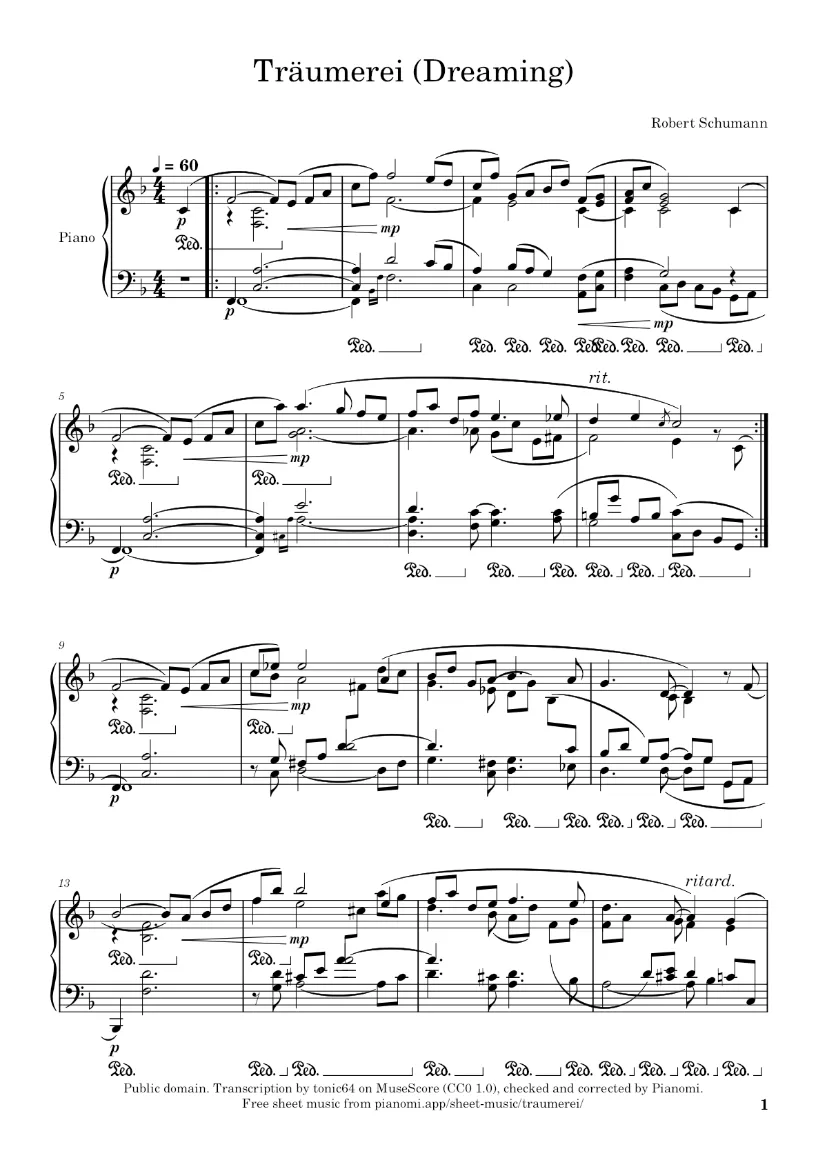
About Träumerei
Schumann wrote the thirteen pieces of Kinderszenen (Scenes from Childhood) in early 1838, and they were printed in 1839. He chose them from about thirty short pieces he had written. They look back on childhood rather than being written for children to play. Träumerei (Dreaming) is the seventh.
The tune is made of long lines in the top voice, with the inner notes of the chords moving under it and a slowly walking left hand. The opening idea returns at bars 5, 9, 17 and 21, each time leading somewhere new, and bar 22 holds a spread chord under a pause before the last phrase. Schumann’s own metronome mark is ♩ = 100, much faster than the slow tempo most pianists choose.
How hard is Träumerei?
The notes are simple, and a pianist in their second or third year can read them. The challenge is tone: singing a tune with inner voices in the same hand and keeping the whole piece soft and unhurried. It is an intermediate piece rather than an easy one.
It reads like level 34 of 44, “Syncopation”: early grade 2 in graded exams’ sight reading, roughly. Its hands, chords and rhythm read like level 33, waltz accompaniment. On top of that: syncopation, rests, accidentals, dotted rhythms, moving out of position, chords with sharps or flats, left-hand jumps and one flat. The hardest bars are 13 and 22. Practise reading at that level with the free sight-reading exercises.
How to practise it
Practise the voices apart. In the right hand the top voice sings while softer notes move below it, so a tune note is often held while the notes beneath it change. Play the top line alone first, then add the inner notes more softly, and listen for the tune above them.
The left hand has a walking line of its own (for example in bars 4 and 12). Hear it as a second voice, and use the pedal to join it to the right hand, changing it with each change of harmony.
Take your time at the pause in bar 22: let the spread chord ring before the last phrase. Keep the whole piece soft, and let the tune breathe at the end of each phrase.
The score
- Composer
- Robert Schumann (1810–1856)
- Catalogue
- Op. 15 No. 7
- Written
- 1838
- Key
- F major
- Time
- 4/4
- Tempo
- ♩ = 60
- Length
- 25 bars, about 2 minutes with its repeats
- Range
- A♯1 to A♯5
Transcribed by tonic64 on MuseScore and given to the public domain (CC0 1.0). We compared every note with other transcriptions and early editions and corrected it where it was wrong.