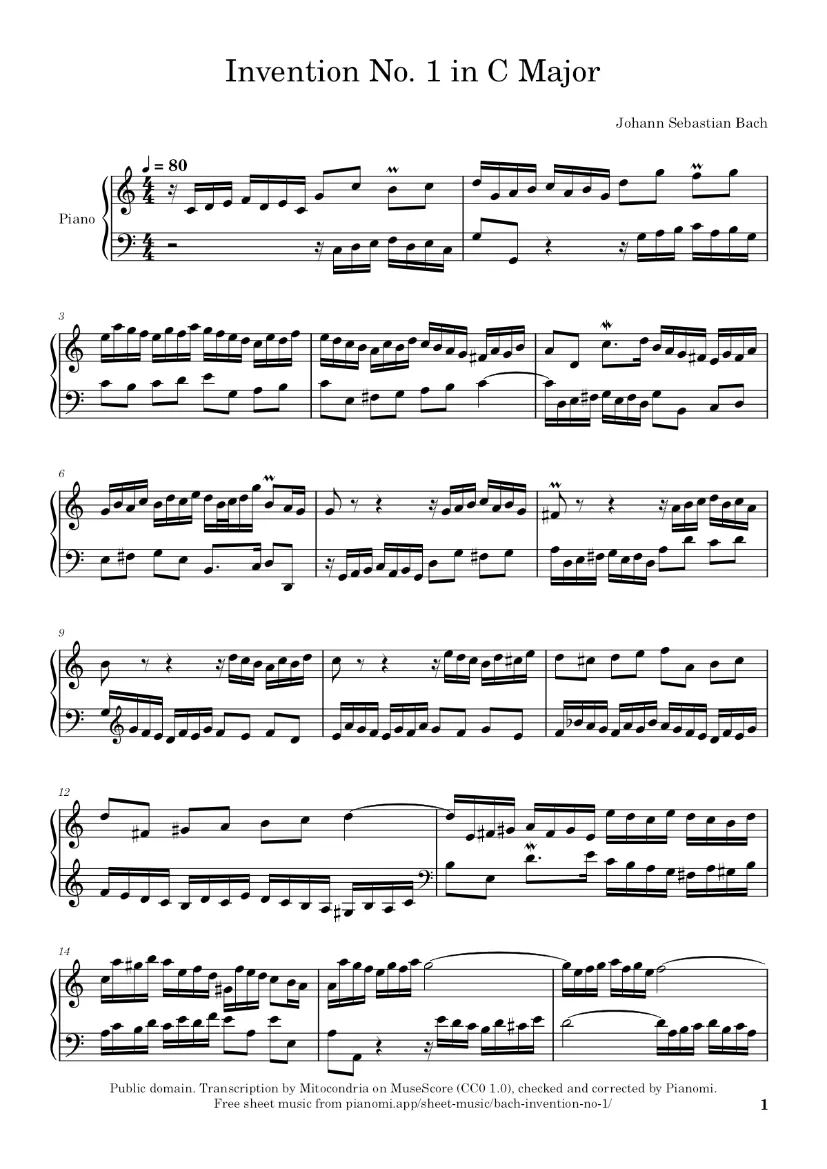
About Invention No. 1 in C Major, BWV 772
Bach wrote his two-part inventions to teach. Early versions are in the keyboard book he began in 1720 for his eldest son, Wilhelm Friedemann, and in 1723 he made a fair copy of all fifteen, together with fifteen pieces in three parts. Its title page says they show how to play two parts cleanly and, above all, how to play in a singing style.
Everything grows from the first bar: four notes stepping up and a little turn back, then a leap. The left hand answers with the same figure half a bar later. Bach turns the figure upside down in bar 3, passes it from hand to hand, reaches G major by bar 7 and A minor by bar 15, and comes home to C. In bars 15 to 18 the hands take turns, one holding a long note while the other plays the figure.
How hard is Invention No. 1 in C Major, BWV 772?
It’s the invention most pianists learn first, and an intermediate piece. The notes aren’t fast, but both hands are equal and each has to sound like its own melody, which takes slow practice. If you can play hands together comfortably and read both clefs, it’s a good place to start with Bach.
At sight, it’s harder to read than all 44 of Pianomi’s sight-reading levels, which end at about grade 3 sight reading, at gentle tempos. What takes it past them: busy hands together and big jumps. On top of that: rests, accidentals, moving out of position and left-hand jumps.
How to practise it
Learn each hand on its own until it sounds like a tune, then put them together slowly. Choose one way to play the figure, say the sixteenths smooth and the eighth notes a little detached, and keep it every time the figure comes, in either hand. Then the two voices answer each other clearly.
Keep the same fingering for the figure wherever you can. Watch bar 6, where the right hand has a quick group of thirty-second notes, and bars 11 and 12, where the left hand plays sixteenths in the treble clef while the right hand moves in eighth notes.
The ornaments are short decorations: prall trills in bars 1, 2, 6 and 8, and mordents in bar 5 and in the left hand in bar 13. Learn the notes without them first, then add them lightly.
The score
- Composer
- Johann Sebastian Bach (1685–1750)
- Catalogue
- BWV 772
- Written
- 1723
- Key
- C major
- Time
- 4/4
- Tempo
- ♩ = 80
- Length
- 22 bars, about 1 minute with its repeats
- Range
- C2 to C6
Transcribed by Mitocondria on MuseScore and given to the public domain (CC0 1.0). We compared every note with other transcriptions and early editions and corrected it where it was wrong.