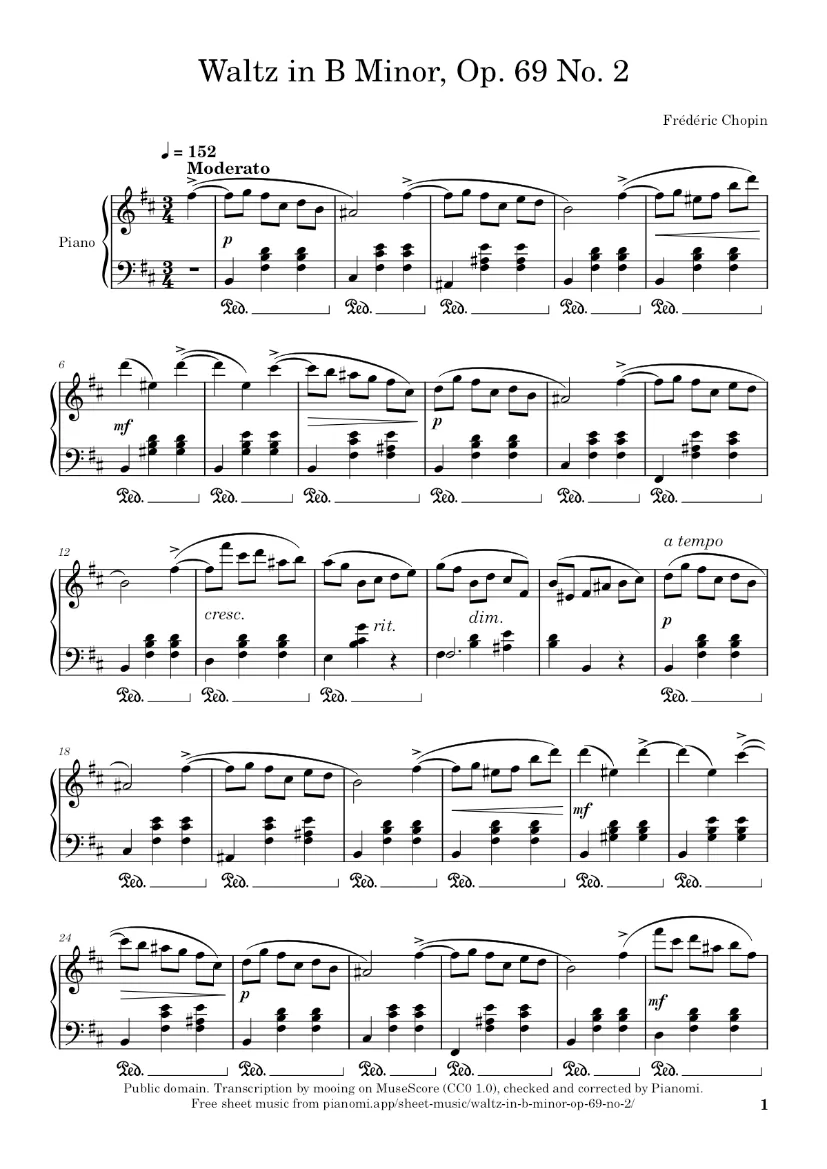
Waltz in B Minor, Op. 69 No. 2 letter notes
The tune’s notes by name, bar by bar (the right hand’s top line), bars 0–16. ♯ is a sharp, ♭ a flat: play the black key just above or below.
- F♯
- G F♯ C♯ D B
- A♯ F♯
- G F♯ C♯ E D
- B F♯
- G E♯ F♯ B D
- D E♯ D
- E C♯
- B A♯ G F♯ C♯
- D G F♯ C♯ D B
- A♯ F♯
- G F♯ C♯ E D
- B F♯
- F♯ C♯ D A♯ B
- A G B C♯ D E
- G F♯ B D C♯ F♯
- B E♯ F♯ A♯ B C♯
The names alone leave out the rhythm and the left hand: the music above has both, and the score with note names prints every note’s name under it.
About Waltz in B Minor, Op. 69 No. 2
Chopin wrote this waltz in 1829, in his late teens, and never published it. After he died in 1849, his friend Julian Fontana published it in 1855 with other pieces Chopin had left, although Chopin had asked that his unpublished music be burned. This page follows Fontana’s first edition, the text most pianists play. Chopin’s own manuscript of 1829 differs in many places.
It is in B minor, in 3/4, and marked Moderato. The left hand plays the waltz pattern: a bass note on the first beat and a chord on beats two and three. Over it the right hand plays a single line, starting with an upbeat. In the middle section, from bar 66, the music turns to B major and the tune brightens. It returns to B minor at bar 98, and the waltz ends where it began.
How hard is Waltz in B Minor, Op. 69 No. 2?
No. It is an intermediate piece: the right hand plays one note at a time and the left hand keeps a regular waltz pattern. The work is in the touch, the pedal and the gentle flexibility in the tune.
At sight, it’s harder to read than all 44 of Pianomi’s sight-reading levels, which end at about grade 3 sight reading, at gentle tempos. What takes it past them: Sixteenth notes. Its hands, chords and rhythm read like level 40, sixteenth notes. On top of that: 5 sharps, 2 sharps, rests, accidentals, dotted rhythms, moving out of position, chords with sharps or flats and left-hand jumps.
How to practise it
The tune needs no chords at all, so its challenge is shape and rhythm. It moves in short phrases that rise and fall in patterns repeated every two bars. Learn the first four bars until they feel like a sentence you could sing, with the last note of each phrase a little softer.
The left hand is the main work: a bass note, then a chord twice, with a leap of a fifth or more between them (bar 1: B up to the chord F♯, B, D). Practise it with the pedal, changing with each bass note, and keep the chords quiet. Keep the first beat steady while the right hand plays with a little give and take.
In bar 13 the right hand leaps up to a high F♯. Play it softly, without hitting it, and let the line come down again after it.
The score
- Composer
- Frédéric Chopin (1810–1849)
- Catalogue
- Op. 69 No. 2 (B. 35)
- Written
- 1829
- Key
- B minor
- Time
- 3/4
- Tempo
- Moderato, ♩ = 152
- Length
- 146 bars, about 3½ minutes with its repeats
- Range
- B1 to F♯6
Transcribed by mooing on MuseScore and given to the public domain (CC0 1.0). We compared every note with other transcriptions and early editions and corrected it where it was wrong.