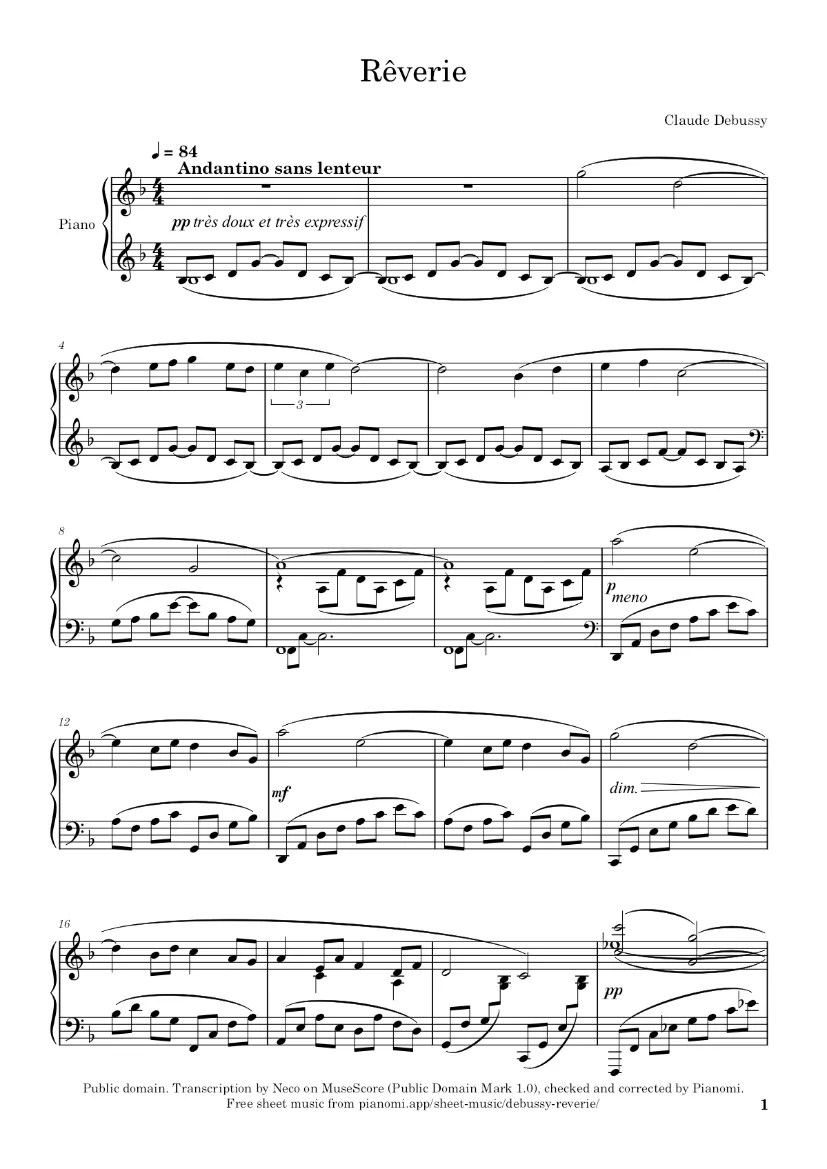
About Rêverie
Debussy wrote Rêverie in 1890, but it was printed only in 1905, by Fromont in Paris. By then he thought little of it: he reportedly told the publisher he regretted its appearing, as a piece written quickly and of no importance.
It’s in F major, marked Andantino sans lenteur (moving, without slowness) and très doux et très expressif (very soft and very expressive). Two bars of the left hand set an eighth-note pattern over a held B♭, and the tune enters in bar 3. A second tune, from bar 11, rises higher over wide arpeggios.
The middle builds to a forte, passes through E major and C major, and slows (Cédez) in a single bar of 3/4 before the opening tune returns, Tempo I°, in bar 76. The piece ends very softly, rit. e perdendosi: slowing down and fading away.
How hard is Rêverie?
It’s an intermediate piece, easier than Clair de lune: the left hand’s patterns repeat and the tune is simple. The wide left-hand arpeggios and the leaping triplets of bars 69 and 70 are the hard parts.
At sight, it’s harder to read than all 44 of Pianomi’s sight-reading levels, which end at about grade 3 sight reading, at gentle tempos. What takes it past them: big jumps and busy hands together. On top of that: syncopation, accidentals, moving out of position, chords with sharps or flats, left-hand jumps and one flat.
How to practise it
The left hand’s eighths carry the piece: keep them smooth and quiet under the tune, and hold the tied notes. From bar 11 they spread wider, over two octaves in bar 13 and from a low F in bar 19: practise these arpeggios on their own, with the pedal, until they’re even.
In bars 35 to 46 the right hand rocks in broken-chord eighths while the left hand sings a line in the middle of the keyboard: keep the eighths light so the left hand comes through. Bars 69 and 70 are the trickiest: the right hand holds a long note while leaping between G5 and G6 in triplets. Practise the leaps slowly with a loose hand, then the arpeggio up and down in bar 74.
Don’t play it slowly: sans lenteur means without slowness. A flowing tempo keeps the tune moving and the left hand from dragging.
The score
- Composer
- Claude Debussy (1862–1918)
- Catalogue
- L. 68 (L. 76)
- Written
- 1890
- Key
- F major
- Time
- 4/4 (it changes)
- Tempo
- Andantino sans lenteur, ♩ = 84
- Length
- 101 bars, about 5 minutes with its repeats
- Range
- D1 to A6
Transcribed by Neco on MuseScore and given to the public domain (Public Domain Mark 1.0). We compared every note with other transcriptions and early editions and corrected it where it was wrong.