About Venetian Boat Song
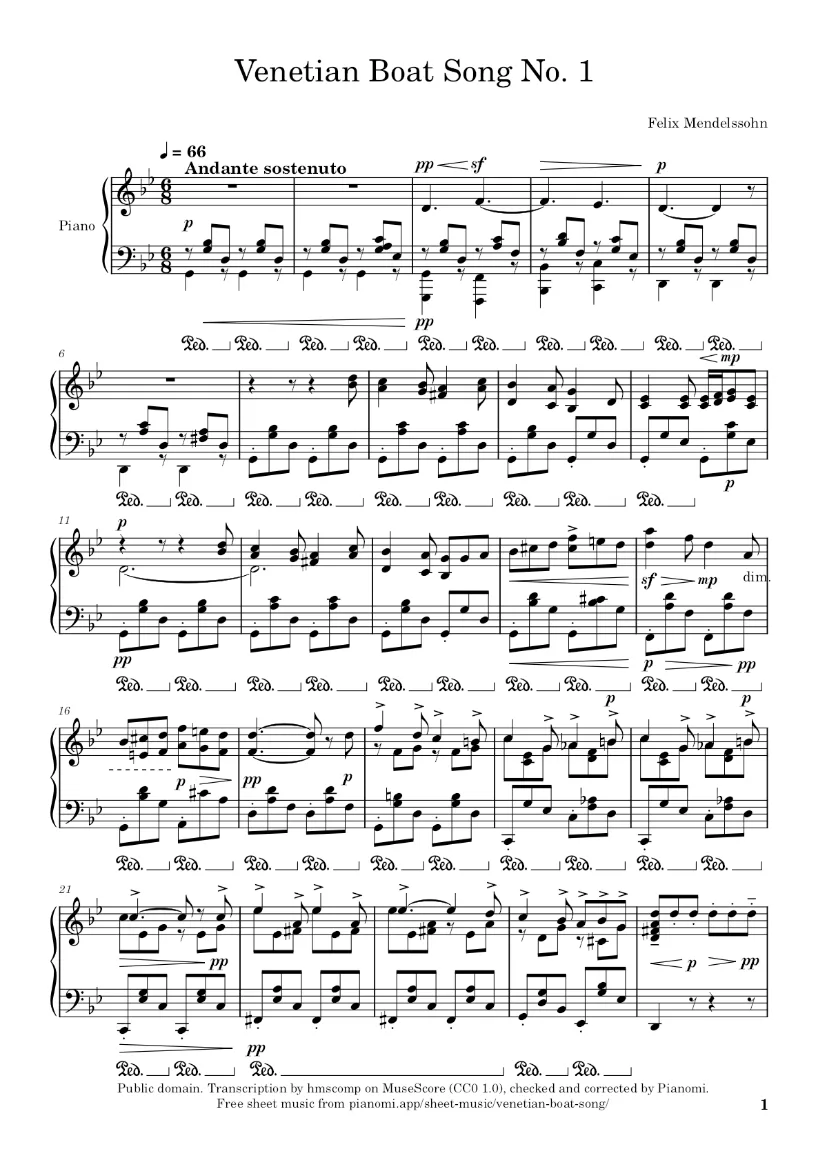
Mendelssohn wrote his Songs Without Words, short piano pieces with a singing tune over an accompaniment, over many years. This one is the sixth of the first book, Op. 19, written in 1830 and printed in 1832. It is the first of his Venetian gondola songs. Mendelssohn marks it Andante sostenuto, a steady, held pace, in 6/8: two big beats of three eighths in each bar.
The left hand starts alone, a low bass note and then a chord, rocking back and forth for two bars before the tune enters at bar 3, low and slow. The music grows stronger around bars 25 to 31, where the right hand repeats a chord figure over a low G that the left hand holds. Music from the first section returns at bar 34, and the piece fades away over its last bars to a single low G.
How hard is Venetian Boat Song?
The notes are not fast. The work is making a long tune sing over a rocking accompaniment in 6/8, keeping the left hand soft and even and the right hand’s lines joined. It is an intermediate piece.
At sight, it’s harder to read than all 44 of Pianomi’s sight-reading levels, which end at about grade 3 sight reading, at gentle tempos. What takes it past them: big jumps and four-note chords. On top of that: 2 flats, rests, accidentals, moving out of position, chords with sharps or flats and left-hand jumps.
How to practise it
Start with the left hand alone, as the music does. Each half-bar is a low G, then a chord, then a D, and the pattern rocks twice in every bar. Practise it until it is smooth and steady, and use the pedal to join it, changing with the bass.
Make the tune sing: use arm weight, play each note to its full length and join the notes into a line. In places the right hand also has a second voice under the tune (for example bar 8). Practise the tune alone, then add the lower notes softly.
In the strong passage from bar 25, keep the repeated chords even and let the sound build gradually, then fall back for the return. The dynamics on this page are the transcriber’s, not Mendelssohn’s, so follow your ear: the climax should be rich but still a song.
The score
- Composer
- Felix Mendelssohn (1809–1847)
- Catalogue
- Op. 19 No. 6
- Written
- 1830
- Key
- G minor
- Time
- 6/8
- Tempo
- Andante sostenuto, ♩. = 44
- Length
- 46 bars, about 2 minutes with its repeats
- Range
- F1 to D6
Transcribed by hmscomp on MuseScore and given to the public domain (CC0 1.0). We compared every note with other transcriptions and early editions and corrected it where it was wrong.