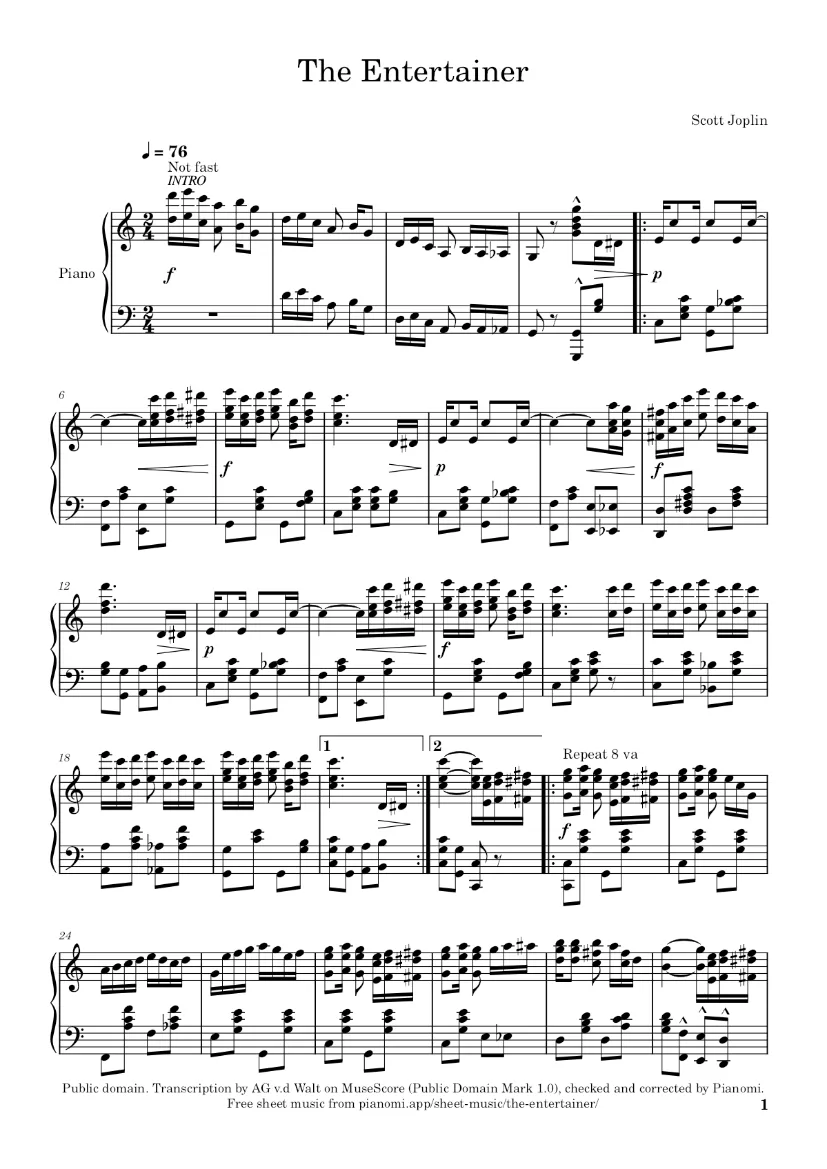
The Entertainer letter notes
The tune’s notes by name, bar by bar (the right hand’s top line), bars 5–16. ♯ is a sharp, ♭ a flat: play the black key just above or below.
- E C E C E C
- C D D♯
- E C D E B D
- C D D♯
- E C E C E C
- A G
- F♯ A C E D C A
- D D D♯
- E C E C E C
- C D D♯
- E C D E B D
- C C D
The names alone leave out the rhythm and the left hand: the music above has both, and the score with note names prints every note’s name under it.
About The Entertainer
Joplin published The Entertainer in 1902 in St. Louis, through John Stark and Son, with the subtitle A Rag Time Two Step. In 1973 the film The Sting used it in Marvin Hamlisch’s arrangement, and the tune became known all over again to people who had never heard of ragtime. The first edition marks it Not fast: a rag is written to be played steadily, not quickly.
A rag is built from strains of about sixteen bars, usually repeated. The Entertainer opens with a four-bar introduction, then the famous strain begins in bar 5. The third strain moves to F major at bar 55, and the music returns to C major at bar 72.
The left hand plays in the classic ragtime way: a bass note on the beat, then a chord just above it, so it rocks between low and middle. Over it the right hand’s tune is syncopated, with accents between the beats that pull against the steady left hand.
How hard is The Entertainer?
It is an intermediate piece. The tune itself is easy to learn, but the left hand’s leaps, the syncopation and the chords in the later strains need steady practice, and it should be played steadily, as Joplin asked, not fast. Many players learn the first strain in a year or two and the whole rag later.
At sight, it’s harder to read than all 44 of Pianomi’s sight-reading levels, which end at about grade 3 sight reading, at gentle tempos. What takes it past them: busy hands together, four-note chords and big jumps. On top of that: rests, accidentals, dotted rhythms, moving out of position, chords with sharps or flats, left-hand jumps and one flat.
How to practise it
Learn the left hand first, and slowly. Each beat is a bass note followed by a chord above it, and the leaps must be exact. Keep the bass on the beat even when the right hand pulls away from it.
Say the syncopated rhythm aloud, in counts of “one and two and”, before you play it, then play the tune against a metronome. The tune pulls against the beat and the beat never changes. Take care with the chords of bars 6 to 8, where the right hand plays thirds and octaves together, with quick chromatic steps (C, D, D♯) leading on.
In the first edition the second strain is written once, with a sign to play it an octave higher the second time. This page prints its notes once, at the lower octave. Bar numbers here give each first and second ending a number of its own.
The score
- Composer
- Scott Joplin (1868–1917)
- Written
- 1902
- Key
- C major
- Time
- 2/4
- Tempo
- Not fast, ♩ = 76
- Length
- 92 bars, about 4 minutes with its repeats
- Range
- F1 to F♯6
Transcribed by AG v.d Walt on MuseScore and given to the public domain (Public Domain Mark 1.0). We compared every note with other transcriptions and early editions and corrected it where it was wrong.