Hark! The Herald Angels Sing letter notes
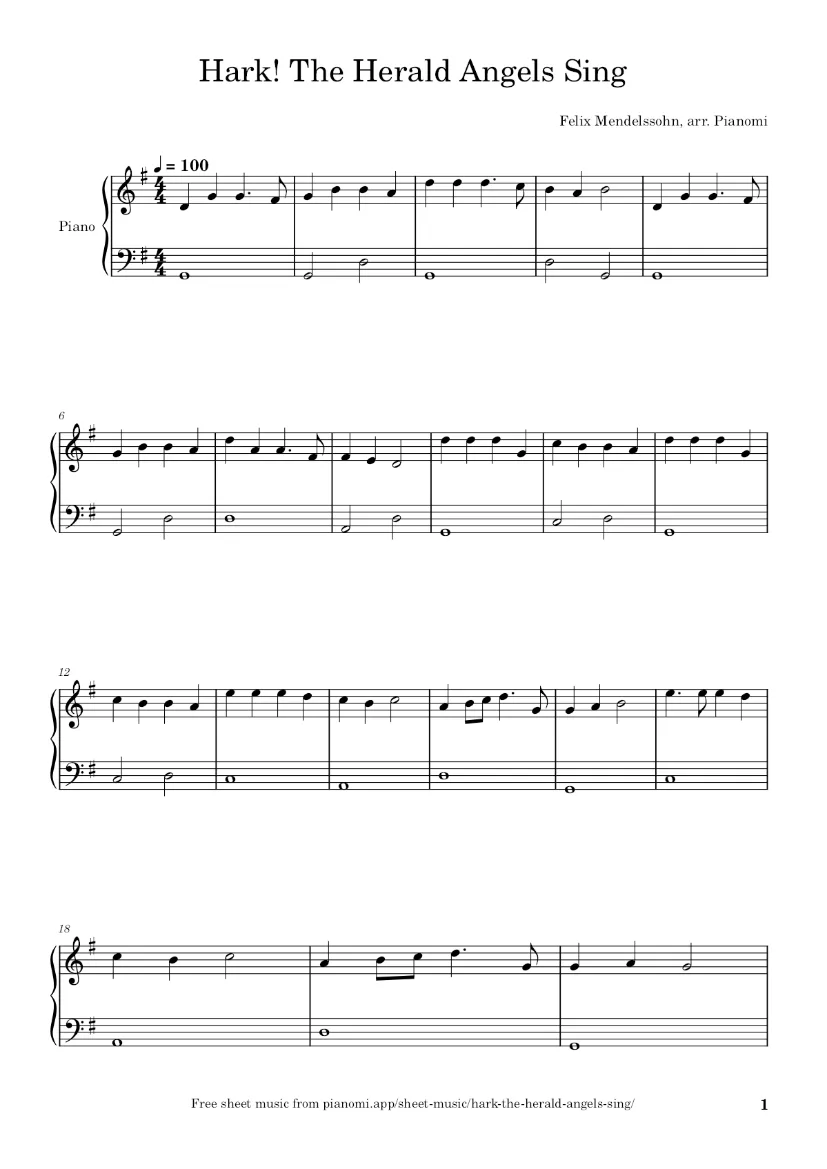
The tune’s notes by name, bar by bar (the right hand’s top line), bars 1–20. ♯ is a sharp, ♭ a flat: play the black key just above or below.
- D G G F♯
- G B B A
- D D D C
- B A B
- D G G F♯
- G B B A
- D A A F♯
- F♯ E D
- D D D G
- C B B A
- D D D G
- C B B A
- E E E D
- C B C
- A B C D G
- G A B
- E E E D
- C B C
- A B C D G
- G A G
The names alone leave out the rhythm and the left hand: the music above has both, and the score with note names prints every note’s name under it.
About Hark! The Herald Angels Sing
Charles Wesley published the words in 1739, with a different first line; George Whitefield changed the opening in 1753 into the one sung today. The tune is Felix Mendelssohn’s, from his Festgesang, a cantata for the festival in Leipzig in 1840 marking 400 years of printing since Gutenberg. Mendelssohn never put the two together: in 1855, after his death, the English musician William H. Cummings fitted Wesley’s hymn to the chorus, and that pairing is the one sung ever since.
This arrangement follows the tune as Carols Old and Carols New (Boston, 1916) and The Golden Book of Favorite Songs (Chicago, 1923) print it, in G major; bar 13, “With th’angelic host proclaim”, is in even quarter notes, as the English Hymnal (1906) has it. It’s 20 bars in 4/4. The right hand stays between the D above middle C and the E an octave higher, and the key has one sharp, F sharp.
How hard is Hark! The Herald Angels Sing?
No. The tune moves mostly in quarter notes within a little more than an octave, and the left hand plays long notes. The F sharps and the quick notes in bars 15 and 19 are the things to practise slowly.
It reads like level 29 of 44, “Dotted rhythms”: grade 1 to 2 in graded exams’ sight reading, roughly. Its hands, chords and rhythm read like level 13, eighth notes. On top of that: dotted rhythms, moving out of position and one sharp. Practise reading at that level with the free sight-reading exercises.
How to practise it
The first bar sets the rhythm of the verse: D, G, then a dotted quarter G and an eighth F sharp, counted “1, 2, 3, 4 and”. Bars 3, 5 and 7 have the same rhythm. Every F is F sharp, and they all come low in the tune, in bars 1, 5, 7 and 8.
Bars 9 to 12 repeat one shape twice: D, D, D, G, then C, B, B, A. Bars 15 and 19 have the quickest notes: A, then B and C as two eighths, a dotted quarter D and an eighth G, counted “1, 2 and 3, 4 and”. Bar 17 starts the other way round, a dotted quarter E and an eighth E, then E and D.
The left hand plays G, D, C and A below middle C: one long note in most bars, two half notes in bars 2, 4, 6, 8, 10 and 12. Learn it alone, then put the hands together slowly, and bring it up to a bright, ringing speed.
The score
- Composer
- Felix Mendelssohn (1809–1847)
- Key
- G major
- Time
- 4/4
- Tempo
- ♩ = 100
- Length
- 20 bars, under a minute with its repeats
- Range
- G2 to E5
Arranged for piano by Pianomi, from a tune in the public domain.