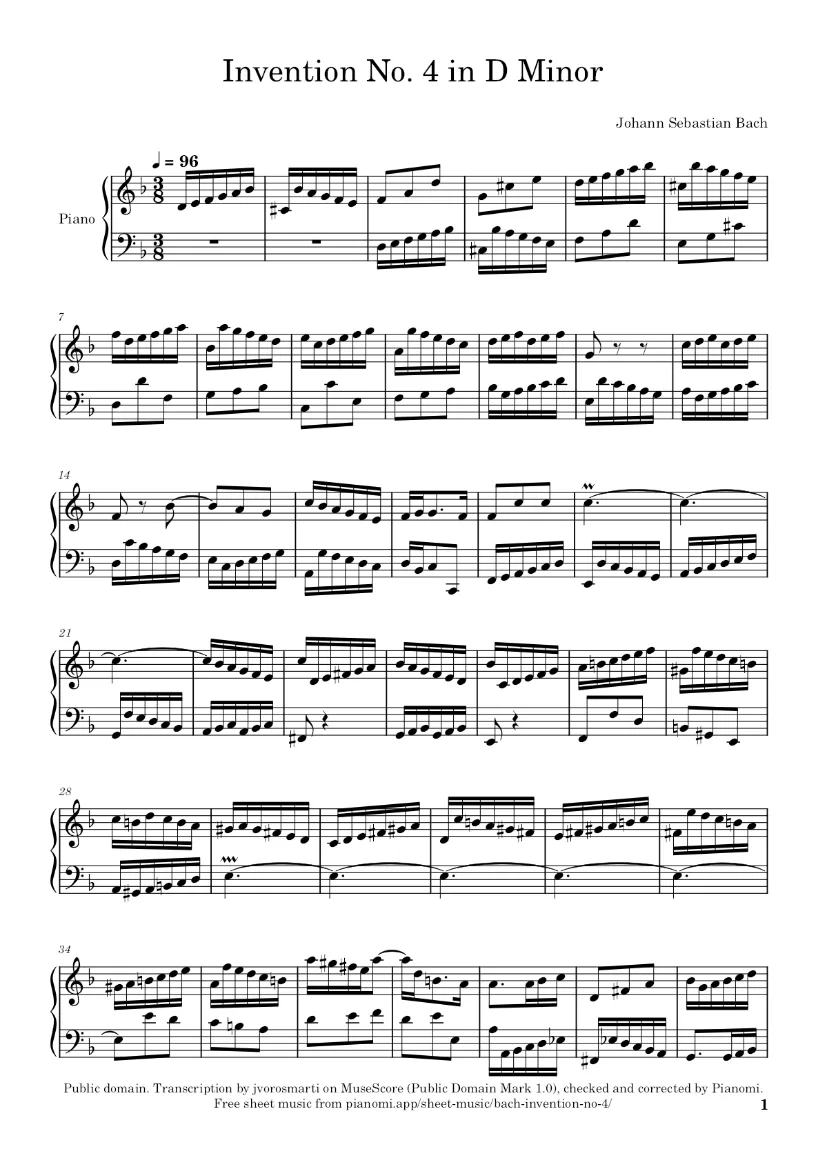
About Invention No. 4 in D Minor, BWV 775
One of the fifteen two-part inventions Bach wrote out in 1723 to teach playing in two parts. Like the others, an earlier version is in the keyboard book he began in 1720 for his eldest son, Wilhelm Friedemann.
The theme is two bars long: a D minor scale running up to B♭, then a jump down to C♯ and back up, and a fall down the scale. The left hand takes it up two bars later, and the music hardly stops moving. By bar 18 it has reached F major, and the right hand holds a trilled C for three bars while the left hand runs beneath. Later, in A minor, the left hand holds a trilled E for five bars under the right hand. The opening comes back in bar 44, and the piece ends on a bare D in both hands.
How hard is Invention No. 4 in D Minor, BWV 775?
It’s an intermediate piece. The notes lie well under the hands, but keeping the sixteenths steady at speed, and trilling in one hand while the other runs, take careful practice.
At sight, it’s harder to read than all 44 of Pianomi’s sight-reading levels, which end at about grade 3 sight reading, at gentle tempos. What takes it past them: its time signature, busy hands together and big jumps. On top of that: accidentals, moving out of position, left-hand jumps and one flat.
How to practise it
Feel one beat in a bar, not three, and keep the sixteenths even and light. The jump in bar 2, from B♭ down to C♯ and up again, comes back many times: find a fingering for it early and keep it.
The trills are the hard part. Learn the other hand alone first, then play it against the long note held without a trill, counting the bars. Then add the trill slowly and evenly, starting on the note above. It needn’t be fast, and it can stop on the main note just before the tie ends.
The left hand’s trill in bars 29 to 33 is harder than the right hand’s in bars 19 to 21, because the right hand runs above it: give it extra time, and practise it a bar or two at a time.
The score
- Composer
- Johann Sebastian Bach (1685–1750)
- Catalogue
- BWV 775
- Written
- 1723
- Key
- D minor
- Time
- 3/8
- Tempo
- ♩ = 96
- Length
- 52 bars, under a minute with its repeats
- Range
- C2 to A♯5
Transcribed by jvorosmarti on MuseScore and given to the public domain (Public Domain Mark 1.0). We compared every note with other transcriptions and early editions and corrected it where it was wrong.